Smart Glasses · Guide
Best smart glasses for iPhone: which pairs work and what limits to expect
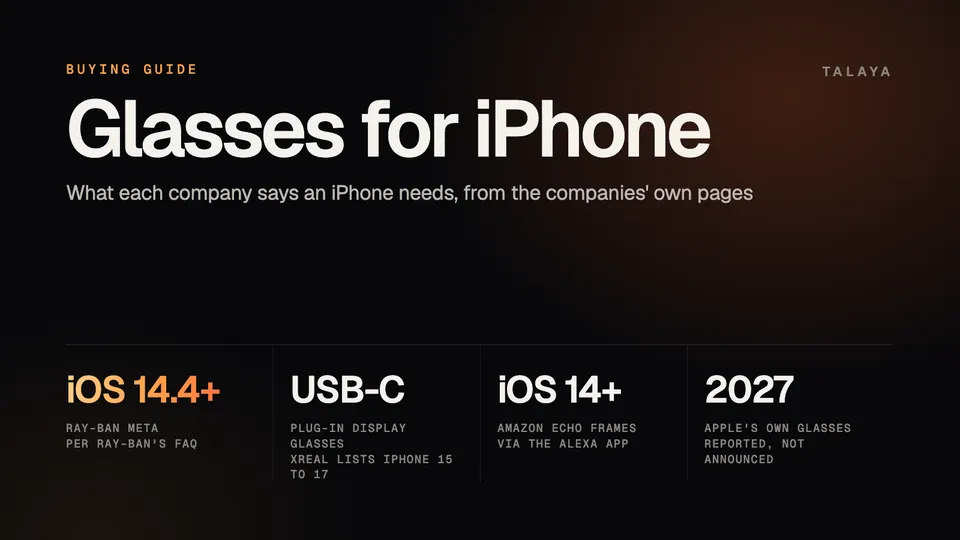
Meta's glasses, Even Realities' G2, Amazon's Echo Frames and plug-in display glasses all work with an iPhone, within limits each company spells out. This guide covers what each needs, what iOS changes and what Apple itself sells.
Most smart glasses work with an iPhone, but they connect in different ways. Meta's glasses, Even Realities' G2 and Amazon's Echo Frames pair over Bluetooth and run through a companion app from the App Store. Plug-in display glasses from XREAL, RayNeo and Viture connect by cable, so the iPhone has to send video over USB-C or through an adapter. Apple sells a headset but no glasses, and its glasses are so far only reported.
This guide is based on each company's published iPhone requirements and our guides to each product, with US list prices as of Oct. 25, 2026, and we haven't tested any of these glasses with an iPhone.
Quick picks for iPhone owners
These picks follow the specs and the iPhone support each company documents.
| If you want | Pick | Price | On iPhone |
|---|---|---|---|
| A camera and an assistant | Ray-Ban Meta Gen 3 | $449 | Same Meta AI app as Android, with a few documented differences |
| The cheapest camera pair | Meta Adventurer | $249 | Meta AI app |
| Messages and directions in a lens | Meta Ray-Ban Display | $799 | Meta AI app; Apple Music works on iPhone |
| A display without a camera | Even Realities G2 | $599 | Connects to iOS and Android phones |
| Audio only | Ray-Ban Meta Audio | $349 | Meta AI app |
| A big virtual screen | XREAL One | $399 listed; back-in-stock sign-up on Oct. 29 | iPhone 15 to 17 over USB-C |
Which smart glasses work with an iPhone
| Glasses | US price | Connects through | What the company says about iPhone |
|---|---|---|---|
| Ray-Ban Meta (Gen 3, Gen 2, Audio) | From $449, $379 and $349 | Meta AI app, over Bluetooth | Ray-Ban's FAQ lists iOS 14.4 or later |
| Oakley Meta (HSTN, Vanguard) | From $399 and $499 | Meta AI app | Set up and managed in the Meta AI app |
| Meta Glasses (Adventurer and other styles) | From $249 | Meta AI app | Meta calls the app the required companion; no separate iOS requirement in the pages we read |
| Meta Ray-Ban Display | $799 with the Neural Band | Meta AI app | FAQ copy lists iOS 14.4 or later; Apple Music works on iPhone |
| Even Realities G2 | $599 | Even Realities app, over Bluetooth | Connects to iOS and Android phones; no minimum in the pages we read |
| Amazon Echo Frames (3rd gen) | No price shown on Oct. 25 | Alexa app | iOS 14 or later |
| XREAL display glasses | From $299 | USB-C cable | Lists iPhone 15 and later except the 16e; Lightning iPhones need an adapter |
| RayNeo Air and GT | $149 to $429 | USB-C cable | Lists iPhone; names iPhone 15 and 16 series; needs DisplayPort video or a $64 HDMI adapter |
| Viture Pro 2 and Luma series (comparison) | $299 to $599 | USB-C cable | Luma page has an "Android & iOS" section; no iPhone model list in the pages we read |
| Rokid Glasses | $699 at B&H | Rokid app | No supported phones or iOS version in the pages we read |
| Brilliant Labs Halo | $399 | Noa app | Docs list the app as "coming soon" on the App Store |
| Snap Specs (due this fall) | $2,195 | Standalone, Bluetooth to a phone | Size try-on needs an iPhone XS or later |
Do Meta glasses work with iPhone?
Yes. Ray-Ban Meta, Oakley Meta, Meta Glasses and Meta Ray-Ban Display all use the Meta AI app. Meta's App Store listing calls it "the required companion app for managing your AI glasses from Meta, importing and sharing media, and more." Setup is the same on both phones: install the app, sign in with a Meta account, turn on Bluetooth and add the glasses. Ray-Ban's FAQ gives the phone requirement as "Android 10 and above (with location services enabled) or iOS 14.4 and above." That copy was archived on Nov. 14, 2025, before Gen 3 launched, so check the app's App Store listing for the current requirement.
Meta Ray-Ban Display needs an iPhone or Android phone with the same app. Its FAQ copy lists iOS 14.4 or later, Meta's music card shows Apple Music on iPhone, and Meta says neural handwriting works across Instagram, WhatsApp, Messenger and native Android and iOS messaging. Mirroring phone notifications on the display is on Meta's list of features coming soon, and the pages we read don't say which phones get it.
Our guide to Ray-Ban Meta on iPhone vs Android lists every difference Meta and Ray-Ban document. The ones iPhone owners will meet:
- If the glasses already appear in the phone's Bluetooth list, Ray-Ban's FAQ tells iPhone owners to tap the info icon, choose Forget This Device and pair again.
- Meta's POV guide says videos save as HEVC on iOS and as MP4 on Android. HEVC uses less storage at the same quality.
- iPhone users see a "Meta AI wants to Join Wi-Fi network" prompt when they import media. Meta's release notes say members of its Early Access program can remove it by turning on Wi-Fi Aware.
- Meta lists voice control for Apple Music as iPhone only.
Beyond those items, the pages we read name no feature that works on only one phone, and Meta says battery saver mode is available in the app on both iOS and Android.
iOS limits: Siri, messages and notifications
Meta's and Ray-Ban's pages describe few iPhone-specific limits, and they leave gaps. In the pages we read, neither company compares the two phones feature by feature.
Messages are where the documentation is thinnest. Meta lists four ways to call and message: WhatsApp, Messenger, Instagram and "your iPhone or Android phone." Its article doesn't mention iMessage, SMS or Apple's Messages app by name. Ray-Ban's FAQ has one iMessage note, about photos: when you ask the glasses to send a photo to your phone, "for iPhone's iMessage, you will still need to go to your phone to confirm sending." Neither company says whether a text sent from the glasses on an iPhone goes out as an iMessage or an SMS. Our calls and messages guide covers the commands.
Notifications work through toggles in the app. The glasses can announce who is calling or messaging you, and read messages aloud, for Messenger, WhatsApp and your phone's own messages. Ray-Ban's FAQ warns that on iPhone, if you also use Siri's call announcements, you may hear both, one from Siri and one from Meta, and that Messenger and WhatsApp calls may sometimes be announced as iPhone calls. You can turn off Siri's announcements in iPhone settings or the glasses' announcements in the app. If you hear nothing, the FAQ points to Bluetooth permission for Messenger under Settings, Privacy, Bluetooth.
The assistant on Meta's glasses is Meta AI, which you wake with "Hey Meta." In the pages we read, Siri comes up only in Ray-Ban's note about call announcements.
AR and display glasses compatible with iPhone
Screen glasses don't run apps of their own. They show the video signal from whatever you plug them into, and the source has to send DisplayPort video over USB-C. What each company says about iPhone:
- XREAL lists iPhone 15 and later models, along with iPads, Android phones with DisplayPort support, the Steam Deck, Macs and PCs. It says Lightning iPhones need an adapter, and its One series user guide excludes the iPhone 16e. Current prices start at $299. XREAL's US store lists the XREAL One at $399, but on Oct. 29, 2026, its page showed a back-in-stock sign-up and no restock date. See our XREAL lineup guide and our display glasses guide for gaming and movies.
- RayNeo's blog says the Air 4 Pro page lists iPhone, Android, PC, Nintendo Switch and PS5, and its buying guide names the iPhone 15 and 16 series. The source device needs USB-C video output (DisplayPort Alt Mode), or RayNeo's $64 HDMI adapter, which the Air 3s Pro and Air 4 Pro accept. RayNeo's pages we read don't mention Lightning. Its X3 Pro, a $1,299 standalone pair with a camera and displays, needs a phone for setup, and its companion app runs on iOS and Android.
- Viture's Luma page has an "Android & iOS" section, and its help center names USB-C iPads and MacBooks. Its Aug. 6 release says the $99 Mobile Dock Mini supports SpaceWalker on iOS. We found no iPhone model list or Lightning statement from Viture. Our XREAL vs Viture comparison has the specs.
Check that your iPhone outputs video over USB-C before buying any of them. XREAL's list starts at the iPhone 15, and it says older Lightning models need an adapter.
Other glasses: Even Realities, Echo Frames, Rokid, Halo and Snap
Even Realities says its G2 and R1 ring connect to iOS and Android phones over Bluetooth, and its support FAQ says the older G1 works with all iPhones through the companion app. The G2 has no camera and costs $599.
Amazon lists iOS 14 or later for Echo Frames, which you set up in the Alexa app. Amazon's listings showed every style as unavailable on Oct. 25, as our Echo Frames guide explains.
Rokid's app connects its $699 Rokid Glasses to your phone, and the pages we read don't list supported phones or software versions. Brilliant Labs' documentation lists the Noa app for its $399 Halo as "coming soon" on the Apple App Store and Google Play, while its store page says "Shipping now!" We couldn't confirm how buyers get the app today.
Snap says Specs don't need a phone, and you can pair them with one over Bluetooth for calls, notifications and music. The pages we read don't name the phones. Snap's size try-on runs on an iPhone XS or later, and its SPECS Intelligence service has an iOS app for US adults.
Google says the audio glasses it is building with Samsung, Gentle Monster and Warby Parker pair with Android and iOS phones. Samsung's footnotes tie the features to a compatible Galaxy AI phone, and neither company has explained the difference, as our Samsung guide notes.
What Apple sells and what is only rumored
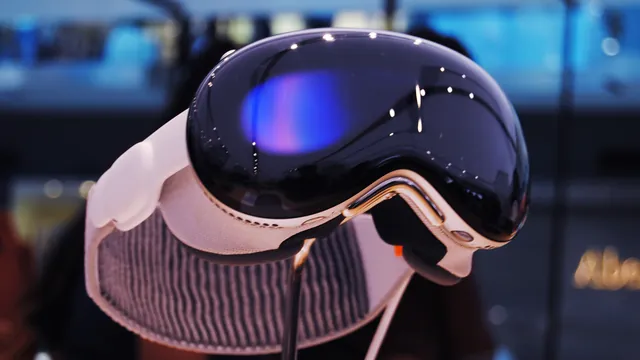
Apple sells one product you wear over your eyes, the Vision Pro headset. The M5 model has started at $3,699 in the US since June 25, 2026, and weighs 750 to 800 grams with a separate 353-gram battery, according to our Vision Pro guide.
Apple hasn't announced smart glasses. Bloomberg's Mark Gurman reported in July that Apple plans to unveil its first glasses at WWDC in June 2027 and ship them in late 2027. The first model reportedly has cameras, speakers and microphones but no display, and works closely with the iPhone and Siri. The analyst Ming-Chi Kuo expects display-free glasses in 2027 and says glasses with a display have slipped to 2029. No price has been reported, and Apple hasn't confirmed any of it. Our Apple Glasses rumors guide tracks each report with its date.
Frequently asked questions
Do Meta glasses work with iPhone?
Yes. Ray-Ban Meta, Oakley Meta, Meta Glasses and Meta Ray-Ban Display all use the Meta AI app, which is on the App Store. Ray-Ban's FAQ lists iOS 14.4 or later, and Apple's App Store page for the app is where to confirm what your iPhone needs today. Our Android vs iPhone guide lists the differences.
Which AR glasses are compatible with iPhone?
Plug-in display glasses from XREAL, RayNeo and Viture work with iPhones that send video over USB-C. XREAL lists the iPhone 15 and later, except the iPhone 16e, and says Lightning models need an adapter. Standalone AR glasses such as Snap Specs, due this fall at $2,195, don't need a phone.
Do older iPhones with a Lightning port work with display glasses?
XREAL says Lightning iPhones need an adapter. RayNeo's pages we read don't mention Lightning, and its blog says the Air 3s Pro and Air 4 Pro can use a $64 HDMI adapter with devices that lack USB-C video output. Viture's pages we read don't say.
Do Meta glasses work with Apple Music?
Yes, on iPhone. Meta lists voice control for Apple Music as iPhone only, and the music card on Meta Ray-Ban Display shows Apple Music on iPhone. See our music guide.
Does Apple make smart glasses?
Not yet. Apple sells the Vision Pro headset, and Bloomberg's Mark Gurman reported in July that Apple plans to unveil its first glasses at WWDC in June 2027 and ship them in late 2027. Apple hasn't confirmed anything. See our Apple Glasses rumors guide.
Will Samsung and Google's glasses work with iPhone?
Google says its glasses pair with Android and iOS phones, but Samsung's footnotes tie the features to a compatible Galaxy AI phone, and neither company has explained the difference. They are due this fall with no price announced. See our Samsung glasses guide.
Sources
- Ray-Ban: Ray-Ban Meta FAQ, US (archived copy of Nov. 14, 2025)
- Ray-Ban: Meta Ray-Ban Display FAQ (read in the Wayback Machine copy of May 13, 2026)
- Apple App Store: Meta AI (listing read Oct. 25, 2026)
- Meta Help Center: Call and message using AI glasses (archived copy of June 9, 2026)
- Meta Help Center: AI glasses release notes (archived copy of Sept. 21, 2026)
- Meta: Guide to shooting POV with AI glasses
- Meta: New features for Meta Ray-Ban Display (Sept. 23, 2026)
- Even Realities: Even G2 product page and specifications
- Even Realities Support: General FAQs (G1)
- Amazon: Echo Frames store page (read Oct. 25, 2026)
- XREAL US store: all products and prices (Oct. 25, 2026)
- RayNeo blog: What new smart glasses are available now, and what's coming soon? (Sept. 3, 2026)
- RayNeo: Buying guide
- Viture: Luma XR glasses series (read Oct. 25, 2026)
- Viture: 5th Anniversary Collection, led by Viture Pro 2 (Aug. 6, 2026)
- Brilliant Labs: Halo product page and FAQ (read Oct. 25, 2026)
- Snap Inc.: Snap debuts SPECS augmented reality glasses (June 16, 2026)
- Google: Intelligent eyewear is coming this fall (May 19, 2026)
- Bloomberg (Mark Gurman): Apple's smart glasses will need to overcome Meta's privacy reputation (July 26, 2026)
- Apple: Buy Apple Vision Pro
- XREAL US store: XREAL One product page (read Oct. 29, 2026)
- XREAL US store: XREAL One series user guide (read Oct. 26, 2026)
Join the conversation
Questions, or something to add? Talk about it with other smart glasses owners in r/Talaya, our community on Reddit.