Smart Glasses · Guide
XREAL vs Viture: display glasses compared by price, specs, dimming and compatibility
XREAL and Viture both make glasses that plug into a phone, laptop or console and show a big virtual screen. Here is how their current lineups compare on price, display, dimming, prescriptions, compatibility, accessories and Android XR.
Part of our XREAL guide
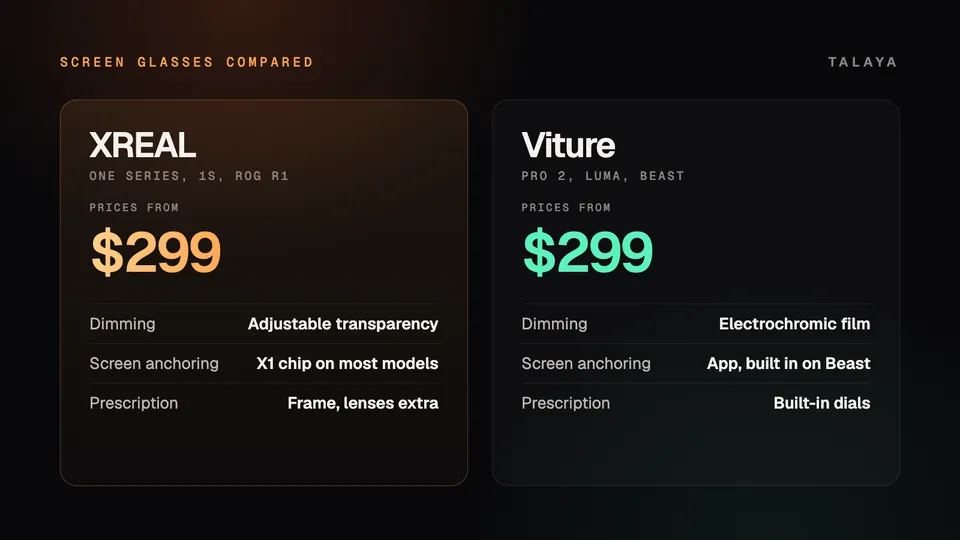
XREAL and Viture both make glasses that plug into a phone, laptop, handheld or console and show its screen as a large virtual display. XREAL's current display glasses cost $299 to $849, and its Android XR Aura has launch pricing from $1,099 through the end of the year. Viture's glasses run from $299 for the Pro 2 to $599 for the Luma Ultra, with the Beast from $549. On the published specs, XREAL lists the wider fields of view and has a chip that pins the screen in place without an app, while Viture builds focus dials into most of its models and sells its own dock and Android neckband.
This comparison is based on XREAL's and Viture's own pages and press releases. Where a company's page doesn't give a number, we use B&H Photo's specification table and say so. XREAL's and Viture's prices are from their own sites on Oct. 25, 2026, except the Viture Pro 2's, which is from its Aug. 6 release, and the XREAL One and One Pro, which we rechecked on XREAL's US store on Oct. 29, 2026. We haven't tested either brand's glasses. Our XREAL lineup guide has the full XREAL details.
The lineups and prices side by side
| Price | XREAL | Viture |
|---|---|---|
| $299 | X By XREAL a01+ | Pro 2 |
| $399 | XREAL One | Luma |
| $449 to $499 | XREAL 1S ($449) | Luma Pro ($499) |
| $539 to $599 | XREAL One Pro ($539 on Oct. 29) and 1 Pro+ ($599) | Beast (from $549), Luma Ultra ($599) |
| $849 | ROG XREAL R1, a 240Hz gaming model | None we found |
| $1,099 and up | XREAL Aura, with Android XR (launch price) | None we found |
At $299, XREAL's a01+ weighs 62 grams and has a 50-degree field of view, 1080p micro-OLED displays at 120Hz and up to 1,600 nits, with no screen anchoring. Viture's Pro 2 weighs 63 grams, which Viture says is 20% lighter than the original Viture Pro, reaches 1,600 nits on a Sony micro-OLED panel, up from 1,000 on the original, and has independent focus dials for each eye covering 0 to -5.00D, according to Viture. That release gives neither a resolution nor a field of view.
At $399, the XREAL One has a 50-degree view, 1080p per eye, 600 nits and the X1 chip. XREAL's US store showed the $399 price with a back-in-stock sign-up and no restock date on Oct. 29, 2026. Viture's Luma is rated up to 1920 by 1200 per eye and, depending on the Viture page, 1,000 nits (help center) or up to 1,500 nits (Luma page). It has focus dials up to -6.0D and no front camera. Viture says the Luma series' field of view is 15% larger than the original Viture Pro's, without giving a number.
Around $450 to $500, the XREAL 1S has 1200p displays, a 52-degree view, 700 nits, the X1 chip and a weight of 82 grams. Viture's help center rates the Luma Pro at the same 1,000 nits as the Luma. It adds a front RGB camera, which Viture's Luma page marks "To be unlocked after launch" and says is hidden under a sticker by default, and the same page gives it focus dials up to -4.0D.
At $539 to $599, the XREAL One Pro ($539 on XREAL's US store on Oct. 29, 2026) has a 57-degree view, the widest in XREAL's display-glasses range, at 1080p per eye and 700 nits, and the 1 Pro+ raises peak brightness to up to 1,200 nits. Viture's Luma Ultra has 1920 by 1200 per eye, 83 grams and a 52-degree view, according to B&H's table, and Viture's help center lists 6DoF tracking with dual depth cameras. The Beast is Viture's flagship for screen size: up to 1200p, up to 1,250 nits and what Viture calls a 174-inch screen at 4 meters, with built-in 3DoF tracking in place of a focus dial.
At $849, the ROG XREAL R1 is the only model from either brand with a 240Hz panel. XREAL and ASUS call that a first for glasses, and Viture's pages we read top out at 120Hz.
Display specs: resolution, brightness and field of view
| Model | Resolution per eye | Peak brightness | Field of view | Weight |
|---|---|---|---|---|
| XREAL a01+ | 1080p | Up to 1,600 nits | 50 degrees | 62 grams |
| XREAL One | 1080p | 600 nits | 50 degrees | Not listed |
| XREAL 1S | 1200p | 700 nits | 52 degrees | 82 grams |
| XREAL One Pro | 1080p | 700 nits | 57 degrees | 87 grams |
| XREAL 1 Pro+ | Not listed | Up to 1,200 nits | 57 degrees | Not listed |
| Viture Pro 2 | Not listed | 1,600 nits | Not listed | 63 grams |
| Viture Luma and Luma Pro | Up to 1920 x 1200 | 1,000 nits (help center); up to 1,500 nits (Luma page) | Not listed | Not listed |
| Viture Luma Ultra | 1920 x 1200 | 1,250 nits | 52 degrees | 83 grams |
| Viture Beast | Up to 1200p | Up to 1,250 nits | Not listed | Not listed |
The XREAL figures are from XREAL's US store and announcements, as collected in our lineup guide. The Viture figures come from its help center, its Luma and Beast pages, its Pro 2 release and B&H, which supplies the Luma Ultra's field of view and weight. Peak brightness is each company's own claim, and the figures don't come from a common test. Viture's own pages disagree on the Luma: the Luma page says up to 1,500 nits, and the help center gives 1,000 for both the Luma and the Luma Pro, so we can't say which figure is current. For the Luma Ultra, B&H lists 1,500 nits of "peak perceived brightness", against 1,250 nits in Viture's help center.
Screen-size claims depend on the distance each company assumes. At the same 4 meters, XREAL describes the a01+ picture as a 147-inch screen, and Viture describes the Beast's as 174 inches.
Anchoring works differently. XREAL's One, 1S, One Pro, 1 Pro+ and R1 have the X1 chip, which keeps the screen fixed in space as you move your head with no app, though the a01+ doesn't. On Viture, the Beast has 3DoF built into the glasses, and the Luma Ultra adds dual depth cameras for 6DoF tracking. The Viture pages we read don't describe built-in anchoring on the Pro 2, Luma or Luma Pro.
Electrochromic dimming
Both brands let you darken the lenses. Viture lists electrochromic film as a feature of the Luma series, and its help center says a single button press toggles it. B&H's listing says the film on the Luma Ultra blocks nearly all outside light.
XREAL's One Pro page lists adjustable lens transparency, and the 1S and ROG XREAL R1 adjust their tint automatically to the light around you. Aura goes further, with five levels of electrochromic dimming that block up to 99.9% of outside light, set automatically or by hand.
Prescription lenses
XREAL and Viture solve prescriptions differently. XREAL's One and One Pro ship with a prescription frame but no lenses. XREAL sells the lenses separately from $49.90, made by a third-party partner and shipped from China in about 10 business days, and because they're custom, they can't be returned unless there's a quality problem. Aura comes with an optical insert frame.
Viture builds focus dials into most models: up to -6.0D on the Luma, up to -4.0D on the Luma Pro and 0 to -5.00D per eye on the Pro 2. The dials correct nearsightedness. The Beast has no dial, which Viture's help center puts down to its hardware-level 3DoF. Our guide to prescription smart glasses covers XREAL's lenses and other brands' options.
Compatibility: phones, laptops, Steam Deck and consoles
Both brands' display glasses need a USB-C source that outputs DisplayPort video. XREAL lists iPhone 15, 16 and 17 models, iPads, Android phones with DisplayPort support, the Steam Deck, the ROG Ally, Macs and PCs. Lightning iPhones need an adapter. Viture's help center names most Android phones, many Windows laptops and handhelds such as the ROG Ally and Steam Deck. The Viture pages we read don't name iPhones.
Consoles need extra hardware. The Nintendo Switch and Switch 2 send video through their docks, so XREAL sells the $119 Neo, a 10,000mAh power bank with a video hub, and the ROG Control Dock that works with the R1 adds HDMI inputs for a PC or consoles. Viture's $99 Mobile Dock Mini turns a Switch 2 into a private big-screen setup and also works as a USB-C hub, Viture says. The pages we read don't list PlayStation or Xbox consoles for Viture.
Extra hardware: XREAL Beam Pro and Viture Pro Neckband
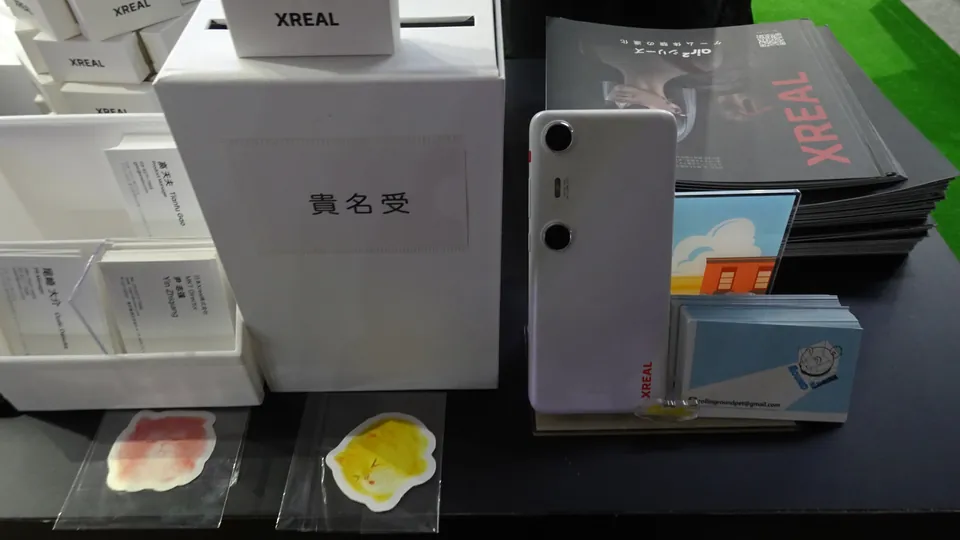
XREAL's Beam Pro, from $199, is a pocket device that runs apps for the glasses and captures spatial video. The $99 XREAL Eye is a camera that clips between the nose pads of One-series glasses and adds six-degrees-of-freedom anchoring.
Viture's counterpart is the Pro Neckband, which Viture's page pitches for remote gaming, cloud streaming and multi-screen work. B&H lists the Elite model with 12GB of RAM, 256GB of storage, Wi-Fi 6E, a 3,280mAh battery rated at up to four hours and a weight of 170 grams. It runs apps from Google Play, casts over Miracast and DLNA, and handles cloud and remote gaming through apps such as GeForce Now, according to B&H. Viture sells it with the Luma Ultra as the Luma Ultra Cloud Pack, while B&H's compatibility field names only the Viture Pro XR glasses, so confirm which other models it supports. We couldn't confirm a current neckband price from the pages we read.
The Android XR angle: XREAL Aura
XREAL is the brand with a product on Google's platform. XREAL Aura has a 70-degree field of view and weighs under 95 grams. A tethered puck runs Android XR with Gemini and Google Play, and the glasses are optical see-through. Google's Oct. 28 announcement gives launch pricing from $1,099 through the end of the year. Orders are open now in the US, Canada and South Korea, and in Japan from Nov. 2, with shipments starting in mid-November. The regular price is $1,279 for the 12GB model, according to 9to5Google. Google doesn't say what the price will be after the launch window.
Viture's Pro Neckband runs Google Play apps, according to B&H, but that isn't Android XR, and we found no Android XR product in Viture's pages or releases. For the platform itself, see our explainer on what Android XR is.
How to choose, on specs
Pick XREAL if the widest published view among these display glasses matters, since the One Pro, 1 Pro+ and R1 list 57 degrees, or if you want the screen pinned in place without an app. The R1 is the pick for 240Hz gaming, and Aura is the pick for Android XR apps.
Pick Viture if you want focus dials instead of a prescription frame, the 63-gram Pro 2 at $299, a dock built for the Switch 2 or an Android neckband for cloud gaming. If you need a field of view or resolution for the Pro 2 or Beast, Viture's pages we read don't give them.
Check that your phone, laptop or console outputs video over USB-C before buying either brand. For more brands, see our RayNeo guide and our best smart glasses guide.
Correction, Oct. 28, 2026: An earlier version said Viture's Aug. 6 release says the Mobile Dock Mini supports SpaceWalker on iOS; the release doesn't say that, and we removed the claim. It also gave the Luma's brightness as 1,000 nits and described the Luma Pro's front camera without caveat. Viture's Luma page says up to 1,500 nits while its help center says 1,000, and the page marks the Luma Pro camera "To be unlocked after launch".
Update, Oct. 30, 2026: This comparison now gives the XREAL One Pro at the $539 XREAL's US store showed on Oct. 29, 2026, in place of $599, and notes that the store showed a back-in-stock sign-up for the XREAL One that day. We also removed the One's weight, which we couldn't confirm on XREAL's US pages.
Frequently asked questions
Is Viture better than XREAL?
Neither wins across the board on published specs. XREAL lists wider fields of view, up to 57 degrees on the One Pro, and a chip that anchors the screen without an app. Viture builds focus dials into most models, makes the 63-gram Pro 2 and sells a $99 dock for the Nintendo Switch 2.
Viture Luma or XREAL One: which should I buy?
Both are listed at $399, though XREAL's US store showed a back-in-stock sign-up and no restock date for the One on Oct. 29, 2026. On the published figures, the Luma has a higher resolution (up to 1920 by 1200 per eye against 1080p), a higher peak brightness rating (1,000 nits in Viture's help center and up to 1,500 on its Luma page, against 600) and built-in focus dials up to -6.0D. The One has the X1 chip, which pins the screen in place with no app, and a published 50-degree view. Viture doesn't publish a number for the Luma.
How does the Viture Pro 2 compare with the XREAL One Pro?
The Pro 2 costs $299, against $539 for the One Pro on XREAL's US store on Oct. 29, 2026. It weighs 63 grams against 87 and has focus dials for each eye covering 0 to -5.00D. The One Pro has a 57-degree field of view and the X1 chip. Viture's Pro 2 release doesn't give a field of view or resolution.
Do XREAL and Viture glasses work with an iPhone?
XREAL lists iPhone 15, 16 and 17 models, because they output video over USB-C, and Lightning iPhones need an adapter. Viture's help center names most Android phones, many Windows laptops and handhelds, and the Viture pages we read don't name iPhones.
Do XREAL and Viture glasses work with the Steam Deck and Nintendo Switch?
Both brands list the Steam Deck. The Switch and Switch 2 need a dock or adapter: XREAL sells the $119 Neo, and Viture sells the $99 Mobile Dock Mini, built for the Switch 2.
Does Viture make Android XR glasses like the XREAL Aura?
Not in the pages and releases we read. Viture's Pro Neckband runs Google Play apps, according to B&H's listing, but it isn't Android XR. XREAL Aura is an Android XR device with launch pricing from $1,099 through the end of the year, according to Google, and orders are open now in the US, Canada and South Korea.
Sources
- XREAL US store: all products and prices (Oct. 25, 2026)
- XREAL US store: XREAL One Pro (read Oct. 25 and Oct. 29, 2026)
- XREAL US store: XREAL One (read Oct. 29, 2026)
- XREAL: XREAL introduces XREAL 1 Pro+ (Oct. 16, 2026)
- Google: XREAL Aura is available to order (Oct. 28, 2026)
- 9to5Google: XREAL Aura is coming in November with a launch discount (Oct. 28, 2026)
- XREAL: XREAL AURA specifications
- Viture: Luma XR glasses series (read Oct. 25, 2026)
- Viture: The Beast (read Oct. 25, 2026)
- Viture Help Center: Luma Series XR Glasses, specs and functions
- Viture: 5th Anniversary Collection, led by Viture Pro 2 (Aug. 6, 2026)
- Viture: Viture introduces The Beast (Jan. 6, 2026)
- Viture: Pro Neckband
- Viture: Luma Ultra Cloud Pack (read Oct. 28, 2026)
- B&H Photo: Viture Luma Ultra XR Glasses (read Oct. 25, 2026)
- B&H Photo: Viture Pro Neckband (Elite) (read Oct. 25, 2026)
Join the conversation
Questions, or something to add? Talk about it with other smart glasses owners in r/Talaya, our community on Reddit.