Smart Glasses · Guide
RayNeo glasses explained: X3 Pro, Air series, GT and iO, with prices
RayNeo sells the X3 Pro, standalone AI and AR glasses with a camera, plus Air and GT screen glasses that plug into a phone or console and the camera-free iO. Here is what each line does, what it costs in the US and who it suits.
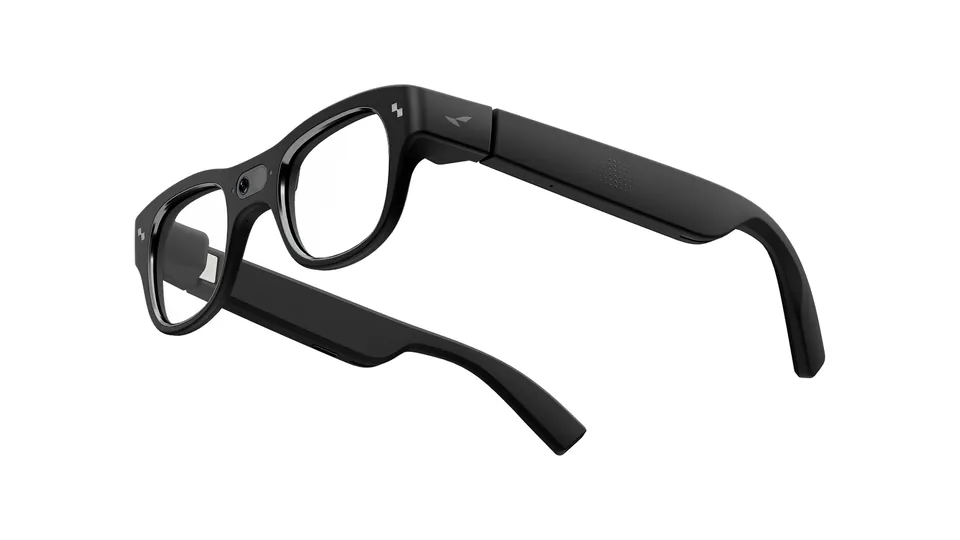
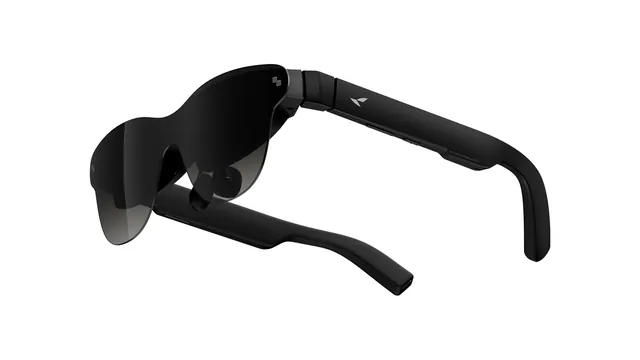
RayNeo sells four kinds of glasses. The X3 Pro ($1,299) is standalone AI and AR glasses with a 12MP camera, full-color MicroLED displays in both lenses and Google Gemini. The Air series, priced from $149 to $299, and the newer GT and GT Max ($329 and $429) are screen glasses that plug into a phone, laptop or console and show a large virtual screen. The iO, from $499, has a small green display and an AI assistant but no camera. RayNeo set Sept. 4 as the retail launch for the iO, GT and GT Max, and its store now sells all three.
This guide is based on RayNeo's store, product pages, blog and press releases, with prices as listed on RayNeo's US-dollar store on Oct. 25, 2026. We haven't tested the glasses.
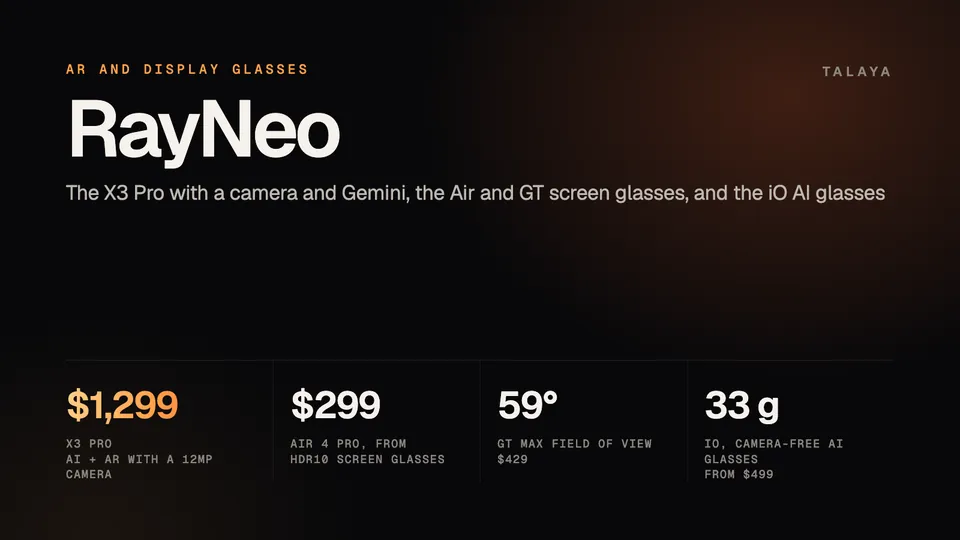
RayNeo's lineup at a glance
| Model | What it is | Price | Weight | Main figures |
|---|---|---|---|---|
| X3 Pro | Standalone AI and AR glasses with a camera | $1,299 | About 76 grams | Full-color MicroLED, up to 6,000 nits, 12MP camera |
| iO | AI glasses with a green display and no camera | From $499 | 33 grams | 23.5-degree field of view, up to 1,300 nits |
| GT Max | Screen glasses | $429 | 78 grams | 59-degree field of view, virtual screen up to 307 inches |
| GT | Screen glasses | $329 | 68 grams | 46-degree field of view, virtual screen up to 231 inches |
| Air 4 Pro | Screen glasses | From $299 | 76 grams | HDR10, up to 1,200 nits, 120Hz, 201-inch virtual screen |
RayNeo's store also lists the Air 3s Pro (from $279), Air 3s ($269), Air 2s ($159, marked down from $299), Air 2 ($149, marked down from $299) and the earlier X2 AR glasses ($499). The iO, GT and GT Max figures come from RayNeo's Sept. 3 blog, written before those three went on sale, which said battery life for the GT and GT Max hadn't been published.
RayNeo X3 Pro: standalone AI and AR glasses
The X3 Pro is RayNeo's flagship and its only model with both a camera and a display. RayNeo says it launched on Dec. 17, 2025, and its launch page advertised an early-bird price of $1,099. The store listed it at $1,299 on Oct. 25.
It runs on its own. RayNeo says the X3 Pro has its own processor, storage, Wi-Fi and battery and runs RayNeo AIOS, an Android-based system, on what its launch page calls a Snapdragon AR1 platform. A phone is still needed for setup, connectivity, hotspot access and companion features, and the companion app runs on iOS and Android, according to RayNeo's blog.
Display, camera and battery
Both lenses carry full-color MicroLED displays. RayNeo says its Firefly optical engine measures 0.36 cubic centimeters and produces 16.77 million colors and up to 6,000 nits, and the product page gives a 3,500-nit average. The pages we read don't give a field of view in degrees. RayNeo describes the image as equivalent to a 43-inch screen viewed from 2 meters away.
The camera is a 12MP Sony IMX681 that shoots photos and 4K and 3K video. A black-and-white camera handles positioning, dual recording and spatial tracking, RayNeo says. The battery is 245mAh according to RayNeo's blog, which says continuous camera use drains it in about 30 minutes and light, intermittent use stretches closer to 3.5 to 5 hours. The launch page rates it at up to five hours of recording, three hours of music or 36 minutes of video, with a low-power mode to extend it.
Gemini, translation and apps
The assistant is Google Gemini, and the product page cites Gemini 2.5 and Gemini Live. Real-time translation covers 14 languages: Chinese, English, Cantonese, German, French, Spanish, Italian, Japanese, Korean, Russian, Thai, Vietnamese, Indonesian and Malay. It appears as on-screen text or synchronized audio. The X3 Pro also has turn-by-turn navigation and nearby places, a teleprompter, a music player and a camera app.
Through a built-in Android virtual environment it runs apps such as TikTok, Instagram and WhatsApp, though RayNeo says some apps need manual installation with developer tools. Its FAQ also says that Gemini may answer a question without handing the action to another app, such as navigation. Creator Mode supports 6DoF and SLAM development with Unity or the Android ARDK. At CES 2026, RayNeo showed an X3 Pro "Project eSIM," which it calls a prototype concept, not a product.
RayNeo iO: AI glasses with a green display and no camera
The iO weighs 33 grams. RayNeo's Sept. 3 blog listed its specifications before launch: a monochrome green display through a diffractive waveguide lens, a 23.5-degree field of view, up to 1,300 nits at eye level, a magnesium-aluminum frame with titanium temples, four microphones and bone-conduction audio. The battery is 240mAh, rated for up to two days of light use, and the frame is rated IP54 for dust and light water. It comes in Polar Night and Dune.
The assistant combines RayNeo's software with Google's Gemini 3.1 Flash Lite. Live translation covers 55 languages and 109 accents, and 40 languages are tuned for on-lens live captions. The iO starts at $499, or $658 with prescription lenses. It is the closest RayNeo gets to the Even Realities G2, a camera-free pair with a green display that costs $599.
The Air series: screen glasses for video and gaming
Air glasses have no camera and need no companion app. Each pair plugs into a phone, laptop or console over one USB-C cable using DisplayPort Alt Mode and shows a large virtual screen, RayNeo's blog explains. Not every USB-C port supports that video mode, so check your device first. The blog says the Air 4 Pro page lists confirmed compatibility with iPhone, Android, PC, Nintendo Switch and PS5, and that the Air 3s Pro and Air 4 Pro work with an optional $64 HDMI adapter for devices without USB-C video output.
The Air 4 Pro, from $299, is the current flagship. RayNeo calls it the first AR glasses with an HDR10 display and rates it at up to 1,200 nits and 120Hz, according to its launch page. A custom Vision 4000 chip upscales standard video to HDR and converts 2D video to 3D, RayNeo says. The glasses weigh 76 grams, project what RayNeo calls a 201-inch virtual screen at 6 meters and have four speakers co-tuned with Bang & Olufsen. HDR10 works with iPhone, Mac, PCs, Switch 2 and other gaming devices, the launch page says.
Cheaper options are the Air 3s Pro (from $279), Air 3s ($269) and, on sale, the Air 2s ($159). RayNeo also sells a $199 Pocket TV Pro, a $129 Pocket TV streaming box and an $89 JoyDock adapter for handheld consoles.
GT and GT Max: bigger virtual screens
The GT series came out of RayNeo's Aug. 21 announcement and is meant for cinema-style viewing. The GT ($329) weighs 68 grams, has a 46-degree field of view from a birdbath optical engine and scales its virtual screen across 136, 201 and 231 inches. The GT Max ($429) weighs 78 grams and uses tandem micro-OLED displays with a 59-degree field of view and a virtual screen from 227 to 307 inches, depending on the mode. RayNeo says the Max also has a dedicated Zone 360 3DoF chip with Steady, Pinned and Follow modes to keep the screen stable on a train or plane, and that it supports native Dolby Vision when paired with RayNeo's Pocket TV Pro. The Dolby Vision claim applies to that pairing, not to the glasses alone.
Both GT models have quad speakers co-tuned with Bang & Olufsen and support custom prescription lens inserts, and the GT Max comes in three IPD sizes. RayNeo's pages we read don't list their resolution, brightness or battery.
RayNeo vs XREAL
RayNeo and XREAL both sell glasses that plug into a phone or console, and their prices overlap. This table pairs the nearest models using each company's figures; RayNeo's pages we read don't give the missing numbers.
| Price tier | RayNeo | XREAL |
|---|---|---|
| About $300 | Air 4 Pro (from $299): 76 grams, up to 1,200 nits, HDR10 | X By XREAL a01+ ($299): 62 grams, 50 degrees, up to 1,600 nits, no screen anchoring |
| $329 to $399 | GT ($329): 68 grams, 46 degrees | XREAL One ($399; back-in-stock sign-up on Oct. 29): 50 degrees, 1080p, 600 nits, X1 chip |
| $429 to $449 | GT Max ($429): 78 grams, 59 degrees | XREAL 1S ($449): 82 grams, 52 degrees, 1200p, 700 nits, X1 chip |
| $539 to $599 | GT Max is the nearest, at $110 less than the One Pro | XREAL One Pro ($539 on XREAL's US store, Oct. 29, 2026) or 1 Pro+ ($599): 57 degrees, X1 chip; the 1 Pro+ reaches 1,200 nits |
On the published figures, the GT Max lists a wider field of view than XREAL's One Pro (59 degrees against 57) for $110 less than the $539 XREAL's US store showed on Oct. 29, 2026. RayNeo's pages we read don't give its resolution or brightness, so the comparison is incomplete.
At the top, XREAL also sells the $849 ROG XREAL R1 for 240Hz gaming and the Android XR Aura, which starts at $1,279 and is due to ship soon. RayNeo's closest counterpart is the $1,299 X3 Pro, which runs RayNeo's own Android-based system on the glasses, while Aura runs Android XR on a tethered puck. Our guides to XREAL's lineup and to XREAL vs Viture have the XREAL figures.
Prescription lenses
RayNeo handles prescriptions through Lensology, a third-party partner it names as its official lens supplier. The X3 Pro takes custom lenses ordered separately, with worldwide shipping. The Air 4 Pro comes with a lens frame for custom lenses, which aren't included in the price, and RayNeo says it isn't responsible for the lenses or the ordering process. The GT and GT Max support custom prescription inserts, and the iO is sold with prescription lenses from $658. RayNeo's pages we read give no supported prescription range. Our prescription guide compares what other brands publish.
Where to buy in the US
RayNeo sells directly through its online store, which lists prices in US dollars, and through an Amazon store. Its Sept. 3 blog said the iO, GT and GT Max would go on sale on Sept. 4 through its website and Amazon store, with a demo at IFA in Berlin. RayNeo says Counterpoint Research ranked it first in global AR glasses market share in the third quarter of 2025, at 24%, and we haven't seen Counterpoint's report.
Who each line suits
On specs, the X3 Pro suits people who want a camera and a two-lens AR display in standalone glasses and can live with the short battery ratings, a 14-language translation limit and a $1,299 price. The iO suits people who want a light, camera-free pair for captions, translation and an assistant. The Air glasses are RayNeo's cheapest route to a large virtual screen, and the GT and GT Max aim at bigger, wider screens for travel and movies. Check that your phone, laptop or console outputs video over USB-C before buying any of the screen glasses. Our explainer on AI, AR and display glasses and best smart glasses guide show where these categories fit.
Correction, Oct. 30, 2026: An earlier version listed the XREAL One Pro at $599. XREAL's US store showed $539 on Oct. 29, 2026, so the price comparison now uses that figure. It also gave a weight of 84 grams for the XREAL One, which XREAL's US store pages don't list, so we removed it.
Frequently asked questions
How much is the RayNeo X3 Pro?
RayNeo's store listed it at $1,299 on Oct. 25, 2026. RayNeo's launch page for the Dec. 17, 2025 release advertised an early-bird price of $1,099.
Does the RayNeo X3 Pro have a camera?
Yes. RayNeo lists a 12MP Sony IMX681 camera that shoots photos and 4K and 3K video, plus a black-and-white camera for positioning. It is RayNeo's only model with both a camera and a display.
What is the difference between RayNeo Air and X-series glasses?
The Air glasses have no camera and plug into a phone, laptop or console to show a large virtual screen. The X-series X3 Pro is standalone, with a camera, its own processor and Gemini, and displays information in your view.
Do RayNeo Air glasses work with iPhone and PlayStation 5?
RayNeo's blog says the Air 4 Pro page lists iPhone, Android, PC, Nintendo Switch and PS5, and its buying guide names iPhone 15 and 16 series phones. The source device needs USB-C video output (DisplayPort Alt Mode), or you need RayNeo's $64 HDMI adapter.
Does the RayNeo iO have a camera?
No. RayNeo's iO is a camera-free pair with a green display, four microphones and live translation, and it starts at $499.
Is RayNeo the same company as XREAL?
No. They are separate companies that both make glasses for big-screen viewing. Our XREAL lineup guide covers XREAL's models, and the comparison table below sets the closest pairs side by side.
Sources
- RayNeo: Products and prices (read Oct. 25, 2026)
- RayNeo blog: What new smart glasses are available now, and what's coming soon? (Sept. 3, 2026)
- RayNeo: X3 Pro AI+AR glasses product page
- RayNeo: X3 Pro launch page
- RayNeo: Air 4 Pro launch page
- RayNeo: Buying guide
- RayNeo: RayNeo debuts the world's first HDR10-enabled AR glasses at CES 2026 (Jan. 6, 2026)
- XREAL US store: all products and prices (Oct. 25, 2026)
- XREAL US store: XREAL One Pro (Oct. 29, 2026)
- XREAL US store: XREAL One (Oct. 29, 2026)
Join the conversation
Questions, or something to add? Talk about it with other smart glasses owners in r/Talaya, our community on Reddit.