Smart Glasses · Guide
Best display glasses for gaming and movies in 2026: XREAL, Viture and RayNeo compared
XREAL, Viture and RayNeo make plug-in glasses that turn a phone, laptop, handheld or console into a big screen. Here is how their models compare on view, brightness, refresh rate, weight and what they connect to.
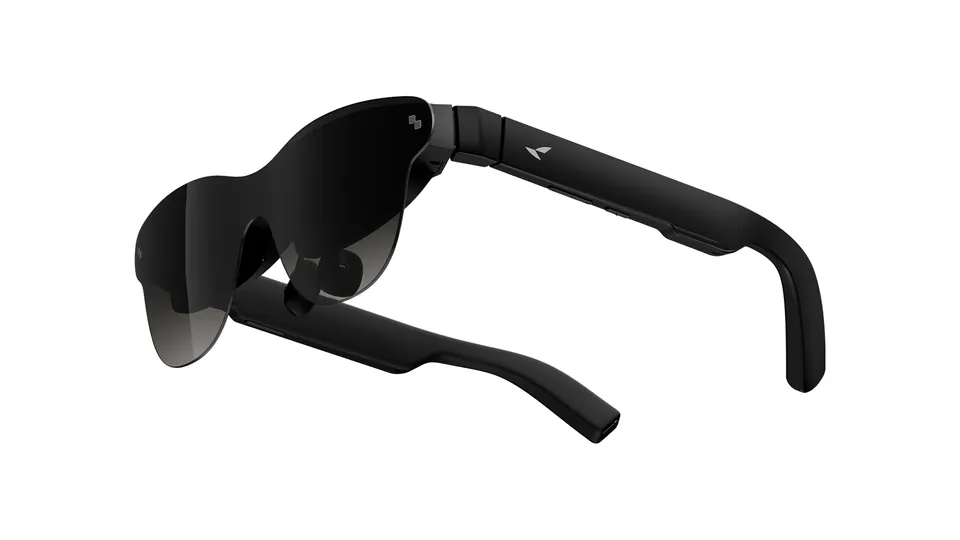
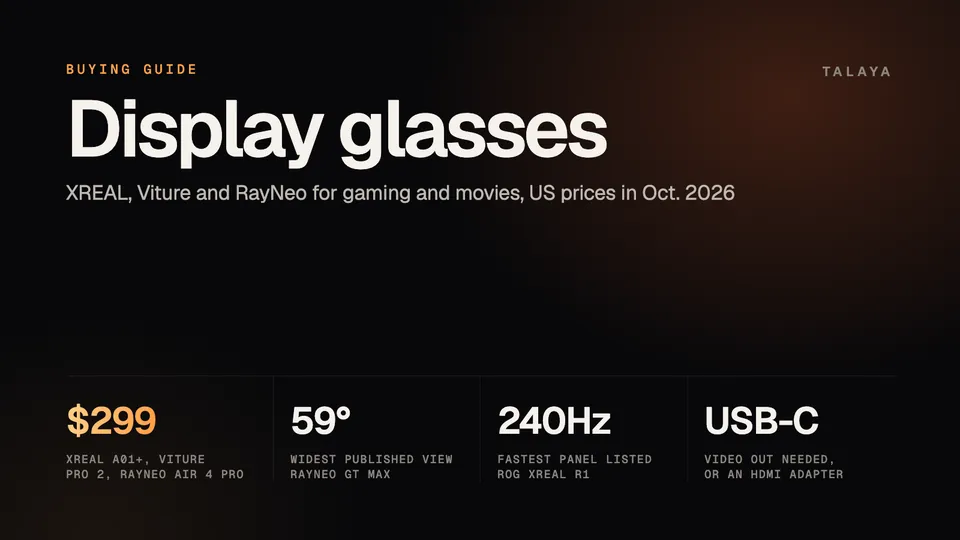
Display glasses, which makers often sell as AR glasses, plug into a phone, laptop, handheld or console over USB-C and show its screen as a large virtual display. The glasses in this guide run no apps of their own. On the published specs, the XREAL 1S ($449) is the pick for a screen that stays fixed in space without an app, the RayNeo GT Max ($429) lists the widest view at 59 degrees, and the ROG XREAL R1 ($849) is the only pair listed at 240Hz. XREAL's a01+, Viture's Pro 2 and RayNeo's Air 4 Pro start at $299, and RayNeo's store also lists older Air models from $149. Viture's Luma and Luma Pro suit nearsighted players because they have focus dials.
This guide is based on XREAL's, Viture's and RayNeo's own pages, store listings and press releases, with B&H Photo's tables where a company gives no number. US prices are as of Oct. 25, 2026 (the XREAL One Pro as of Oct. 29), and compatibility pages were read on Oct. 26. We haven't tested these glasses, so the picks follow the specs alone. Our explainer on AI, AR and display glasses covers where this category fits.
The picks at a glance
| If you want | Pick | US price | Why, on the specs | What it gives up |
|---|---|---|---|---|
| A screen that stays put when you turn your head | XREAL 1S | $449 | X1 chip, 1200p, 52 degrees, 700 nits, 82 grams | A narrower view than the One Pro's 57 degrees |
| The widest published view for movies | RayNeo GT Max | $429 | 59 degrees, tandem micro-OLED, anchoring chip with Steady, Pinned and Follow modes | No resolution, brightness or battery in the pages we read, 78 grams |
| The lightest big screen | X By XREAL a01+ or Viture Pro 2 | $299 each | 62 and 63 grams, up to 1,600 nits | The a01+ has no screen anchoring, and Viture lists no field of view for the Pro 2 |
| HDR video | RayNeo Air 4 Pro | From $299 | HDR10, up to 1,200 nits, 120Hz, 76 grams | No field of view listed, and HDR10 is RayNeo's own claim |
| PC and console gaming | ROG XREAL R1 | $849 | 240Hz, 57 degrees, X1 chip, 91 grams | $250 more than the 1 Pro+, which has the same view |
| Nearsighted without lens inserts | Viture Luma | $399 | Focus dials up to -6.0D, up to 1920 by 1200 per eye | No field of view listed, and its anchoring comes from an app |
Picture, view and speed
| Model | US price | Field of view | Resolution per eye | Peak brightness | Refresh rate |
|---|---|---|---|---|---|
| X By XREAL a01+ | $299 | 50 degrees | 1080p | Up to 1,600 nits | 120Hz |
| XREAL 1S | $449 | 52 degrees | 1200p | 700 nits | 120Hz |
| XREAL One Pro | $539 (Oct. 29) | 57 degrees | 1080p | 700 nits | 120Hz |
| XREAL 1 Pro+ | $599 | 57 degrees | Not listed | Up to 1,200 nits | Not listed |
| ROG XREAL R1 | $849 | 57 degrees | 1080p | Not listed | 240Hz |
| Viture Pro 2 | $299 | Not listed | Not listed | 1,600 nits | Not listed |
| Viture Luma | $399 | Not listed | Up to 1920 by 1200 | 1,000 nits (help center) or up to 1,500 (Luma page) | Up to 120Hz |
| Viture Luma Ultra | $599 | 52 degrees (B&H) | 1920 by 1200 | 1,250 to 1,500 nits | Up to 120Hz |
| Viture Beast | From $549 | Not listed | Up to 1200p | Up to 1,250 nits | Not listed |
| RayNeo Air 4 Pro | From $299 | Not listed | Not listed | Up to 1,200 nits | 120Hz |
| RayNeo GT | $329 | 46 degrees | Not listed | Not listed | Not listed |
| RayNeo GT Max | $429 | 59 degrees | Not listed | Not listed | Not listed |
Brightness is each company's own peak claim, and Viture's sources differ. For the Luma, its help center says the Luma and Luma Pro reach 1,000 nits, while its Luma page says up to 1,500 nits, adjustable to your environment, so we don't pick one. For the Luma Ultra, its help center says 1,250 nits, while its Luma page and B&H say 1,500. Viture's help center gives the Luma series refresh rates up to 120Hz, without a figure for each model. Viture's Luma pages we read on Oct. 28 show no prices, so the Luma, Luma Pro and Luma Ultra prices here are from Oct. 25. XREAL's US store listed the One Pro at $539.00 on Oct. 29, with no regular price shown. The XREAL One ($399) and Viture Luma Pro ($499) sit between these rows. On Oct. 29, XREAL's US store showed a sign-up for back-in-stock alerts on the One's page, with no restock date. Our XREAL lineup guide and XREAL vs Viture comparison have their specs.
Weight, anchoring and prescription
Anchoring, which XREAL calls 3DoF, keeps the virtual screen fixed in space as you move your head.
| Model | Weight | Screen anchoring | Prescription |
|---|---|---|---|
| X By XREAL a01+ | 62 grams | None, the screen follows your view | Not listed |
| XREAL 1S | 82 grams | X1 chip, 3DoF with no app | Not listed |
| XREAL One Pro | Not listed | X1 chip, 3DoF with no app | Ships with a prescription frame, lenses from $49.90 |
| ROG XREAL R1 | 91 grams | X1 chip | Not listed |
| Viture Pro 2 | 63 grams | Not listed | Focus dials, 0 to -5.00D per eye |
| Viture Luma | Not listed | 3DoF through the SpaceWalker app | Focus dials up to -6.0D |
| Viture Luma Ultra | 83 grams | 6DoF with depth cameras | Not listed |
| Viture Beast | Not listed | Built-in 3DoF | No dial |
| RayNeo Air 4 Pro | 76 grams | Not listed | Comes with a lens frame, custom lenses extra |
| RayNeo GT | 68 grams | Not listed | Custom prescription inserts |
| RayNeo GT Max | 78 grams | Zone 360 3DoF chip | Custom prescription inserts, three IPD sizes |
XREAL's lenses are made by a third-party partner, ship from China in about 10 business days and can't be returned unless there is a quality problem. RayNeo names Lensology as its official lens supplier and says it isn't responsible for the lenses or the ordering process. For higher prescriptions than its dials cover, Viture's help center says to set the dial to zero and attach a model-specific lens frame. Our prescription guide compares every brand.
What each brand connects to
| XREAL | Viture | RayNeo | |
|---|---|---|---|
| Steam Deck and ROG Ally | Direct connection | Named in Viture's help center | Steam Deck, Steam Deck OLED and ROG Ally models listed |
| Nintendo Switch 2 | Not direct, needs the $119 Neo hub or a dock | $99 Mobile Dock Mini | Says the Air 4 Pro's HDR10 works with Switch 2, sells an $89 JoyDock for handheld consoles |
| PS5 and Xbox | HDMI adapter and HDMI-to-USB cable | Not listed in the pages we read | PlayStation and Xbox consoles listed, $64 HDMI adapter |
| iPhone | iPhone 15 and later, 16e excluded | No iPhone list in the pages we read | iPhone 15 and 16 series, 16e not included |
| Android | Phones with DisplayPort output, 4 to 6 hours from a full charge | Most Android phones | Pixels and other phones listed, DisplayPort needed |
| Laptops | DisplayPort over USB-C, PCs through HDMI | Many Windows laptops, MacBooks, USB-C iPads | Macs, iPads and Surface listed |
XREAL's list comes from its One series guide, dated March 2025, so it predates the Switch 2, and our lineup guide records XREAL's later statement that the Switch and Switch 2 need an adapter or a dock. RayNeo's compatibility page names the Air 2 through Air 3s Pro in its headings, and RayNeo's blog says the Air 4 Pro page lists iPhone, Android, PC, Switch and PS5. Every brand says the source must output DisplayPort video over USB-C or go through an adapter.
Gaming: Steam Deck, Switch 2, PS5 and PC
Handhelds are the easy case. XREAL's guide says the Steam Deck and ROG Ally connect directly and that a fully charged console supports 4 to 5 hours of typical gaming, and it recommends its hub for charging while you play. For consoles, the guide says to set the glasses' audio protocol to DP mode, which moves volume control to the glasses' menu. If you're choosing between XREAL and Viture for a Steam Deck, both brands list it. XREAL lists the wider views, up to 57 degrees, and an anchoring chip, while Viture's Luma and Luma Pro add focus dials and Viture's $99 dock also covers a Switch 2.
The Switch 2 and PS5 need hardware beyond the glasses. Neo, the Mobile Dock Mini and JoyDock are separate purchases, and a PS5 needs XREAL's HDMI adapter and cable or RayNeo's $64 adapter. The R1 is the pair for fast games: XREAL and ASUS call 240Hz a first for glasses, XREAL's store lists a 0.01-millisecond response time, and the ROG Control Dock adds a DisplayPort 1.4 input and two HDMI 2.0 inputs for switching between a PC and consoles. If you don't play fast games on a PC or console, the 1 Pro+ gives you the same 57-degree view for $250 less, and the One Pro for $310 less at its Oct. 29 price.
Movies: size, brightness, dimming and comfort
Compare degrees, not inches, because each company's size claim assumes a different distance: XREAL says the One Pro shows up to 171 inches, Viture says the Beast looks like 174 inches at 4 meters, and RayNeo describes the Air 4 Pro as 201 inches at 6 meters. Our field of view explainer converts the angles. By the published degrees, the GT Max (59) and the One Pro, 1 Pro+ and R1 (57) lead.
For picture quality, RayNeo says the Air 4 Pro is the first AR glasses with an HDR10 display, and its Vision 4000 chip upscales standard video to HDR and converts 2D video to 3D. XREAL's 1 Pro+ adds AI HDR, Standard, Movie and Reading modes and 2D-to-3D conversion at 60 frames per second. RayNeo says the GT Max supports native Dolby Vision, but only when paired with its Pocket TV Pro.
Dimming matters on a plane or in a bright room. Viture lists electrochromic film on the Luma series with a one-button toggle, and B&H says the Luma Ultra's film blocks nearly all outside light. XREAL's One Pro lists adjustable lens transparency, and the 1S and R1 adjust their tint automatically. For long films, the lighter pairs are the a01+ (62 grams), Viture Pro 2 (63) and RayNeo GT (68). XREAL says a fully charged iPhone supports 4 to 6 hours of normal viewing and recommends its hub for longer sessions. The 1S has speakers tuned under the Sound by Bose label, and RayNeo's Air 4 Pro and GT have quad speakers co-tuned with Bang & Olufsen.
What these glasses give up
None of these glasses has an assistant, and they need a cable to a source that outputs DisplayPort video and draw power from it. Most have no camera: Viture's Luma Ultra has dual depth cameras for 6DoF tracking, Viture marks the Luma Pro's front camera "To be unlocked after launch", and XREAL sells the $99 Eye as an add-on. The models above that list a weight run 62 to 91 grams, against 69 grams for Meta Ray-Ban Display, and comfort over a long session is something a spec sheet can't settle. Our under $400 guide lists the cheaper options and our RayNeo guide covers its AI and AR models.
Correction, Oct. 28, 2026: An earlier version said Viture's dock brings SpaceWalker to iOS, which the Viture pages and release we read don't say, and gave the Luma Ultra a -4.0D dial range that Viture lists for the Luma Pro; we removed both. It also gave the Luma's brightness as 1,000 nits, listed no refresh rate for the Luma series and described the Luma Pro's camera without Viture's note that it will be unlocked after launch.
Correction, Oct. 30, 2026: An earlier version listed the XREAL One Pro at $599. XREAL's US store listed it at $539.00 on Oct. 29, so the table now shows that price with its date, and a note says the One showed a back-in-stock sign-up that day. It also gave weights of 84 grams for the One and 87 grams for the One Pro, which XREAL's US store pages don't list, so we removed them.
Frequently asked questions
Do XREAL, Viture and RayNeo glasses work with the Steam Deck?
Yes, according to all three. XREAL's One series guide says the Steam Deck and ROG Ally connect directly and that a fully charged console supports 4 to 5 hours of typical gaming. Viture's help center names the Steam Deck, and RayNeo's compatibility page lists the Steam Deck and Steam Deck OLED.
Which display glasses work with the Nintendo Switch 2?
All three need extra hardware. XREAL says its glasses can't connect to a Switch directly and sells the $119 Neo hub, Viture sells the $99 Mobile Dock Mini for the Switch 2, and RayNeo sells an $89 JoyDock adapter for handheld consoles and says the Air 4 Pro's HDR10 works with Switch 2.
Can I use display glasses with a PS5 or Xbox?
XREAL says PlayStation and Xbox consoles need an HDMI adapter and an HDMI-to-USB cable. RayNeo's compatibility page lists PlayStation and Xbox consoles and RayNeo sells a $64 HDMI adapter. The Viture pages we read don't list PlayStation or Xbox consoles.
Do display glasses work with iPhone?
With iPhones that output video over USB-C. XREAL lists the iPhone 15 and later and excludes the iPhone 16e, and RayNeo's page lists the iPhone 15 and 16 series and says the 16e isn't included. Viture's pages we read give no iPhone model list. Our iPhone guide has the rest.
How do display glasses work with a prescription?
The brands handle it differently. XREAL's One and One Pro ship with a prescription frame and sell lenses from $49.90, Viture builds focus dials into most models, and RayNeo works with a lens partner and ships some models with a lens frame. Our prescription guide compares the options.
Sources
- XREAL US store: all products and prices (Oct. 25, 2026)
- XREAL US store: XREAL One Pro (Oct. 29, 2026)
- XREAL US store: XREAL One (Oct. 29, 2026)
- XREAL US store: XREAL One series user guide (March 2025, read Oct. 26, 2026)
- XREAL US store: ROG XREAL R1
- XREAL: XREAL introduces XREAL 1 Pro+ (Oct. 16, 2026)
- XREAL: XREAL opens US sales of X By XREAL a01+ for $299 (July 10, 2026)
- XREAL: New 1S glasses and Neo power hub (Jan. 4, 2026)
- XREAL: Partnership with ASUS Republic of Gamers, ROG XREAL R1 (Jan. 5, 2026)
- Viture: Luma XR glasses series (read Oct. 26, 2026)
- Viture: The Beast
- Viture Help Center: Luma Series XR Glasses, specs and functions
- Viture: 5th Anniversary Collection, led by Viture Pro 2 (Aug. 6, 2026)
- B&H Photo: Viture Luma Ultra XR Glasses (read Oct. 25, 2026)
- RayNeo: Products and prices (read Oct. 25, 2026)
- RayNeo: Compatibility (EU store, read Oct. 26, 2026)
- RayNeo blog: What new smart glasses are available now, and what's coming soon? (Sept. 3, 2026)
- RayNeo: Air 4 Pro launch page
- RayNeo: RayNeo debuts the world's first HDR10-enabled AR glasses at CES 2026 (Jan. 6, 2026)
- RayNeo: Buying guide
Join the conversation
Questions, or something to add? Talk about it with other smart glasses owners in r/Talaya, our community on Reddit.