Smart Glasses · Guide
AR glasses field of view explained: degrees, screen size and the published numbers
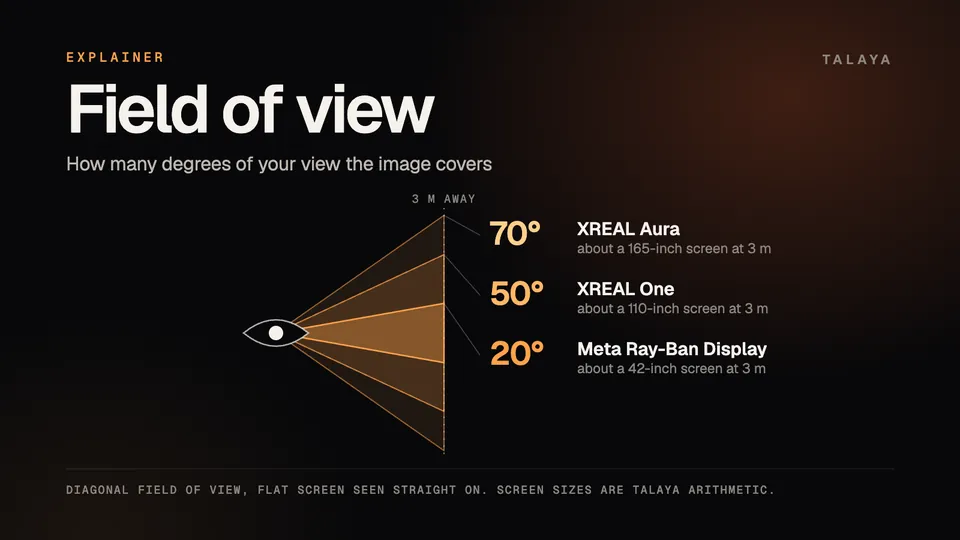
Field of view is how much of your vision the image covers, measured in degrees and usually quoted across the diagonal. A simple formula turns degrees into virtual screen sizes, and the published numbers run from 20 degrees on Meta Ray-Ban Display to 70 on XREAL Aura.

Part of our Explainers guide
Field of view, or FOV, is how much of your vision the image covers, measured in degrees. For glasses the number is usually the diagonal of the image, corner to corner, and a bigger number means a bigger picture. Published figures run from 20 degrees on Meta Ray-Ban Display to 70 on XREAL Aura, which is the difference between a 42-inch screen and a 165-inch one at 3 meters.
The figures here are the companies' published numbers, collected in our product guides, and the screen-size conversions are our own arithmetic.
How field of view is measured
Glasses and headsets don't quote the angle the same way. Snap says its 2024 Spectacles have "a 46 degree diagonal field of view." Meta lists Quest's view horizontally and vertically, 110 by 96 degrees for Quest 3 and 96 by 90 for Quest 3S, and UploadVR puts Meta VR Glasses at 70 by 66, according to our Meta VR Glasses guide. For the same image, the diagonal angle is always larger than the horizontal one, so compare the two kinds of number with care.
The other glasses makers' pages we read don't say which angle they mean, but the figures from Meta, XREAL and Snap work out as diagonals. Meta's 600 by 600 pixels at 42 pixels per degree is about 14.3 degrees per side, and the diagonal of that square is about 20 degrees, which matches the figure Ray-Ban lists.
A camera has its own field of view. Meta lists 100 degrees for Ray-Ban Meta's camera and 122 for Oakley Meta Vanguard's, and that is how much of the scene the camera captures. It has nothing to do with a display, and our camera quality guide covers it.
Size and sharpness are separate. Field of view says how large the image is, and pixels per degree says how sharp. Meta publishes 42 for Ray-Ban Display, 37 for Meta VR Glasses, 25 for Quest 3 and 20 for Quest 3S. XREAL lists 32 for Aura, and Snap lists 37 for its 2024 Spectacles.
From degrees to inches
A flat screen with diagonal d, seen straight on from distance D, covers an angle of 2 × arctan(d ÷ 2D). Run backward, the screen that fills an angle A at distance D has a diagonal of 2 × D × tan(A ÷ 2).
Makers' own claims fit the formula. XREAL says the 50-degree a01+ looks like a 147-inch screen from 4 meters away, according to our XREAL lineup guide, and the formula gives 50 degrees. Snap compares Specs' 51 degrees to a 115-inch screen about 10 feet away, as our Snap Specs guide reports, which works out to 51. For the 2024 Spectacles, Snap said 46 degrees was "similar to a 100 inch display just 10 feet away," and the formula gives about 45.
For scale, a 65-inch TV viewed from 3 meters covers about 31 degrees, and a 55-inch TV about 26.
Claims about screen size are harder to compare because each maker picks its own distance. XREAL says the One Pro shows a screen of up to 171 inches. Viture says the Luma series looks like a 120-inch display from about 3 meters and the Beast like 174 inches at 4 meters, and RayNeo describes the Air 4 Pro as a 201-inch screen at 6 meters, according to our XREAL vs Viture and RayNeo guides. Where a maker gives a size and a distance but no angle, you can estimate it. Viture's Luma claim implies roughly 54 degrees and the Beast's roughly 58, and RayNeo's 201 inches at 6 meters works out to 46, the angle RayNeo lists for the GT. Treat those as estimates, because the distances are rounded.
Published fields of view
Figures are each company's own, as collected in our guides, and the Rokid and Viture Luma Ultra numbers come from B&H Photo's listings. The last column converts each angle to a flat screen 3 meters away, about 10 feet. Specs and Aura haven't shipped yet, and prices are US prices on Oct. 25, 2026.
| Glasses | Published field of view | Type | Matches a screen at 3 m | US price |
|---|---|---|---|---|
| Meta Ray-Ban Display | 20 degrees | Display glasses | About 42 inches | $799 with Neural Band |
| RayNeo iO | 23.5 degrees | Display glasses | About 49 inches | From $499 |
| Even Realities G2 | 27.5 degrees | Display glasses | About 58 inches | $599 |
| Rokid Glasses | 30 degrees | Display glasses | About 63 inches | $699 at B&H |
| Vuzix Z100 | 30 degrees | Display glasses | About 63 inches | $499 at launch, out of stock |
| RayNeo GT | 46 degrees | Screen glasses | About 100 inches | $329 |
| Snap Spectacles (2024) | 46 degrees diagonal | AR glasses, developers only | About 100 inches | $99 a month program |
| XREAL a01+ | 50 degrees | Screen glasses | About 110 inches | $299 |
| XREAL One | 50 degrees | Screen glasses | About 110 inches | $399 |
| Snap Specs | 51 degrees | AR glasses | About 113 inches | $2,195 |
| XREAL 1S | 52 degrees | Screen glasses | About 115 inches | $449 |
| Viture Luma Ultra | 52 degrees | Screen glasses | About 115 inches | $599 |
| XREAL One Pro and 1 Pro+ | 57 degrees | Screen glasses | About 128 inches | $599 each |
| ROG XREAL R1 | 57 degrees | Screen glasses | About 128 inches | $849 |
| RayNeo GT Max | 59 degrees | Screen glasses | About 134 inches | $429 |
| XREAL Aura | 70 degrees | AR glasses | About 165 inches | From $1,279 |
The XREAL, RayNeo and Viture rows come from our XREAL lineup guide, XREAL vs Viture comparison and RayNeo guide. Some pages we read give no number at all: RayNeo's X3 Pro, and Viture's Pro 2, Luma, Luma Pro and Beast.
Headsets are quoted horizontally.
| Headset | Published view | Sharpness | US price |
|---|---|---|---|
| Meta Quest 3S | 96 degrees horizontal, 90 vertical | 20 pixels per degree | $349.99 or $449.99 |
| Meta Quest 3 | 110 degrees horizontal, 96 vertical | 25 pixels per degree | $599.99 |
| Meta VR Glasses | About 70 degrees horizontal, 66 vertical (UploadVR) | 37 pixels per degree | $1,299.99, spring 2027 |
| Apple Vision Pro | Not published | Not published | From $3,699 |
Apple lists a display of 23 million pixels but no angle. Its technical specifications page, which we read on Oct. 25, 2026, gives no field of view in degrees.
Why display glasses are narrow and screen glasses wide
Display glasses are narrow partly by design. Meta says the Ray-Ban Display's screen is "placed off to the side, so it doesn't obstruct your view" and is meant for "short interactions," as our explainer on AI, AR and display glasses quotes. Even Realities' G2 is built around text and notifications. A 20 to 30 degree image leaves most of your view clear.
The optics add limits. In a waveguide, OptoFidelity says, simple binary gratings can lose efficiency at the edges of the view and reflective designs need larger mirrors for a bigger view, which our waveguide explainer describes. Screen glasses use micro-OLED panels with prism or birdbath optics instead and publish 46 to 59 degrees. They are built to show video on a large virtual screen.
See-through AR glasses start where screen glasses do. Snap's developer Spectacles went from 26.3 degrees in 2021 to 46 in 2024, and Specs publish 51 at 132 or 136 grams, against 226 grams for the 2024 pair, according to our Snap guide. Those are different products, but the view grew while the weight fell. XREAL Aura publishes 70 degrees at under 95 grams, with the computer in a tethered puck. Meta says its Orion prototype has "the largest field of view in the smallest AR glasses form to date," and it hasn't sold the glasses.
Meta VR Glasses show the cost of small size on the headset side. UploadVR puts their view at 70 by 66 degrees, against about 110 by 96 on Quest 3, in glasses of about 100 grams.
What the numbers mean for text, directions and movies
Text and notifications don't need a big view. At 20 to 30 degrees, an image covers what a 42 to 63-inch screen would at 3 meters. Meta says the Display's screen is large enough to read a text message or watch a small video, and that its 42 pixels per degree is sharper than any of its consumer VR headsets. Sharpness matters for reading too: Meta says the 37 pixels per degree in its VR Glasses are "great for text legibility."
Directions show the split between glasses types. Meta's Maps app puts a mini-map with upcoming turns in the right lens, and display glasses generally keep an image in one spot, like a car's heads-up display. Snap's Specs lay walking directions over the street as arrows, which is what a see-through AR design adds.
Movies need the widest view. Screen glasses publish 46 to 59 degrees and Snap Specs 51, which match screens of about 100 to 134 inches at 3 meters, against about 31 degrees for a 65-inch TV.
Choosing by field of view
On the published numbers, messages, directions and captions fit the 20 to 30 degrees of display glasses, so look at sharpness, brightness and the prescription range before the angle. For movies and games, look at the 46 to 59 degrees that screen glasses publish, and check whether the maker states the distance behind its screen-size claim. For AR apps placed around you, only Snap Specs and XREAL Aura have published figures, and neither has shipped. If a number isn't labeled diagonal, horizontal or vertical, ask the maker which it is.
Frequently asked questions
What is a good field of view for AR glasses?
It depends on the job. Glance-style display glasses publish 20 to 30 degrees, enough for messages and directions. Screen glasses built for video publish 46 to 59 degrees, and the see-through AR glasses, Snap Specs and XREAL Aura, list 51 and 70.
How big is a 50-degree field of view in inches?
About a 110-inch screen at 3 meters (10 feet), by our arithmetic. XREAL describes its 50-degree a01+ as a 147-inch screen at 4 meters, which works out to the same angle.
What is the field of view of Meta Ray-Ban Display?
Ray-Ban lists 20 degrees for the display in the right lens. Meta says its 600 by 600 pixels work out to 42 pixels per degree. See our Meta Ray-Ban Display guide.
What is the field of view of Apple Vision Pro?
Apple doesn't publish one. Its technical specifications page, read on Oct. 25, 2026, gives no field of view in degrees. For comparison, Meta lists 110 degrees horizontal for Quest 3 and 96 for Quest 3S.
Is a camera's field of view the same thing?
No. A camera's field of view, such as the 100 degrees Meta lists for Ray-Ban Meta's camera, is how much of the scene it captures. A display's field of view is how much of your vision the image covers.
What are pixels per degree?
Pixels per degree measures sharpness: how many pixels fit in each degree of your view. Meta publishes 42 for Ray-Ban Display, 37 for Meta VR Glasses, 25 for Quest 3 and 20 for Quest 3S, and XREAL lists 32 for Aura.
Sources
- Snap Newsroom: Introducing new Spectacles and Snap OS (Sept. 17, 2024)
- Apple: Apple Vision Pro technical specifications (read Oct. 25, 2026)
- Meta: Introducing Orion, our first true augmented reality glasses (Sept. 25, 2024)
- OptoFidelity: Comparing and contrasting different waveguide technologies: diffractive, reflective, and holographic waveguides (Apr. 8, 2024)
Join the conversation
Questions, or something to add? Talk about it with other smart glasses owners in r/Talaya, our community on Reddit.