Smart Glasses · Guide
Meta VR Glasses: price, release date, specs and how they compare with Quest
Meta's VR Glasses put micro-OLED displays into a pair of glasses of about 100 grams, tethered to a pocket puck. They go on sale in spring 2027 for $1,299.99. Meta says they're five times lighter than Quest 3, and they have Meta AI built into the system.
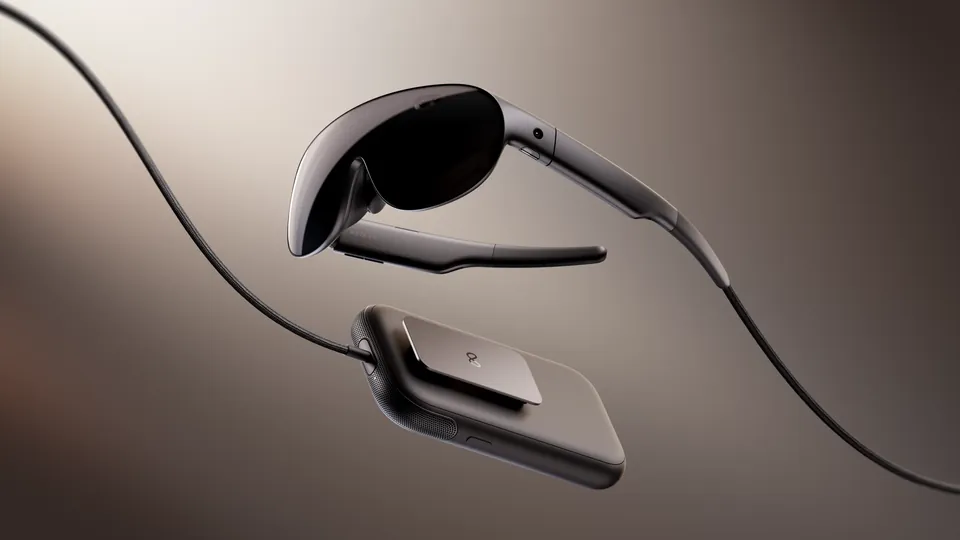
Meta VR Glasses are a virtual reality device shaped like a pair of glasses. They weigh about 100 grams, roughly as much as a deck of cards by Meta's comparison, because the computer, battery and storage live in a separate puck on a cable. Meta announced them at its Connect conference on Sept. 23 and says they will go on sale in spring 2027 for $1,299.99. It calls them its "most advanced device yet."
This guide is based on Meta's Connect 2026 announcements. Where we use details Meta hasn't published itself, mostly from UploadVR's reporting, we say so. We haven't used the glasses.
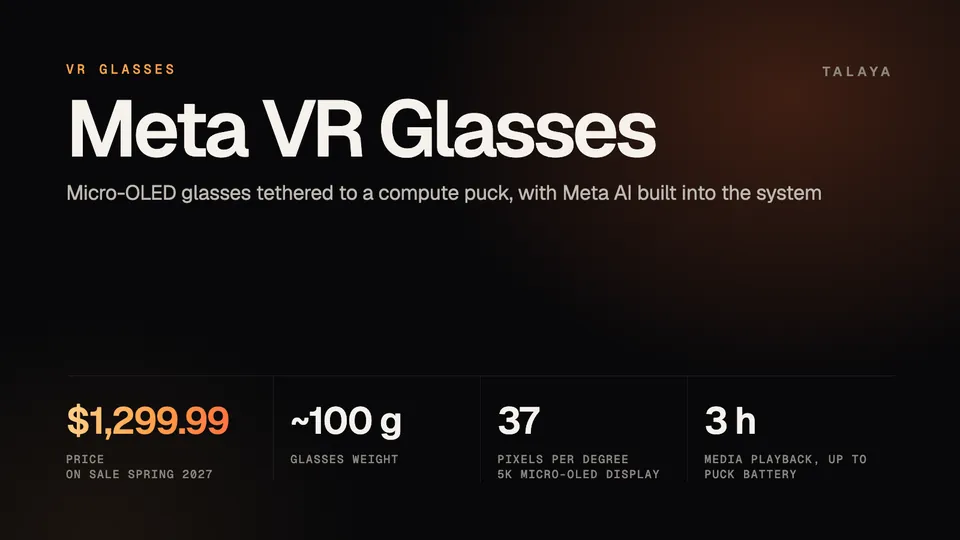
Meta VR Glasses price and release date
Meta's price is $1,299.99 in the US, and the only timing it has given is "Spring 2027." It hasn't said which countries will get the glasses first or when pre-orders open.
Two details that affect the real cost come from UploadVR, which reported the full specifications on announcement day. The glasses come with 128GB of storage and a microSD slot in the puck to add more. And they don't include controllers by default: you can buy Touch Plus controllers separately in a new all-black color, pair the ones from a Quest 3 or Quest 3S, or look for a bundle that includes them in some retail channels. In October, Sandisk said it would be the exclusive provider of storage products designed for the glasses at launch, UploadVR reported, without giving capacities or prices.
How the glasses and the puck split the work
Meta says the glasses are five times lighter than Meta Quest 3, mainly because of a two-part design. The glasses hold the sensors and displays. The puck, connected by what Meta calls an optical tether, handles computing, battery and storage, and clips to a pocket or bag. There are no straps. The sides are open and a passthrough camera shows the room, so you keep some sense of what's around you.
UploadVR adds that the puck weighs about 300 grams, "roughly the size of two phones stuck together," and that a thin hybrid fiber-optic cable carries both power and data. It also reports that the glasses have a magnesium frame with passive cooling and no fan, and that optional light blockers close off the sides for fully immersive VR.
Meta VR Glasses specs
| Meta VR Glasses | Source | |
|---|---|---|
| Price | $1,299.99 | Meta |
| Availability | Spring 2027 | Meta |
| Glasses weight | About 100 grams | Meta |
| Display | "5K Infinite Display" on micro-OLED panels, Dolby Vision | Meta |
| Resolution | 2412 x 2288 per eye, 120Hz, HDR | UploadVR |
| Sharpness | 37 pixels per degree | Meta |
| Field of view | 70 degrees horizontal, 66 degrees vertical | UploadVR |
| Lenses | Ultra-compact pancake lenses | Meta |
| Chip | Qualcomm Snapdragon Reality Elite | Meta |
| Memory and storage | 12GB RAM, 128GB, microSD slot | UploadVR |
| Battery | Up to 3 hours of continuous high-resolution media playback; 45W fast charging | Meta |
| Audio | Dolby Atmos spatial audio in the frames | Meta |
| Input | Eyes, hands and voice; controllers optional | Meta, UploadVR |
| Tracking | Hands, eyes and face | UploadVR |
The trade-off for the small size is the field of view. UploadVR puts it at 70 by 66 degrees, compared with about 110 by 96 degrees on Quest 3, and notes that these are Meta's first headset displays that aren't LCD since the original Oculus Quest in 2019. In return, the 37 pixels per degree make the image sharper than on Meta's current headsets, and Meta says that makes the glasses "great for text legibility."
What you can do with Meta VR Glasses
Meta is selling the glasses first as a personal cinema. They are the first VR device certified as IMAX Enhanced, which Meta says will make them one of the only ways to watch select films in IMAX's expanded aspect ratio at home. Disney+ subscribers can start streaming movies such as Marvel's The Avengers and Black Panther in 3D in November in select countries, inside themed environments like Tatooine and Avengers Tower, and a separate Disney Immersive Cinema by ILM app will offer enhanced versions of films like Star Wars: A New Hope. Meta lists Prime Video, YouTube, DIRECTV, AMC+, Crunchyroll, Plex, ESPN and Tubi as partners, says Peacock, HBO Max and Paramount+ are offering their 3D catalogs for the first time, and expects thousands of titles internationally by launch. James Cameron's Lightstorm Vision plans "first time in 3D" releases of blockbusters in 2027.
For sports, Meta promises more than 100 immersive live events a year once the glasses launch, with partners including MLB, NBC Sports, TNT Sports and UFC, and an ESPN "Immersive Sports" format with 8K streaming and 180-degree views that starts on Quest with college football this year.
For work, the glasses can show one large screen or several, and they can turn any flat surface into a keyboard and touchpad, with full-color passthrough so you can still see your desk and phone. UploadVR reports that you can plug a phone, laptop or handheld into the puck's USB-C port and see its screen in the glasses, a first for one of Meta's standalone devices.
For games, Meta says more than 75 will work with hand gestures alone at launch, and Xbox Cloud Gaming adds hundreds more. UploadVR reports that the puck runs the same operating system as Quest 3 and supports the same content, so controller-based Quest games work if you have controllers.
Meta also announced hologram calling: a photorealistic version of you, with your real-time expressions, for hands-free video calls in apps from WhatsApp to Zoom. According to UploadVR, the version that ships in the spring will be a stereoscopic video stream seen from the front, and Meta plans to make it fully three-dimensional later.
Meta AI and controls
Meta built its AI agent into the operating system. You can talk to the glasses or use your eyes and hand gestures to play a movie, open an app, rearrange your workspace or search for something. The default input is what UploadVR describes as "Look and Pinch": you look at an item and pinch your fingers to select it, using the glasses' eye and hand tracking. Meta has released new developer tools, including a Gaze SDK, to help apps work well with that kind of input, UploadVR reported in October.
Meta VR Glasses vs Quest 3, XREAL Aura and Apple Vision Pro
Meta hasn't said VR Glasses will replace Quest, and UploadVR reports that the two share software and apps. The comparison below uses each company's published prices and specifications.
| Meta VR Glasses | XREAL Aura | Apple Vision Pro | |
|---|---|---|---|
| Type | VR glasses with camera passthrough and a tethered puck | See-through glasses with a tethered puck | Headset |
| Price | $1,299.99 | From $1,279 | From $3,699 |
| Availability | Spring 2027 | Shipping soon | On sale |
| Software | Meta's VR platform with Meta AI | Android XR with Gemini | visionOS |
The nearest match in design is XREAL Aura, which also uses a pocket puck with a Snapdragon Reality Elite chip and costs almost the same. The difference is in the lenses: Aura lets you see the room directly through clear glass, while Meta's glasses show it through cameras, which allows full VR when you close off the sides. Apple Vision Pro, now from $3,699, and Samsung's Galaxy XR, which launched at $1,799.99, are full headsets. Compared with Quest 3, the glasses give up field of view for a far lighter, sharper device.
Who should wait for Meta VR Glasses
On paper, the glasses are aimed at people who watch a lot of video, follow live sports or want a private multi-monitor setup when traveling, and who found headsets too heavy to wear for a full movie. The three-hour battery covers most films with time to spare. People who mainly play controller-based VR games get a narrower view than on Quest 3, and they'll need controllers, either bought separately or paired from a Quest 3 or 3S. It's worth waiting for prices outside the US and for the first reviews, with spring still at least five months away.
Frequently asked questions
How much do Meta VR Glasses cost?
Meta says they will cost $1,299.99 in the US. UploadVR reports that the price includes 128GB of storage and that controllers are sold separately, with bundles in some retail channels.
When is the Meta VR Glasses release date?
Meta says they go on sale in spring 2027. It hasn't announced a specific date or which countries will get them first.
Do Meta VR Glasses come with controllers?
Not by default, according to UploadVR. You can use your eyes, hands and voice, buy Touch Plus controllers separately or pair the controllers from a Quest 3 or Quest 3S.
Will Meta VR Glasses run Quest apps?
UploadVR reports that the puck runs the same operating system as Quest 3 and supports the same content. Games that need controllers will still need them, which is why Meta is adding more games that work with hand tracking.
Do Meta VR Glasses work with prescription glasses?
Meta's announcement doesn't mention prescription lenses or whether the glasses fit over eyeglasses, and Meta hasn't detailed either yet.
Are Meta VR Glasses the same as Ray-Ban Meta glasses?
No. Ray-Ban Meta glasses are everyday camera glasses with Meta AI. VR Glasses are a virtual reality device for movies, games and work, with a tethered puck, which Meta describes as glasses you can comfortably wear for hours.
Sources
- Meta: Introducing Meta VR Glasses (Sept. 23, 2026)
- Meta: The biggest news from Connect 2026 (Sept. 24, 2026)
- UploadVR: Meta VR Glasses officially announced, shipping spring 2027 (Sept. 23, 2026)
- UploadVR: Meta expands SDKs to boost spatial apps on Quest and VR Glasses (Oct. 20, 2026)
- UploadVR: Sandisk announces Made for Meta storage for Quest and VR Glasses (Oct. 15, 2026)
- XREAL: XREAL AURA starts at $1,279 (Oct. 7, 2026)
- Apple: Buy Apple Vision Pro
- Google: Introducing Galaxy XR, the first Android XR headset (Oct. 2025)
- Samsung: Introducing Galaxy XR, Opening New Worlds (Oct. 22, 2025)
Join the conversation
Questions, or something to add? Talk about it with other smart glasses owners in r/Talaya, our community on Reddit.