Smart Glasses · Guide
Waveguide displays explained: how smart glasses put a screen in a clear lens
A waveguide is a clear plate that carries light from a tiny projector to your eye, so text can appear in front of you while the lens stays see-through. The three main types bend the light in different ways, and each one costs something in brightness, color, field of view or price.
Part of our Explainers guide
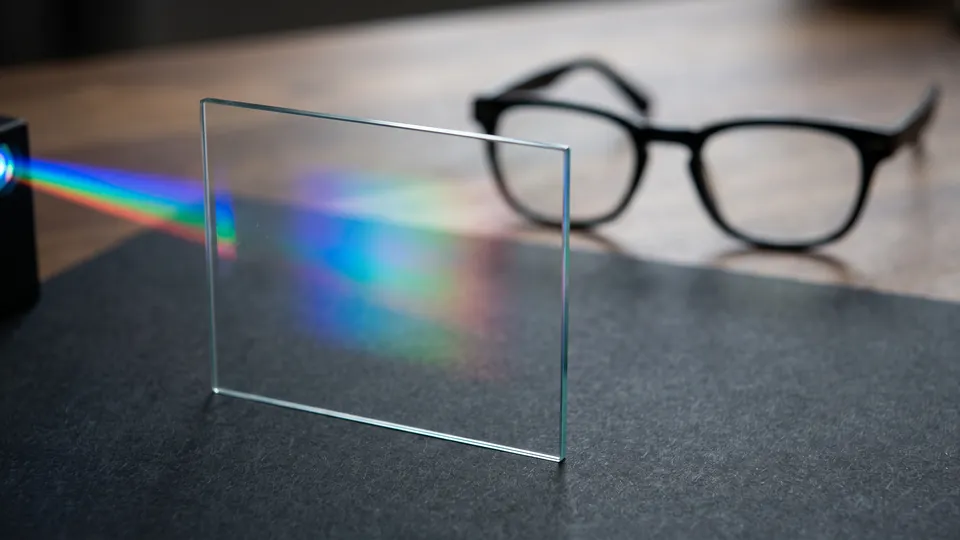
A waveguide is a thin, clear plate of glass or plastic that carries light from a tiny projector to your eye. Structures built into the plate send the light in, keep it traveling along the plate and let it out in front of your pupil, so text or graphics seem to float in your view while the lens stays see-through. Meta Ray-Ban Display, Even Realities G2, Rokid Glasses, the Vuzix Z100 and Snap Specs all use one.
This explainer is based on engineering papers, manufacturer documentation and the published specifications of the glasses it names, not on our own testing.
How light gets from the projector to your eye
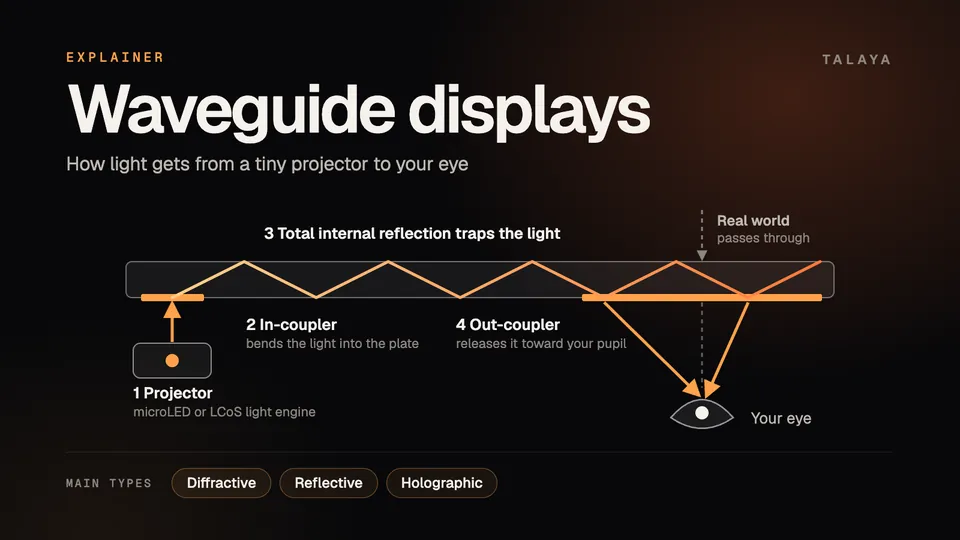
The steps are the same for every type of waveguide. What differs is how the light is bent in and out.
- A small projector, called a light engine, makes the image. Meta Reality Labs researchers list liquid crystal on silicon (LCoS), microLED, laser beam scanning and digital light projection as the usual choices. A microLED panel makes its own light, pixel by pixel. An LCoS panel is a reflective chip lit by a separate source.
- The light enters the plate at an in-coupler, a patch of microscopic gratings or a set of partial mirrors that bends it so it travels along the plate instead of through it.
- The plate traps the light. It bounces between the two faces by total internal reflection, which OptoFidelity, a company that makes test equipment for AR optics, describes as light hitting the surface at an angle that reflects it entirely rather than letting it escape.
- An out-coupler releases the light toward your eye. Many designs also copy the image across a larger area on the way, called pupil replication, so the picture stays visible as your eye moves.
- You see the image together with the real world, because the plate is clear. Even Realities lists 98% passthrough for the G2, meaning nearly all outside light reaches your eyes, as our Even Realities explainer notes.
The plate itself is clear, so the projector can be "hidden in the temple of the glasses while the user's view stays unobstructed," in OptoFidelity's words. The light also enters the plate collimated, which in practice means the image seems to sit out in front of you rather than on the lens. Even Realities says text on its first-generation G1 appears about 2 meters ahead.
Light engines: microLED and LCoS
The engines are small enough to hide in a temple. Rokid says its engine measures 0.15 cubic centimeters, and RayNeo puts the X3 Pro's at 0.36. Both microLED and LCoS appear in the table below, and Vuzix, which designs and makes waveguides for other companies, shows partner engines next to its own: full-color microLED from Rayprus, front-lit LCOS from Himax and a microLED projector from Hongshi. Our Vuzix guide has the details.
The three main types of waveguide
Researchers and manufacturers sort waveguides by how the in-coupler and out-coupler work. OptoFidelity's April 2024 overview uses three groups: diffractive, reflective and holographic. Meta's researchers describe two kinds of coupler: gratings in diffractive combiners and semi-reflective mirrors in geometric ones.
| Type | How it moves light | Strengths | Trade-offs | Examples named in the sources |
|---|---|---|---|---|
| Diffractive | Nanoscale gratings, imprinted or etched into a layer on the plate, diffract the light in and out. The most common form is the surface relief grating | Can be stamped onto glass or plastic with nanoimprint lithography. OptoFidelity cites Microsoft HoloLens and Magic Leap as examples | Colors spread apart inside the plate, which can show as color fringes at the image edge. Full color may need stacked plates or cost efficiency and field of view | Even Realities G2 (gratings etched into the waveguide); RayNeo iO (a diffractive waveguide lens, per RayNeo) |
| Reflective (geometric) | A stack of partly reflective mirrors, sliced to form the plate, passes the light through a series of reflections | The best color uniformity, and efficient because mirrors reflect every wavelength at once | Mirror coatings and alignment must be exact or sharpness suffers. Wider views and larger eye boxes need larger mirrors, so the plate can grow | Meta Ray-Ban Display ("geometric waveguide"); Lumus, per OptoFidelity |
| Holographic | Holographic optical elements are recorded inside the material as changes in its refractive index, often as volume holographic gratings | Made by exposing the material to interfering laser beams, a gentler process than stamping that allows roll-to-roll production | More complex to design and not widely adopted yet. Putting all colors in one plate lowers efficiency and field of view, as with diffractive | DigiLens, per OptoFidelity |
OptoFidelity cautions that the categories are loose: each type has subtypes, and some newer designs fit none of the three or combine them. Writing in April 2024, it called the question of which will dominate "still an open question," and it said the largest players showed all three at SPIE's 2024 conference.
The word holographic also turns up in marketing. Meta's post introducing Orion, its AR glasses prototype, talks about "large holographic displays." That describes what the wearer sees, not the waveguide type.
Waveguide glasses compared on what their makers publish
The figures below are the companies' own. The pages we read don't say how brightness was measured, apart from RayNeo's note that the iO's number applies at eye level.
| Glasses | Light engine | Color | Field of view | Brightness | What the maker says about the optics |
|---|---|---|---|---|---|
| Meta Ray-Ban Display | "Highly custom" engine, 600 by 600 pixels | Full color, right lens only | 20 degrees | Up to 5,000 nits | Meta says "geometric waveguide" and that only 2% of the light leaks outward |
| Even Realities G2 | Green microLED, 640 by 350 | One color, both lenses | 27.5 degrees | Up to 1,200 nits | Gratings etched into the waveguide; 98% passthrough |
| Rokid Glasses | Monochrome micro-LED, 480 by 400 per eye | One color, both lenses | 30 degrees | 1,500 nits | A waveguide in each lens |
| Vuzix Z100 | Monochrome green microLED, 640 by 480 | One color, right lens | 30 degrees | Not listed | A waveguide display; Vuzix makes its own waveguides |
| RayNeo iO | Green display, type not named | One color | 23.5 degrees | Up to 1,300 nits at eye level | A diffractive waveguide lens |
| RayNeo X3 Pro | Full-color MicroLED, 0.36 cubic centimeters | Full color, both lenses | Not listed | Up to 6,000 nits (3,500 average) | ChinaBiz Insider describes the X series as full-color etched waveguide optics |
| Snap Specs | LCoS | Full color | 51 degrees | Not listed | Waveguides with "billions of invisibly small nanostructures" |
Snap's 2024 developer Spectacles used LCoS projectors too, and Snap said its waveguides made it possible to see the image "without the need for lengthy calibrations or custom fittings."
Not every pair uses a waveguide
Screen glasses, the kind that plug into a phone or console, use a different design. The XREAL One Pro's flat "X-Prism" optics are thinner than the older birdbath lenses, our XREAL guide notes, and RayNeo's GT gets its 46-degree view from a birdbath optical engine. Our explainer on AI, AR and display glasses sorts the categories.
What waveguides cost you
Brightness
In the Meta Reality Labs paper, the researchers explain that the input power spreads over a larger space to give a large eye box, that part of the light never reaches the eye box, and that "brightness is the prominent bottleneck for waveguide combiners." That is the background to the nit figures in the table, which run from 1,200 for the G2 to 6,000 for the X3 Pro. Meta says the Display's 5,000 nits, together with its Transitions lenses and automatic brightness, is meant to keep it readable on sunny days.
Color and rainbow artifacts
Red, green and blue diverge inside a diffractive waveguide, so each color can appear slightly offset. OptoFidelity says that may be noticeable only at the very edge of the image, and it rates reflective waveguides best for color. A September 2024 research preprint on arXiv describes "conspicuous rainbow artifacts" as a limit of traditional high-index glass diffractive waveguides in full-color displays. Its authors propose silicon carbide, a material with a high refractive index. Their prototype weighed 2.7 grams, measured 0.55 millimeters thick and showed a 30-degree view. It was a research sample and isn't on sale.
Full color is harder than one color. OptoFidelity says putting all colors through one plate can cut efficiency and field of view compared with a separate plate for each color. Most of the display glasses in the table show a single color and cost $499 to $699, counting the Z100 at its launch price. The full-color pairs, Meta Ray-Ban Display, the RayNeo X3 Pro and Snap Specs, start at $799. The makers don't say why they chose one color, so read the pattern as an observation only.
Field of view
A wide view is hard to get from a plate this thin. OptoFidelity says simple binary gratings can be less efficient at the edges of the view, especially at larger sizes, and that reflective designs need larger mirrors for a bigger view and eye box, which can enlarge the plate. The glance-style display glasses in the table publish 20 to 30 degrees, and Snap Specs publish 51. Our field of view explainer turns those degrees into screen sizes.
Eye box and fit
The eye box is the zone where your pupil can sit and still see the whole image. Meta's researchers list a large eye box, produced by pupil replication, as one advantage of waveguide combiners over other architectures. By comparison, XREAL's One Pro, a prism design, comes in two sizes for different eye spacings, 57 to 66 millimeters and 66 to 75.
Light that leaks out
Light can also escape toward the people in front of you. Meta says only 2% of the Ray-Ban Display's light leaks outward, so people near you shouldn't be able to read the screen. Even Realities says the G2's lenses carry more than 100 layers of coating to cut reflections that people around you might notice.
Prescriptions
The waveguide sits where a prescription lens would normally go, so makers handle correction in different ways. Meta bonds the lens to the Ray-Ban Display's waveguide, from -4.00 to +4.00 total power in single vision only, and you can't swap it later. Even Realities etches custom lenses from -12.00 to +12.00 and bonds them to the display instead of stacking a lens behind it. Snap uses removable inserts, and the Vuzix Z100 takes prescription inserts. Our prescription guide lists each brand's range.
Price
OptoFidelity calls price "the biggest issue" for every waveguide type: the tools, processes and materials are expensive, which it says is why AR displays stay costly. The companies' pages we read don't say what their waveguides cost to make. For context, Meta Ray-Ban Display costs $799 with its Neural Band, Even Realities G2 $599 and Snap Specs $2,195, against $449 for Ray-Ban Meta Gen 3, which has no display.
What to check on a spec sheet
Check whether the field of view is diagonal, where the maker measured brightness, whether the image is one color or full color and reaches one lens or both, how much outside light passes through (Even says 98%) and how much display light leaks out (Meta says 2%), and whether the prescription is built in or added as an insert.
For the models themselves, see our guides to Meta Ray-Ban Display, Even Realities, Rokid, Vuzix, RayNeo and Snap Specs.
Frequently asked questions
What is a waveguide display?
A waveguide display uses a flat, clear plate of glass or plastic to carry light from a tiny projector to your eye. Structures in the plate send the image in, trap it by total internal reflection and release it in front of your pupil, so graphics appear while you still see through the lens.
What is the difference between diffractive and reflective waveguides?
Diffractive waveguides move light in and out with microscopic gratings. Reflective waveguides, which Meta's researchers call geometric, use stacked partly reflective mirrors. Meta says Meta Ray-Ban Display has a geometric waveguide, and Even Realities describes gratings etched into the G2's waveguide.
Can other people see what's on a waveguide display?
The makers say they shouldn't. Meta says only 2% of the Ray-Ban Display's light leaks outward, and Even Realities says the G2's lenses carry more than 100 layers of coating to cut reflections that people around you might notice. Both are the companies' own claims.
Do all smart glasses with a display use a waveguide?
No. Screen glasses that plug into a phone, such as the XREAL One Pro, use prism optics, and RayNeo's GT is built on a birdbath optical engine. Our explainer on AI, AR and display glasses sorts the categories.
Can you get prescription lenses with waveguide glasses?
Yes, but each maker does it differently. Meta bonds the prescription into the Ray-Ban Display's lens, from -4.00 to +4.00 total power. Even Realities makes custom lenses from -12.00 to +12.00 and bonds them to the display, and Snap uses removable inserts. Our prescription guide compares them.
Sources
- OptoFidelity: Comparing and contrasting different waveguide technologies: diffractive, reflective, and holographic waveguides (Apr. 8, 2024)
- Meta Reality Labs researchers: Theoretical efficiency limit of diffractive input couplers in augmented reality waveguides (arXiv, Jan. 2024)
- arXiv preprint: Ultra-thin, ultra-light, rainbow-free AR glasses based on single-layer full-color SiC diffractive waveguide (Sept. 2024)
- Meta blog: Meta Ray-Ban Display, breakthrough AI glasses available now
- Snap Newsroom: Introducing new Spectacles and Snap OS (Sept. 17, 2024)
- Meta: Introducing Orion, our first true augmented reality glasses (Sept. 25, 2024)
- ChinaBiz Insider: China's smart glasses war reshapes as Alibaba's Qianwen and Xiaomi crack the top five (June 23, 2026)
Join the conversation
Questions, or something to add? Talk about it with other smart glasses owners in r/Talaya, our community on Reddit.