Smart Glasses · Guide
Rokid glasses explained: price, specs, US availability and the full lineup
Rokid sells AI glasses with a camera and a small display in each lens, a display-free Style model and older AR glasses for gaming and video. On Oct. 27 it also launched Glasses 2, the full-color Rokid Color and the Rokid Ring, priced so far only in yuan. Here is what each does, what it costs, where US buyers can get it and how the Kickstarter launch fits in.
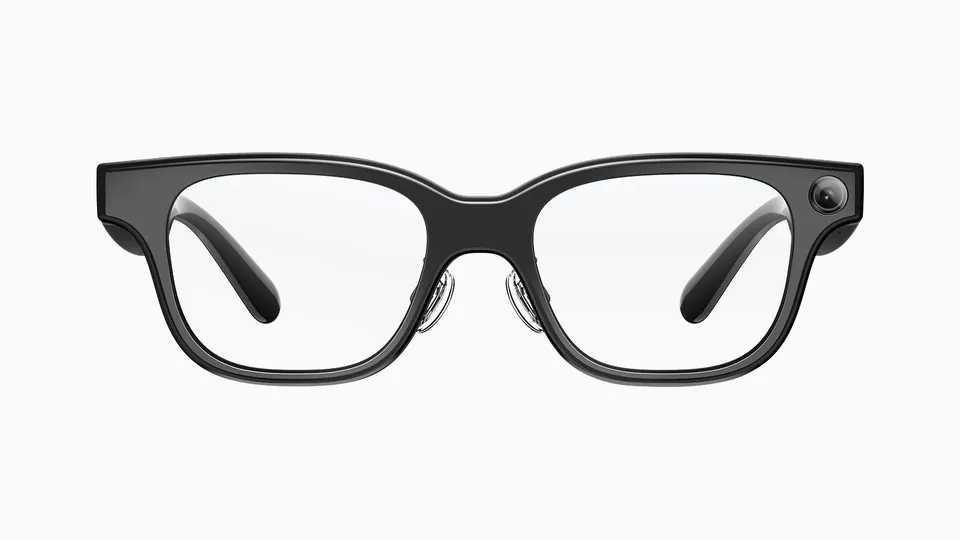
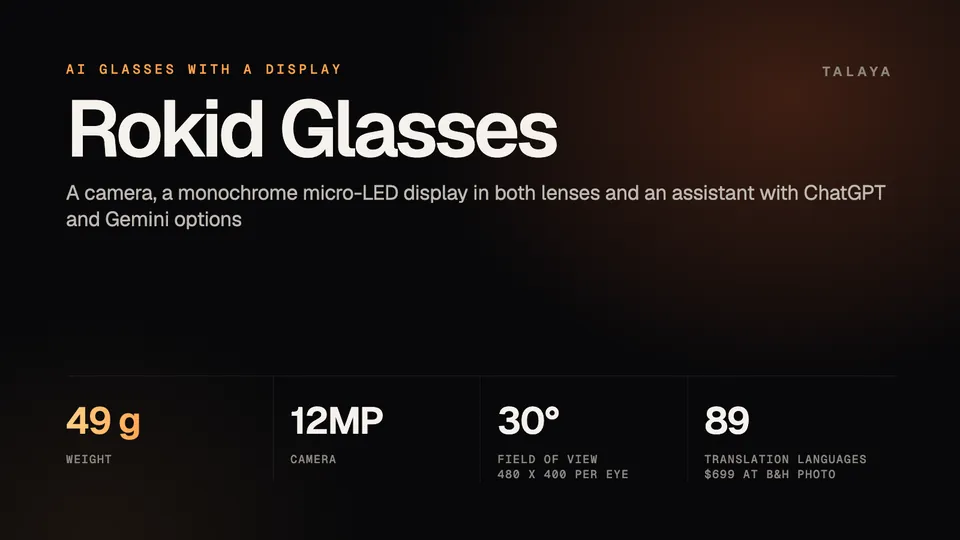
Rokid Glasses have a 12MP camera and a small monochrome display in each lens, weigh 49 grams and cost $699 at B&H Photo in the US. Rokid AI Glasses Style, introduced at CES in January 2026, keeps the camera and drops the display, weighs 38.5 grams and has a regular price of $399. Rokid also sells older AR glasses for gaming, entertainment and productivity, including the Max 2 and the AR Spatial. On Oct. 27, 2026, it added Rokid Glasses 2, the full-color Rokid Color and the Rokid Ring, all priced in yuan so far.
This guide is based on Rokid's own pages and press releases. B&H Photo's listing supplies the US price and the specifications Rokid's pages don't give, and we name the outlet wherever a fact comes only from news coverage. That includes the three Oct. 27 products: we found no Rokid page for them, so they rest on launch reports from BigGo, Tech Insider, 36Kr and Economic Observer. The US and older-product prices are as of Oct. 25, 2026. We haven't tested the glasses.
Rokid's lineup at a glance
| Product | What it is | Weight | Listed price |
|---|---|---|---|
| Rokid Glasses (with display) | AI glasses with a camera and a display in both lenses | 49 grams | $699 at B&H Photo in the US; $619 on Rokid's international store |
| Rokid AI Glasses Style | AI glasses with a camera and no display | 38.5 grams | $399 regular; $299 event price on Rokid's fall sale page |
| Rokid Max 2 | AR glasses Rokid describes as made for gaming, entertainment and productivity | Not listed | $399 regular; $249 on sale |
| Rokid AR Spatial | Rokid's spatial computing setup, which it describes as made for multitasking and immersive experiences | Not listed | $549 regular; $399 on sale |
| Rokid Glasses 2 | Next generation of Rokid's AI glasses, launched Oct. 27 | Not reported | From 3,699 yuan; no US price reported |
| Rokid Color | Rokid's first full-color AI glasses, launched Oct. 27 | 55 grams, excluding the nose pad | 4,999 yuan for the black 2GB + 64GB model, 5,499 yuan for the tortoiseshell 4GB + 64GB model; shipments expected from April 2027 |
| Rokid Ring | Interaction ring, launched Oct. 27 | Not reported | From 1,699 yuan; no US price reported |
Rokid's fall sale page lists the Max 2 and AR Spatial at $429 and $558 regular, with event prices of $279 and $449 that include a free gift bag, so the regular prices differ by a few dollars between Rokid's own pages. Its glasses collection also lists a Rokid AR Joy 2 at $499, and we found no specification page for it that we could read.
Glasses 2, Rokid Color and Rokid Ring
Rokid launched the three products on Oct. 27 at an event themed "Smarter, More Colorful," according to BigGo. The prices below are in yuan, as reported by 36Kr and Economic Observer. Rokid hasn't published a page for them that we could confirm, no source gives a US price or a list of countries, and BigGo's dollar figures are its own conversions.
- Rokid Glasses 2 starts at 3,699 yuan. BigGo reports a 263mAh battery, up 25% from the previous generation, with overall endurance up 50%, a 12-megapixel camera that records 4K at 30 frames per second or 2K at 60, and AI call translation in 89 languages. No source gives a ship date.
- Rokid Color is the company's first full-color AI glasses, according to Tech Insider. It weighs 55 grams without the nose pad and uses a 0.16cc Micro-LED full-color optical engine, per Economic Observer. The black 2GB + 64GB model costs 4,999 yuan and the tortoiseshell 4GB + 64GB model 5,499 yuan. Shipments are expected from April 2027, according to BigGo and Economic Observer. The sources give no battery life, brightness or outdoor-visibility figures.
- Rokid Ring starts at 1,699 yuan. BigGo reports on-device gesture recognition with accuracy above 95%, aimed at 97% to 98% at launch, plus heart rate, body temperature, blood oxygen and sleep monitoring.
BigGo says CEO Zhu Mingming called the launch AI glasses' "iPhone 1 moment," while 36Kr attributes the line to the company. The specs and prices for the 49-gram Rokid Glasses below don't apply to any of the new products.
Rokid Glasses: the specifications
| Spec | Rokid Glasses |
|---|---|
| Display | Two monochrome micro-LED displays, 480 by 400 pixels per eye, 60Hz |
| Field of view | 30 degrees |
| Brightness | 1,500 nits with 10 dimming levels, according to Rokid |
| Camera | 12MP photos, 1680P video at 30 frames per second, low-light HDR |
| Weight | 49 grams |
| Battery | Up to 12 hours (B&H); all day under moderate use and six hours of Bluetooth music (Rokid) |
| Water resistance | IPX4 |
| Connectivity | Wi-Fi 6, Bluetooth 5.3 |
| Audio | Four-microphone array and a speaker in each temple |
| Frame | TR90 plastic with titanium hinges; temple length 155.5 mm, lens width 49 mm |
| Translation | 89 languages |
The resolution, refresh rate, field of view, water rating, connectivity, battery hours and translation languages come from B&H Photo's listing, where the model is catalogued as the RV101. The brightness, camera, weight, frame and audio details come from Rokid's product page and its store listing. B&H's table leaves brightness blank, so the 1,500-nit figure is Rokid's own claim.
What the display and camera do
Each lens has a micro-LED projector and a waveguide that puts text and simple graphics in your view. Rokid says the engine measures 0.15 cubic centimeters, which it calls the world's smallest, and reaches 1,500 nits, with 10 dimming levels. B&H's table gives 480 by 400 pixels per eye across a 30-degree field of view. On the published figures, 30 degrees is wider than Meta Ray-Ban Display's 20 degrees and a little wider than the Even G2's 27.5, and like the G2, Rokid shows its image in both lenses.
The camera sits on the front of the frame. You can say "Hi Rokid, take a photo" or "Hi Rokid, record a video," or press the button on the frame: a short press takes a photo and a long press records video. Rokid lists three aspect ratios, a low-light HDR mode and video at 1680P and 30 frames per second. B&H's listing says a privacy indicator lets others know when the camera is active, and our guide to smart glasses and privacy covers why bystanders can miss those lights.
The AI assistant, translation and apps
You wake the assistant by saying "Hi Rokid." B&H's listing says it can draw on ChatGPT or Google's Gemini, and Tech Times reported in March that Rokid is among the first makers in the category to support both. Answers appear as text in the display. B&H says you can ask about what you're looking at, such as signs, labels, landmarks and menus, and Rokid says you can ask the assistant to take a photo to identify what you're seeing and then follow up with more questions.
Translation is the feature Rokid leads with. It shows live subtitles in the lenses, works in both directions in a face-to-face conversation and covers 89 languages, according to B&H and Tech Times. B&H adds one limit: on Pixel phones with Google's Tensor chips, the offline translation model can't be downloaded, though online translation works.
Rokid lists several other tools. An "invisible teleprompter" shows your script in the lens, and audio transcription adds speaker identification and summaries. Voice notes and hands-free calls are built in, and according to B&H you answer a call with a nod and end it with a shake of the head. For navigation, you say "Hi Rokid, navigate to..." and the route shows in your view, though Rokid notes that full access requires a subscription.
The Rokid app connects the glasses to your phone and manages translation, navigation, calls, notes and device settings. Rokid's pages we read don't list supported phone models or software versions.
Battery and prescription lenses
B&H lists up to 12 hours of battery life. Rokid's own page says one charge covers all-day use under moderate use, lets you keep using the glasses while charging and rates continuous Bluetooth music at six hours. Rokid's store lists a charging case and a Power Capsule as battery accessories, and the glasses charge through a magnetic port.
For prescriptions, Rokid sells an official magnetic prescription lens frame separately. B&H lists it as the RLL01. You take the frame to one of Rokid's partnered online optical providers or to a local optician to have lenses fitted. Rokid's pages we read give no supported prescription range for the display model, so ask the optician before you order. For Style, Rokid says its global online prescription service covers myopia, astigmatism, presbyopia, progressive lenses and other lens options. Our guide to prescription smart glasses compares the published ranges of other brands.
Price and US availability
B&H Photo, an authorized dealer, listed the Rokid AI/AR Glasses with Display at $699 and in stock on Oct. 25. Rokid also sells through its own international store, where a listing labeled for the EU showed $619 and the collection page gave a $739 regular price. Rokid runs frequent promotions and region-specific listings, and the pages we read don't give a single US list price for the display model, so what you pay depends on the store and the day. Rokid's store terms, shown on its Max 2 page, add a 30-day return window and a one-year limited warranty on eligible glasses, with free standard shipping on US orders over $60.
Reports of the Oct. 27 launch give prices for Glasses 2, Rokid Color and the Rokid Ring only in yuan, with no US price and no list of countries.
Style has wider distribution. Rokid said on Feb. 2 that it is available through its website, Amazon US, Amazon DE and regional partners, and that it had sold more than 15,000 units. Rokid is also targeting US optical retailers. At Vision Expo 2026 in Orlando in March, Tech Times reported, Rokid's global general manager Zoro Shao said: "Our focus on bringing Rokid innovations to U.S. store shelves remains strong."
Rokid's timeline from Kickstarter to US retail
Rokid, which says it was founded in 2014, launched Rokid Glasses on Kickstarter in the fall of 2025.
- Fall 2025: the Kickstarter campaign launches, and Rokid says it became the number one XR project on the platform.
- Nov. 20, 2025: new pre-orders move from Kickstarter to Rokid's own website, with different prices and offers than during the campaign.
- Nov. 21, 2025: Rokid reports that the campaign closed at $4,028,111 from more than 5,800 backers in more than 80 countries, and that its crowdfunding total, including Taiwan, passed $5.5 million.
- January 2026: Rokid introduces Style at CES.
- Feb. 2, 2026: Rokid says Style is available worldwide and has sold more than 15,000 units, and plans offline retail with partners in Japan by the end of February.
- March 2026: Rokid sets out its US retail plans at Vision Expo.
- Oct. 27, 2026: Rokid launches Glasses 2, Rokid Color and the Rokid Ring, according to launch reports.
Rokid AI Glasses Style
Style is the simpler, lighter pair. Rokid says it weighs 38.5 grams and describes it as voice-first, with a camera, open-ear audio and an AI assistant that works with several platforms, including ChatGPT and DeepSeek according to Rokid's news page. It has no display, so answers and translations reach you by voice. At $399 regular it costs $300 less than the display model at B&H, and Rokid lists it on Amazon US. Rokid's Feb. 2 release gives no battery rating for it.
Rokid Max 2, AR Spatial and AR Joy 2
Rokid's older line is built around gaming, entertainment and productivity. Rokid describes the Max 2 AR Glasses that way and calls them the world's first with built-in myopia and pupillary distance adjustment, covering 0.00D to -6.00D of myopia. In its section on the AR Spatial, the Max 2 page lists 8GB of RAM, 128GB of storage, Wi-Fi 6, Bluetooth 5.2 and a 5,000mAh battery with 18W charging, along with a spatial browser called YodaOS-Master. Rokid's fall sale gives Max 2 buyers a gift bag that includes a Station. For how the screen-glasses market compares, see our guides to XREAL vs Viture and RayNeo's lineup.
How Rokid compares with Meta Ray-Ban Display and Even G2
| Rokid Glasses | Even Realities G2 | Meta Ray-Ban Display | |
|---|---|---|---|
| Price | $699 at B&H | $599 | $799 with Neural Band |
| Display | Monochrome, both lenses | Green, both lenses | Full color, right lens |
| Field of view | 30 degrees | 27.5 degrees | 20 degrees |
| Camera | 12MP | None | 12MP |
| Weight | 49 grams | 36 grams | 69 grams |
Rokid is the only one of the three with a camera and a display in both lenses. It sits between the other two on weight and price. Our Even G2 vs Meta Ray-Ban Display comparison goes through those two in detail, and our best smart glasses guide and explainer on AI, AR and display glasses show where all of them fit.
Who Rokid's glasses suit
On specs, the display model fits people who want a camera and a two-lens display in a 49-gram frame, translation across many languages and a choice of assistant. Style fits people who want a lighter camera pair without a screen. Rokid Color is the one to watch for full-color images, but with shipments expected from April 2027 and no US price, it isn't something US buyers can plan around yet. Before you buy, note what Rokid's pages leave open: no supported prescription range, no list of compatible phones, a subscription for full navigation access and prices that vary by store. Comfort and display readability are things a spec sheet can't settle.
Frequently asked questions
How much do Rokid Glasses cost in the US?
B&H Photo, an authorized dealer, listed the display model at $699 and in stock on Oct. 25, 2026. Rokid's international store showed $619 for an edition labeled for the EU, and Rokid runs frequent promotions, so the price depends on the store and the day.
Do Rokid Glasses have a camera?
Yes, a 12MP camera that records 1680P video at 30 frames per second, according to Rokid. B&H's listing says a privacy indicator lets others know when the camera is active. Rokid AI Glasses Style has a camera too.
Do Rokid Glasses work with ChatGPT and Gemini?
B&H's listing says the assistant can use either ChatGPT or Google's Gemini, and Tech Times reported in March that Rokid is among the first AI glasses makers to support both.
What is the difference between Rokid Glasses and Rokid AI Glasses Style?
Style has no display, weighs 38.5 grams instead of 49 and has a regular price of $399 against $699 at B&H for the display model. Both have cameras and an AI assistant.
Can I use prescription lenses with Rokid Glasses?
Yes. Rokid sells an official magnetic prescription frame separately, and lenses come from its partner online opticians or a local optical store. Rokid's pages we read don't give a supported prescription range for the display model.
Were Rokid Glasses on Kickstarter?
Yes. The 2025 campaign closed at $4,028,111 from more than 5,800 backers in more than 80 countries, Rokid said on Nov. 21, 2025. New pre-orders moved to Rokid's website on Nov. 20, 2025.
Sources
- Rokid: Rokid Glasses product page
- Rokid Store: Rokid Glasses (Display Smart Glasses)
- Rokid: Glasses collection (read Oct. 25, 2026)
- Rokid: Fall Sale 2026 (read Oct. 25, 2026)
- Rokid: Rokid Max 2 AR Glasses (read Oct. 25, 2026)
- Rokid: News
- Rokid: Rokid surpasses $4 million on Kickstarter, announces transition to official website pre-orders (Nov. 21, 2025)
- Rokid: Rokid Ai Glasses Style now available worldwide, surpassing 15,000 units sold (Feb. 2, 2026)
- B&H Photo: Rokid AI/AR Glasses with Display (RV101), price and specifications (read Oct. 25, 2026)
- BigGo Finance: Rokid launches Glasses 2, Rokid Color and Rokid Ring (Oct. 28, 2026)
- Tech Insider: Rokid Color full-color AI glasses, 4,999 yuan, 55 grams (Oct. 28, 2026)
- 36Kr: Rokid launches three new products (Oct. 28, 2026)
- Economic Observer (eeo.com.cn): Rokid launch report, in Chinese (Oct. 27, 2026)
- Tech Times: Smart glasses go mainstream, Rokid makes its US retail push at Vision Expo 2026 (Mar. 19, 2026)
Join the conversation
Questions, or something to add? Talk about it with other smart glasses owners in r/Talaya, our community on Reddit.