Smart Glasses · Guide
Even Realities G2 vs Meta Ray-Ban Display: price, display, controls and battery compared
The Even G2 is a camera-free pair of display glasses for $599. Meta Ray-Ban Display costs $799 with a camera, a full-color screen and a wristband. Here is how they compare on price, display, controls, battery, prescriptions and privacy.

The Even Realities G2 and Meta Ray-Ban Display both put a screen in the lens, and they differ on almost everything else. The G2 costs $599, weighs 36 grams, has no camera and is rated for up to two days of battery. Meta Ray-Ban Display costs $799 with its Neural Band wristband, weighs 69 grams, has a 12MP camera and a full-color screen, and is rated for up to six hours.
This comparison is based on Even Realities' and Meta's published specifications, store pages and help articles, with prices as of Oct. 25, 2026. We haven't tested either pair. Our guides to the Even G2 and the Meta Ray-Ban Display have the full specifications for each.
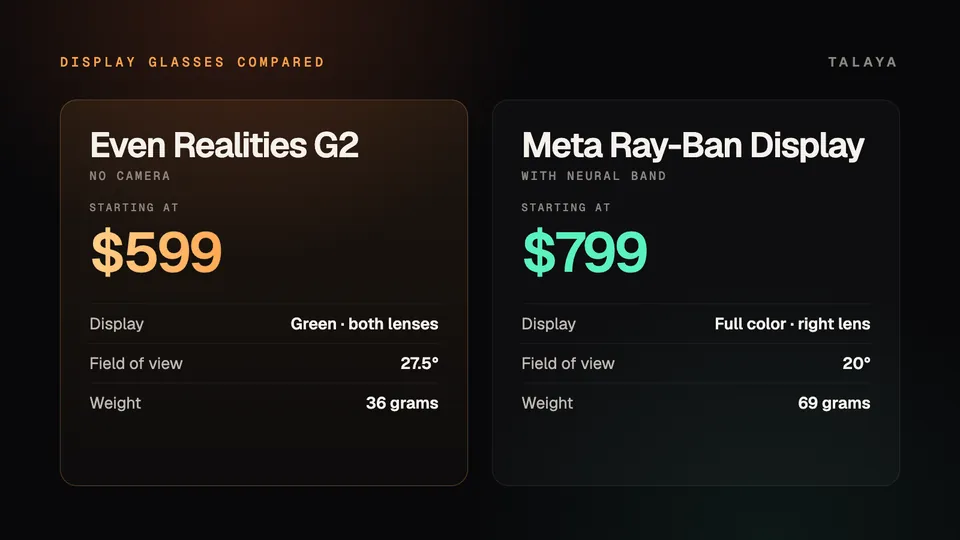
Even G2 vs Meta Ray-Ban Display at a glance
| Even Realities G2 | Meta Ray-Ban Display | |
|---|---|---|
| US price | $599 (G2 A or G2 B), plus $249 for the optional R1 ring | $799, Neural Band included |
| Display | Green micro LED, both lenses | Full color, right lens only |
| Resolution | 640 by 350 | 600 by 600 |
| Field of view | 27.5 degrees | 20 degrees |
| Brightness | Up to 1,200 nits | Up to 5,000 nits |
| Camera | None | 12MP, 3x zoom |
| Controls | Temple touch areas, app, optional R1 ring | Neural Band, touchpad on the right arm, voice |
| Weight | 36 grams | 69 grams (68 standard, 70 large) |
| Battery | Up to two days; case holds seven full charges | Up to six hours; case adds up to 24 hours |
| Water and dust | IP65 | No rating published for the glasses; the band is IPX7 |
| Prescription | -12.00 to +12.00, bonded to the display | -4.00 to +4.00, single vision, ordered with the glasses |
| Phones | iPhone and Android | iPhone and Android, through the Meta AI app |
| Sold in | US, Canada, UK, much of Europe and several other markets | US, UK, Canada, France, Italy, Germany |
Figures come from Even Realities' G2 page and store, Meta's announcement and Ray-Ban's specification sheet.
The display: green text in both lenses, or full color in one
The G2 shows monochrome green text and simple graphics in both lenses. Even Realities describes a layered heads-up display, with quick prompts and notifications in front and items such as navigation farther back, 9to5Google reported at launch. The panel is 640 by 350 pixels across 27.5 degrees and reaches up to 1,200 nits. Even Realities also lists 98% passthrough, meaning nearly all light reaches your eyes, so the glasses work as everyday eyewear.
Meta's screen is full color but sits in the right lens only. It is 600 by 600 pixels across a 20-degree field of view, which Meta says works out to 42 pixels per degree, and it reaches up to 5,000 nits. Meta describes it as a display for short interactions: it sits slightly off to the side of your view and disappears a few seconds after you stop using it. Meta says only 2% of the light leaks outward, so people nearby shouldn't be able to read it. Because only one eye sees the screen, Meta's buying FAQ framed the in-store demo as a way to confirm you're "comfortable using a monocular display."
The numbers alone don't settle which screen reads better. Meta publishes a pixels-per-degree figure that we haven't seen Even Realities match, and readability outdoors depends on the lens and the light. On paper, the G2 has a wider view and an image in both eyes. The Display has color, more pixels in the one lens that carries them (360,000 against 224,000 per lens) and a much higher brightness rating.
Controls: the R1 ring against the Neural Band
Even Realities' R1 is a ring that costs $249. You tap, scroll and control the glasses with your thumb, and Even Realities calls the setup TriSync, with the glasses, phone and ring staying connected. The ring also tracks health data: Even's support center lists sensors for blood oxygen, heart rate, heart rate variability and sleep, plus activity and body temperature trends. It has a ceramic exterior and a stainless steel inner surface, comes in sizes 6 to 15 and is rated IP68. Even says a full charge typically lasts three to four days, and charging takes 20 to 90 minutes on a magnetic wireless charger that costs $49.
Meta's Neural Band is a wristband that reads the electrical signals your wrist muscles make when you move your fingers. Tapping your index finger and thumb together selects, tapping your middle finger and thumb goes back, and swiping your thumb along your index finger scrolls. The band also powers neural handwriting, which lets you write replies with a finger on any surface. It comes in the box in three sizes, lasts up to 18 hours and is rated IPX7. Our Neural Band explainer lists every gesture.
Neither accessory is mandatory. The G2 also takes input from touch areas on the temples and from the app, and the Display has a touchpad on the right arm and voice control, although Meta says the band is needed for neural handwriting. With the ring, the G2 comes to $848, which is $49 more than the Display with its band.
Camera and AI features
The biggest practical difference is the camera. Meta Ray-Ban Display has a 12MP camera with 3x zoom, and its screen doubles as a viewfinder, so you can frame a photo before you take it and preview it before you share it. Meta lists video at 1,440 by 1,920 pixels at 30 frames per second. The G2 has no camera. Even Realities presents that as a privacy choice, and it means the G2's assistant answers your voice but can't see what you're looking at.
The G2 is built around speech and text. Its Conversate feature lets you write prep notes before a meeting and keep them in view, shows AI cues when an unfamiliar name or reference comes up, and gives you a transcript and an AI summary afterward. Translate shows real-time translations in 35 languages, Teleprompt is a voice-controlled teleprompter, and the dashboard shows your calendar, reminders and notifications. Navigate works wherever Google Maps does. The Even Hub adds apps from other developers, and Even Realities publishes an SDK for G2 plugins.
Meta Ray-Ban Display leans on Meta's apps. You can read and reply to WhatsApp, Messenger, Instagram and phone messages, including with neural handwriting, and take WhatsApp and Messenger video calls that show the other person what you see. Walking directions with a map in the lens now cover every US city. Live captions show speech directed at you, and Meta says real-time translation covers 20 languages. In the US, a July 2026 update moved Meta AI to Meta's Muse Spark models. There is also a teleprompter, a calendar app that links to Google Calendar and Outlook, and music controls. Several features are limited to the US or to English, and some are still rolling out, as our Display guide details.
Battery, weight and durability
Battery is where the two differ most. Even Realities rates the G2 at up to two days, and its charging case holds seven full charges. Meta rates the Display at up to six hours of mixed use, with up to 24 more hours in its folding case, and the Neural Band has its own 18-hour battery and charger. Both are ceilings from the companies, and Meta doesn't say what its "mixed use" covers, as our Display battery guide explains.
The G2 weighs 36 grams and comes in two frame styles, G2 A and G2 B. The Display weighs 69 grams by Meta's figure (Ray-Ban lists 68 grams for the standard frame and 70 for the large) and comes in one style, in Shiny Black or Shiny Sand. Even Realities rates the G2 IP65 for dust and water, while neither Meta's announcements nor Ray-Ban's spec sheet gives a water rating for the Display glasses themselves.
Prescription lenses
Even Realities makes custom G2 lenses from -12.00 to +12.00, each etched to match your prescription and bonded to the display. Its website handles standard distance prescriptions, while progressive and prism prescriptions go through partner retail stores, according to its support center. Reading-only lenses aren't offered online. In Even's US store, G2 glasses with prescription lenses can be paid for with an HSA or FSA card.
Meta Ray-Ban Display takes single-vision prescriptions from -4.00 to +4.00 total power (sphere plus cylinder), with up to 4.00 of cylinder, and progressive lenses aren't compatible. The prescription is built into the display lens, so you order it with the glasses, wait five to eight weeks and place a new order if your prescription changes. Meta's October 2025 buying FAQ listed it as a $200 add-on in the US, for $999 in total, so check the price at checkout.
If your prescription falls outside Meta's range or you need progressives, the G2 is the only one of the two with a published route. Our Display prescription guide and our guide to prescription smart glasses cover ordering in more detail.
Apps and phones
The G2 and R1 connect to iPhone and Android phones over Bluetooth through the Even Realities app, and third-party apps come through the Even Hub. Meta Ray-Ban Display needs the Meta AI app on an iPhone or Android phone and a Meta account. Its apps are mostly Meta's own plus partners such as Spotify and Google Calendar, and a few depend on your phone: Apple Music, for example, works only on iPhone.
Where each is sold
Even Realities sells the G2 through its own store. Its shipping policy lists the US, Canada, the UK, much of Europe, Japan, Singapore, the United Arab Emirates, Hong Kong, Macao, Australia and New Zealand, with $15 shipping in each region. Customs and duties on international orders are the buyer's responsibility. The company also works through opticians for fitting.
Meta sells the Display in six countries: the US ($799), the UK (£749), Canada (CA$1,149) and France, Italy and Germany (€899). Online ordering opened on Sept. 23, 2026, in the US, UK and Canada and on Oct. 13 in France, Italy and Germany, and select stores let you try the glasses first. Our guides to Display pricing and release dates go through each market.
Privacy
The G2 can't take photos or video of the people around you. It does have four microphones, and Conversate transcribes conversations. Even Realities says no data is stored in the cloud without your explicit consent and that processing is encrypted, with sensitive personal information removed.
Meta Ray-Ban Display has the same white capture LED on the front as Meta's other camera glasses, which blinks when you take photos or record video. Our guides to smart glasses and privacy and recording lights cover what the light does and doesn't tell bystanders. A camera-free pair can still fall under a venue's rules. New York's courts, for example, exclude eyewear with cameras or microphones, according to our best smart glasses guide.
Who each suits, going by the specs
The G2 fits people who want information in the lens without a camera on their face. It is the lighter pair, has the longer battery rating and the wider prescription range, and costs $200 less without the ring. Its green, text-first display lines up with notes, a teleprompter, captions and translation.
Meta Ray-Ban Display fits people who want photos and video with a viewfinder, a full-color screen, Meta's messaging and video-calling apps and wristband control, and who can live with six hours of battery, one frame style, 69 grams and a narrow prescription range. It is sold in six countries.
A spec sheet can't settle comfort over a full day or how readable each screen is in sunlight, and Meta runs in-person demos of the Display for that reason. If you want a camera and a display in both lenses, Rokid Glasses are a third option. Our best smart glasses guide and explainer on AI, AR and display glasses show where both fit.
Frequently asked questions
Is the Even G2 cheaper than Meta Ray-Ban Display?
Yes, by $200: $599 against $799 on Oct. 25, 2026. Add Even's $249 R1 ring and the G2 comes to $848, which is $49 more than the Display, whose price includes the Neural Band.
Can I use the Even G2 without the R1 ring?
Yes. The G2 also takes input from touch areas on the temples and from the Even Realities app, and the $249 ring is optional.
Does Meta Ray-Ban Display work without the Neural Band?
Yes. It has a touchpad on the right arm and answers to "Hey Meta," although Meta says the band is needed for features such as neural handwriting. The band comes in the box.
Which has the wider field of view?
The G2, at 27.5 degrees against 20 degrees for the Display. The G2 also shows its image in both lenses, while the Display's screen sits in the right lens only.
Do both work with iPhone and Android?
Yes. The G2 and R1 connect to iOS and Android phones over Bluetooth, and Meta Ray-Ban Display needs the Meta AI app on an iPhone or Android phone plus a Meta account.
Which is better for people who wear glasses?
On published ranges, the G2: lenses from -12.00 to +12.00, against -4.00 to +4.00 for the Display, which takes single-vision lenses only. See our prescription guide for how each is ordered.
Sources
- Even Realities: Even G2 product page and specifications
- Even Realities: Store (prices and availability, Oct. 25, 2026)
- Even Realities Support: Specs, Even R1 (read Oct. 25, 2026)
- Even Realities Support: Shipping policy (read Oct. 25, 2026)
- Even Realities Support: Supported prescription types for online and offline purchase
- 9to5Google: Even Realities G2 smart glasses bring a spatial display and R1 controller ring (Nov. 12, 2025)
- Meta: Meta Ray-Ban Display, AI glasses with an EMG wristband (Sept. 17, 2025)
- Meta blog: Making Meta Ray-Ban Display more useful to more people (Sept. 23, 2026)
- Meta blog: Meta Ray-Ban Display, how to buy and why (Oct. 2025)
- Meta Help Center: About battery life on Meta Ray-Ban Display and Meta Neural Band
- Ray-Ban: Meta Ray-Ban Display product details
Join the conversation
Questions, or something to add? Talk about it with other smart glasses owners in r/Talaya, our community on Reddit.