Smart Glasses · Guide
Apple Vision Pro in 2026: price, specs, visionOS 27 and where it's sold
Apple sells one Vision Pro, the M5 model from October 2025, and since June it starts at $3,699. Here is what it costs, what's inside, what visionOS 27 adds, where you can buy it and what Apple is reportedly planning next.
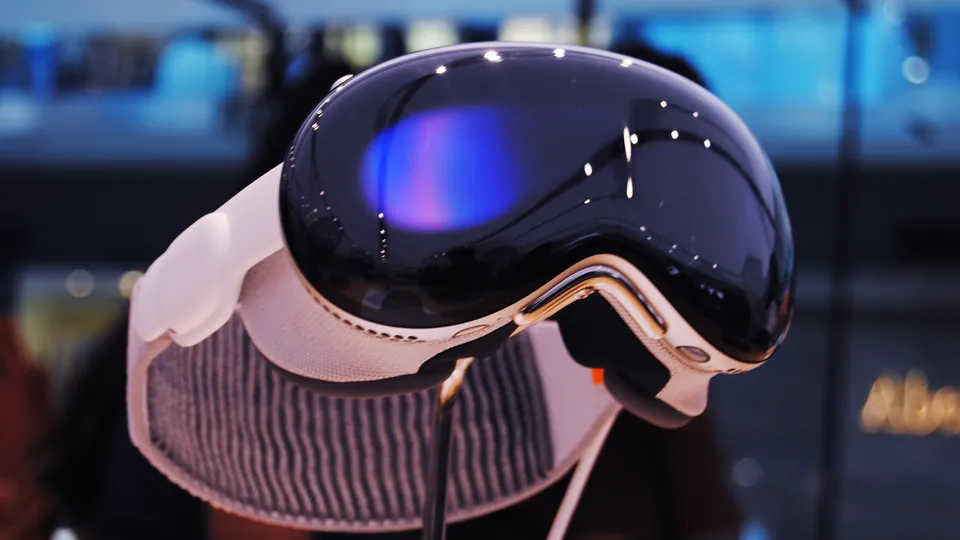
There is one Apple Vision Pro on sale in 2026: the version with Apple's M5 chip and the Dual Knit Band, which Apple introduced on Oct. 15, 2025, and put in stores a week later. It replaced the original model, which used the M2 chip and launched in February 2024. Since June 25, 2026, it starts at $3,699, and it now runs visionOS 27, the update Apple released on Sept. 14 with an all-new version of Siri.
This guide is based on Apple's newsroom, technical specifications, support notes and online store. We haven't tested the M5 model.
What the M5 model changed
The 2025 update kept the headset's basic idea: a computer you wear on your face that shows apps around you, controlled with your eyes, your hands and your voice. Apple says the M5 chip brings faster performance, better display rendering, quicker AI features and longer battery life. On paper, the external battery now lasts up to 2.5 hours of general use and up to three hours of video playback, and you can keep using the headset while it charges.
The other change sits on the back of your head. The Dual Knit Band combines soft straps with a counterbalanced design, and a Fit Dial adjusts the upper and lower straps separately. It comes in the box, and Apple also sells it separately for $99. The Solo Knit Band remains an option.
When the M5 model arrived, Apple said more than 1 million apps were available for Vision Pro, including more than 3,000 built specifically for visionOS. Most of the rest are compatible iPhone and iPad apps.
Price and what's in the box
Apple sells three storage sizes. These are the US prices on Apple's store today:
| Storage | US price |
|---|---|
| 256GB | $3,699 |
| 512GB | $3,899 |
| 1TB | $4,199 |
Vision Pro launched at $3,499, and the M5 model kept that price until June 25, 2026, when Apple raised prices on most of its products, the headset included, MacRumors reported. Tim Cook had told The Wall Street Journal that the increases were "unavoidable" because of the rising cost of memory and storage chips, according to the same report.
The box includes the Dual Knit Band, a Light Seal with two Light Seal Cushions, a cover for the front, a polishing cloth, the battery, a USB-C charge cable and a 40W power adapter. When the M5 model launched, Apple listed these accessories in the US:
- ZEISS Optical Inserts: $99 for readers, $149 for prescription lenses
- Apple Vision Pro Travel Case: $199
- Dual Knit Band: $99
- Logitech Muse, which Apple calls "a digital pencil built for Vision Pro": $129.95
- PlayStation VR2 Sense controllers with a charging station: $249.95
Apple Vision Pro specs
| Apple Vision Pro (M5) | |
|---|---|
| Display | Micro-OLED, 23 million pixels, 7.5-micron pixel pitch, 92% of DCI-P3 |
| Refresh rates | 90Hz, 96Hz, 100Hz, 120Hz |
| Chips | M5 (10-core CPU, 10-core GPU, 16-core Neural Engine) and R1 |
| Memory | 16GB unified memory |
| Storage | 256GB, 512GB or 1TB |
| Cameras and sensors | Two main cameras, six world-facing tracking cameras, four eye-tracking cameras, TrueDepth camera, LiDAR Scanner, four inertial measurement units |
| Photos and video | Stereoscopic 3D camera, 6.5 stereo megapixels, spatial photos and videos |
| Security | Optic ID iris authentication |
| Battery | External, up to 2.5 hours of general use or 3 hours of video |
| Weight | 750 to 800 grams with Light Seal and Dual Knit Band; battery 353 grams |
| Interpupillary distance | 51 to 75 mm |
| Wireless | Wi-Fi 6, Bluetooth 5.3 |
| Input | Eyes, hands, voice; keyboards, trackpads, game controllers |
The R1 chip handles the cameras, sensors and microphones and sends images to the displays within 12 milliseconds, which is what keeps the passthrough view of your room close to real time. Optic ID data stays encrypted on the device, and Apple says eye input isn't shared with Apple, apps or websites; only your final selection is sent when you tap your fingers together. All of these figures come from Apple's specifications page.
What's new in visionOS 27
Apple released visionOS 27 on Sept. 14, 2026, along with its other "2027 software releases." The headline is Siri AI, which Apple describes as an entirely new version of Siri with personal context, onscreen awareness, app actions and answers drawn from the web. It started rolling out in beta in English, and Apple said it would expand to French, Japanese, Korean, Portuguese and Spanish the following month.
On Vision Pro, Siri AI takes a spatial form, according to Apple's release notes:
- You can place Siri anywhere in your space and it stays pinned there.
- You can talk to Siri by looking at it and speaking, without saying "Hey Siri."
- Visual Intelligence lets you ask about physical objects in your room or about what's in your app windows just by looking at them.
- A new Siri app keeps your conversations and syncs them through iCloud, so you can start a chat on an iPhone and continue it in the headset.
- Write with Siri drafts or edits text almost anywhere you type.
The rest of the update is about space. You can turn a panorama into a spatial scene with depth and set it as your own Environment. Windows in Safari, Freeform and Apple TV's Multiview can now curve around you. Spatial Preview pulls 3D models from Mac Virtual Display into your room at true scale, Safari can show fully immersive web environments, and there's a new Environment based on Thórsmörk in Iceland. Apple also says the headset starts up and connects to Wi-Fi up to three times faster, and you can expand a notification just by looking at it.
Siri AI and the new Apple Intelligence features work on Apple Vision Pro with M2 and later, so owners of the 2024 model get them too. The customizable, more expressive voices rely on on-device models on the M5 model.
Where you can buy Apple Vision Pro
Apple sells the headset in 13 countries and regions: the US, Australia, Canada, China mainland, France, Germany, Hong Kong, Japan, Singapore, South Korea, Taiwan, the United Arab Emirates and the UK. The M5 model reached 11 of them on Oct. 22, 2025; Apple said South Korea and Taiwan would follow, and its stores in both now sell it.
A few limits come with that list, according to Apple's store page. The App Store, and purchases in the Apple Music and Apple TV apps, require an Apple Account set to a country where Vision Pro is sold. ZEISS only accepts prescriptions written in the country where you buy the inserts, and in the US you upload a valid prescription from a US eye care professional within 30 days of ordering. You can book a free demo at any Apple Store that sells the headset.
Is there an Apple Vision Pro 2?
Apple hasn't announced one, and the M5 model is now a year old. What's known comes from reporting. In September, Bloomberg's Mark Gurman wrote that Apple's Vision team is exploring four concepts for a "completely revamped" headset, codenamed N224, including designs that move components into an external module, the approach Meta took with its VR Glasses, MacRumors reported. Gurman said a new model likely won't arrive before late 2028 or early 2029, that the work is on "life support" while Apple focuses on smart glasses it aims to release in late 2027, and that the lighter "Vision Air" was canceled last year. None of that is confirmed by Apple. We collected what's reported about those glasses in our Apple Glasses rumors guide.
Who should buy one now
Judged on specs and price, Vision Pro makes the most sense for people already deep in Apple's world. Mac Virtual Display, iCloud syncing of your photos and files, and a Siri app that carries conversations between devices all work best if you already own a Mac and an iPhone. Apple says the M5 gives the headset "a giant leap in chip performance," and visionOS 27 shows Apple is still updating the software.
It also costs more than any other headset mentioned here. Samsung's Galaxy XR costs $1,799.99 with Android XR and Gemini, Meta's Quest 3 and Quest 3S cost $349.99 to $599.99, and Meta's 100-gram VR Glasses, announced at Connect 2026, go on sale in spring 2027 for $1,299.99. And if Gurman's reporting holds, the Vision Pro you buy today will stay Apple's current model for at least two more years.
Frequently asked questions
How much does Apple Vision Pro cost in 2026?
On Apple's US store it costs $3,699 with 256GB of storage, $3,899 with 512GB and $4,199 with 1TB. Those prices took effect on June 25, 2026; before that, the headset started at $3,499.
Is there an Apple Vision Pro 2?
Apple hasn't announced one. Bloomberg's Mark Gurman reported in September that Apple is weighing four concepts for a redesigned model that likely won't arrive before late 2028 or early 2029, according to MacRumors.
Can you wear glasses with Apple Vision Pro?
No. Apple says the headset is designed to be used without glasses, and people who need vision correction buy ZEISS Optical Inserts that attach magnetically. Apple lists them at $99 for readers and $149 for prescription lenses in the US.
Does the original Vision Pro get visionOS 27 and Siri AI?
Yes. Apple's release notes say Siri AI and the new Apple Intelligence features work on Apple Vision Pro with M2 and later, which covers the 2024 model. The more expressive voice options use on-device models on the M5 model.
Which countries sell Apple Vision Pro?
The US, Australia, Canada, China mainland, France, Germany, Hong Kong, Japan, Singapore, South Korea, Taiwan, the United Arab Emirates and the UK.
Sources
- Apple: Apple Vision Pro technical specifications
- Apple Newsroom: Apple Vision Pro upgraded with the M5 chip and Dual Knit Band (Oct. 15, 2025)
- Apple Store: Buy Apple Vision Pro
- Apple: visionOS 27
- Apple Support: About visionOS 27 updates
- Apple Newsroom: Siri AI, a profoundly more capable and personal assistant, is here (Sept. 14, 2026)
- MacRumors: Apple Vision Pro just got even more expensive (June 25, 2026)
- MacRumors: New Vision Pro headset, Apple considering four different concepts (Sept. 28, 2026)
- Apple Store South Korea: Apple Vision Pro
Join the conversation
Questions, or something to add? Talk about it with other smart glasses owners in r/Talaya, our community on Reddit.