Smart Glasses · Guide
Samsung Galaxy XR explained: price, specs, Android XR and how it compares
Galaxy XR is the first headset to run Google's Android XR, with Gemini built in. A year after launch it still costs $1,799.99 in the US. Here is what you get, what has changed since October 2025 and how it stacks up against Apple Vision Pro.
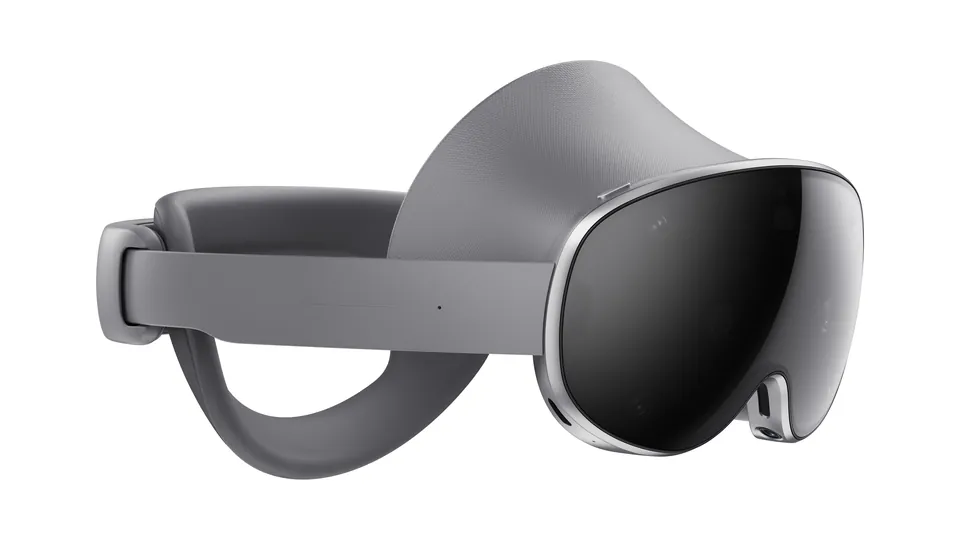
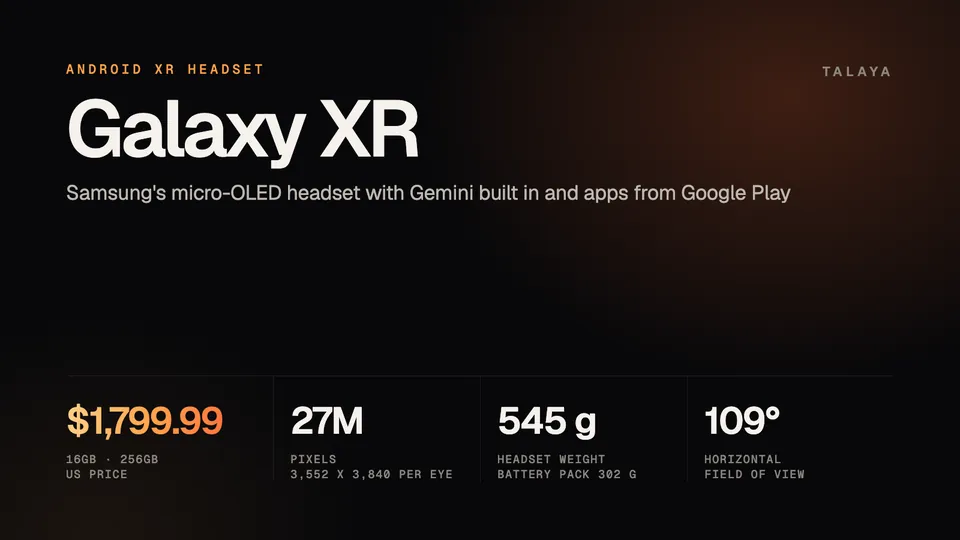
Samsung Galaxy XR is a mixed reality headset that runs Android XR, the operating system Samsung developed with Google and Qualcomm, with Google's Gemini assistant built in. It went on sale on Oct. 21, 2025, in the US and the next day in South Korea, and a year later it still costs $1,799.99 on Samsung's US store, with one configuration: 16GB of memory and 256GB of storage.
This guide is based on Samsung's and Google's announcements, specifications and support pages. We haven't tested Galaxy XR.
What Galaxy XR is
Its closest rival is Apple Vision Pro, and it costs about half as much. Like Apple's headset, it can show apps in the room around you through its passthrough cameras, or block out the room completely for immersive video and games. You control it with your hands, your eyes and your voice, and the battery sits in a separate pack connected by a cable, which keeps weight off your head.
Samsung's launch announcement called it the first step in a longer XR plan that includes AI glasses. It was also the first product on Android XR, which means it runs apps from Google Play alongside apps made for headsets.
The design leans on comfort. Samsung says the frame spreads pressure across your forehead and the back of your head to reduce discomfort on your face, and the light shield is detachable: leave it off for comfort, or attach it to block outside light when you want deeper immersion.
Price and where to buy
After the US and South Korea, Samsung opened UK pre-orders on June 17, 2026, and started selling the headset there on July 8. Samsung's UK store lists it at £1,699. Samsung's announcements so far cover those three countries.
Two accessories cost extra: the Galaxy XR Controllers and the Galaxy XR Travel Case. Samsung's US store says neither is essential but recommends both "for an enhanced XR experience." Prescription wearers need separately sold optical inserts, and Samsung says the headset isn't meant for anyone under 13.
Galaxy XR specs
| Samsung Galaxy XR | |
|---|---|
| Display | Micro-OLED, 3,552 x 3,840 per eye, 27 million pixels, 6.3-micron pixel pitch, 95% of DCI-P3 |
| Refresh rates | 60Hz, 72Hz (default), up to 90Hz |
| Field of view | 109 degrees horizontal, 100 degrees vertical |
| Chip | Qualcomm Snapdragon XR2+ Gen 2 |
| Memory and storage | 16GB, 256GB |
| Cameras and sensors | Two passthrough cameras, six world-facing tracking cameras, four eye-tracking cameras, five inertial measurement units, a depth sensor, a flicker sensor |
| Photos and video | 3D photo and video capture, 6.5MP |
| Security | Iris recognition |
| Audio | Two two-way speakers, six microphones |
| Battery | Separate pack: up to 2 hours of general use, up to 2.5 hours of video |
| Weight | 545 grams with forehead cushion; battery 302 grams |
| Interpupillary distance | 54 to 70 mm |
| Wireless | Wi-Fi 7, Bluetooth 5.4 |
These figures come from the specifications Samsung published with the UK launch. Samsung notes that 90Hz is available "upon service request," so the headset runs at 72Hz by default. It plays video up to 8K at 60 frames per second, and you can use it while the battery charges.
What Android XR and Gemini do on it
Gemini is built into the system, which means you can talk to it about what's on your screens or, if you allow it, about the room around you. According to Google's help page, you start Gemini by saying "Hey Google," by opening the Gemini app or by pressing and holding the top button on the headset. Gemini Live lets you hold a back-and-forth conversation about the apps and windows you have open, and if you turn on view sharing, it can see your full view, including your physical space when your virtual environment is off. Google warns you to keep things like passwords and medications out of view and to ask people before including them.
Samsung's own examples of what that looks like:
- Explore a city in 3D with Immersive View in Google Maps and ask Gemini for directions or places to eat nearby.
- Watch 180- and 360-degree videos on YouTube and ask Gemini about what you're watching.
- In passthrough mode, draw a circle with your hand around something in front of you to search for it with Circle to Search.
- Turn 2D photos and videos into 3D.
- Ask Gemini for tips while you play a game.
Outside of Gemini, Samsung pitches the headset as a personal theater for streaming on its micro-OLED displays, a way to follow several sports games at once and a canvas for editing video in 3D with Adobe's Project Pulsar.
You need a Google account, and Gemini Live works where the Gemini mobile app is available. Our guide to Gemini on Android XR goes deeper on what the assistant can and can't do.
What has changed since launch
Galaxy XR gets new features through Android XR updates, and two of them stand out.
In December 2025, Google added PC Connect, which brings a Windows PC's desktop or a single window into the headset next to your Android apps, and travel mode, which keeps your view stable on planes and other vehicles. It also launched Likeness, a realistic digital version of your face that mirrors your expressions in video calls. PC Connect and Likeness started in beta.
In April 2026, an update added auto-spatialization as an experimental feature that can turn almost any app, game, website, image or video into 3D, plus the ability to pin apps to your walls, a setting that shows your real hands instead of outlines, and automatic restoring of your last session. Google said more than 100 apps had been built specifically for XR by then, more than double the number at launch. The same update brought Android Enterprise support, which lets companies manage fleets of headsets.
Galaxy XR vs Apple Vision Pro
| Galaxy XR | Apple Vision Pro (M5) | |
|---|---|---|
| US price | $1,799.99 (256GB) | $3,699 (256GB), up to $4,199 (1TB) |
| Display | 27 million pixels, micro-OLED | 23 million pixels, micro-OLED |
| Chip | Snapdragon XR2+ Gen 2 | Apple M5 and R1 |
| Memory | 16GB | 16GB |
| Battery life | Up to 2 hours (2.5 hours video) | Up to 2.5 hours (3 hours video) |
| Headset weight | 545 grams | 750 to 800 grams |
| Battery weight | 302 grams | 353 grams |
| Interpupillary distance | 54 to 70 mm | 51 to 75 mm |
| Wireless | Wi-Fi 7, Bluetooth 5.4 | Wi-Fi 6, Bluetooth 5.3 |
| Assistant | Gemini | Siri AI |
| Apps | Google Play plus Android XR apps | App Store with visionOS, iPhone and iPad apps |
Apple's figures come from its specifications page and US store. The two companies don't weigh their headsets the same way: Samsung's 545 grams counts the forehead cushion but not the light shield, while Apple's range includes its Light Seal and band.
On the spec sheet, Galaxy XR wins on price, pixel count and weight, and it supports newer wireless standards. Vision Pro has Apple's M5 chip, a longer-lasting battery, more storage options and a wider range of interpupillary distances. The bigger difference for most buyers is the ecosystem. Galaxy XR fits people who use Android phones, Google apps and Windows PCs. Vision Pro is built around iPhones, Macs and iCloud. For the full picture of Apple's headset, see our Apple Vision Pro guide.
Should you buy one?
If you want the most capable headset on Android and $1,799.99 doesn't scare you off, Galaxy XR is the only option of its kind right now. Two things are worth weighing first. Meta's VR Glasses, announced in September for $1,299.99, are due in spring 2027, and Meta's Quest 3 and Quest 3S remain far cheaper if games are your priority. And Android XR is expanding beyond headsets: XREAL Aura, wired glasses with a 70-degree field of view, starts at $1,279, and Google says the first audio glasses arrive this fall. Our explainer on what Android XR is covers all of those devices.
Frequently asked questions
How much does Galaxy XR cost?
Samsung sells Galaxy XR for $1,799.99 in the US with 256GB of storage, the only configuration. In the UK it costs £1,699. Controllers and the travel case are sold separately.
Does Galaxy XR come with controllers?
No. Samsung says the Galaxy XR Controllers and Travel Case aren't in the box and aren't essential, since the headset works with your hands, eyes and voice, but it recommends them for an enhanced experience.
Can Galaxy XR run regular Android apps?
Yes. Android XR runs apps from Google Play, and Google says there were more than 100 apps built specifically for XR by April 2026, more than double the number at launch.
Is Galaxy XR better than Apple Vision Pro?
On paper it has more pixels, weighs less and costs about half as much, while Vision Pro has Apple's M5 chip, longer battery life and more storage options. Which one suits you depends mostly on whether you live in Google's or Apple's ecosystem.
Where can you buy Galaxy XR?
Samsung launched it in the US and South Korea in October 2025 and in the UK in July 2026, where it costs £1,699. In the US you can order it from Samsung.com.
Sources
- Samsung: Introducing Galaxy XR, Opening New Worlds (Oct. 22, 2025)
- Samsung UK Newsroom: Samsung Galaxy XR arrives in the UK, with specifications
- Samsung Mobile Press: Samsung launches Galaxy XR in the UK (June 17, 2026)
- Samsung US: Galaxy XR store page
- Samsung UK: Galaxy XR
- Google: New features for Galaxy XR and a look at future devices (Dec. 8, 2025)
- Google: 5 new features for Android XR (April 7, 2026)
- Android XR Help: Use Gemini Live on Android XR
- Apple: Apple Vision Pro technical specifications
- Meta: Introducing Meta VR Glasses (Sept. 23, 2026)
- XREAL: XREAL AURA starts at $1,279 (Oct. 7, 2026)
- Android: Android XR
Join the conversation
Questions, or something to add? Talk about it with other smart glasses owners in r/Talaya, our community on Reddit.