Smart Glasses · Guide
Brilliant Labs Halo and Frame guide: specs, price, Noa AI and what's open source
Brilliant Labs' store now lists one pair of glasses, the $399 Halo, with a color microOLED display, a small camera and the Noa assistant, and its earlier Frame is gone. Here is how they compare, what is open source and what to check before ordering.
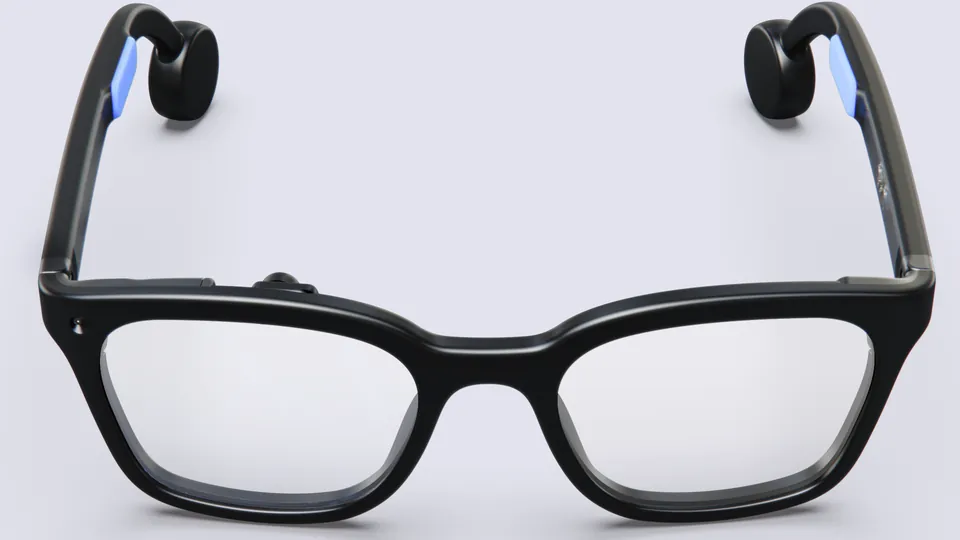
Brilliant Labs' online store lists one pair of glasses today: Halo, open-source AI glasses with a small color display, a camera and an assistant called Noa. On Oct. 25, 2026, the company's store listed Halo in black at $399 and called it "Shipping now!" Frame, the glasses Brilliant announced in 2024, is no longer in that store, and the store and documentation we read mention no model newer than Halo.
This guide is based on Brilliant Labs' product pages, documentation and code repositories, plus press reports on the two launches, and we haven't tested either pair.
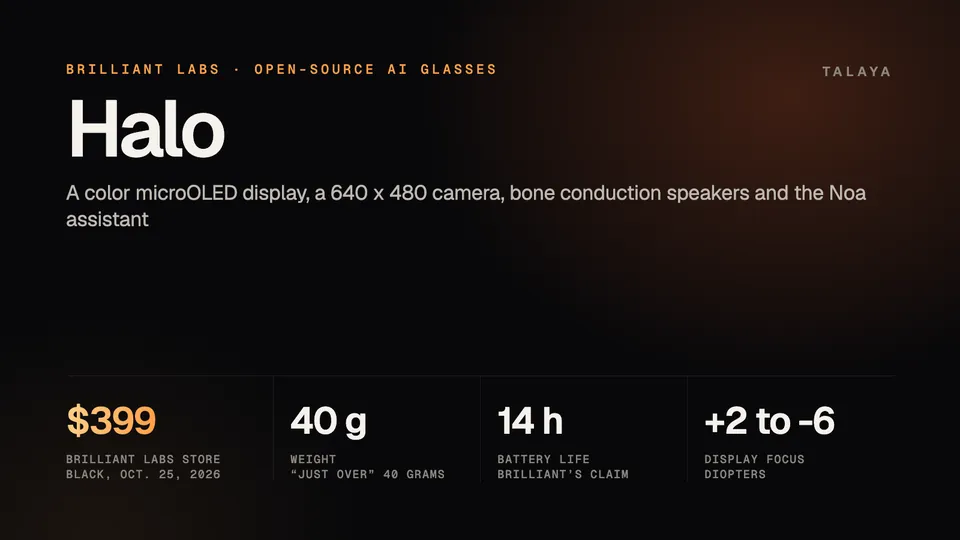
Halo and Frame at a glance
| Halo | Frame | |
|---|---|---|
| Announced | July 31, 2025, per Heise | Feb. 8, 2024, per TechCrunch |
| Price | $399 on Brilliant's store; Heise reported a planned $299 | $349 at launch, per TechCrunch; not in Brilliant's store |
| Weight | Just over 40 grams, per Brilliant | 39 grams, per TechCrunch |
| Display | 0.2-inch color OLED on silicon, 640 x 480 pixels, 256 x 256 drawable area | 0.23-inch color micro OLED, 640 x 400 pixels, 20-degree field of view |
| Camera | 640 x 480 color, global shutter | 720p color |
| Audio | Stereo bone conduction speakers, two microphones | One microphone |
| Battery | 300mAh; Brilliant claims 14 hours | 210mAh, plus a 140mAh charging cradle |
| Chip | Alif Balletto B1 with an Arm Ethos-U55 NPU | Nordic nRF52840 plus a Lattice FPGA |
| Software | Zephyr OS with a Lua runtime | Lua-based OS |
| Prescription | Display focus adjusts from +2 to -6 diopters; lenses through SmartBuyGlasses | Optional prescription lenses |
Specifications come from Brilliant's hardware manuals.
What is in Halo
Halo's display is a 0.2-inch color panel that Brilliant's hardware manual describes as OLED on silicon. It has 640 x 480 pixels and a peak brightness of up to 5,000 nits, and apps get a 256 x 256 pixel drawable area. The panel is mounted on top of the frame. You slide it sideways, tilt it to line it up with your eye, then turn its lens to focus the image.
Halo has a camera. Brilliant's home page lists an "ultra low-power optical sensor for AI inference," and the hardware manual identifies it as a front-facing PixArt color camera that captures 640 x 480 images with an 81.2-degree horizontal field of view. At 640 x 480 it is far below the 12MP camera in Ray-Ban Meta Gen 3. We found no description of an outward recording light in the pages we read.
Sound comes from two bone conduction speakers in the temples and two microphones with a low-power, always-on mode for audio activity detection. Up to five devices can be paired. A button under the left arm wakes the glasses with a click, puts them to sleep with a two-second hold and starts pairing with a five-second hold.
Battery is the least certain number. Brilliant's home page claims "14 hour(!) all day battery life," and its store page says that at estimated normal use Halo "can achieve all-day battery life." The hardware manual lists two 150mAh cells, 300mAh in total, charged through a magnetic connector that plugs into USB-C. The pages we read give no runtime with the display and camera in constant use.
For fit, Brilliant says Halo "is designed to fit most people, but not all." It is built for an interpupillary distance of 58 to 72 mm and suggests its Eye Measure app to check yours.
Noa, Miniapps and what the AI does
Brilliant describes Noa as "your private conversational AI agent with long-term memory of your life." Its home page says Noa "handles realtime, multimodal conversations about anything you see, hear, or imagine" and can remember what it saw, heard and said. The listed specifications include a cloud-based AI agent, a mobile app and a low-power AI chip in the glasses for on-device AI.
Memory is central to Brilliant's pitch. Heise reported at the July 2025 unveiling that Brilliant's memory system, called Narrative, generates an abstracted representation of what the glasses capture instead of storing raw data. Brilliant says the processing is local, so names and conversations can be recalled without personal data ending up in the cloud. That is the company's description, and the pages we read don't show how the system works.
The store page adds Miniapps: "Halo lets you build new experiences using natural language and share them with others on our App Store." Heise called the voice-driven app builder "Vibe Mode" at launch. The page says these features are "included free out of the box with daily usage caps" and doesn't say what the caps are or what happens after them. It also doesn't say which AI models power Noa on Halo. For Frame, TechCrunch reported at launch that Noa drew on Perplexity's search engine, Stability AI's Stable Diffusion, OpenAI's GPT-4 and Whisper.
One practical gap: Brilliant's Halo documentation says the Brilliant Noa app is "coming soon" to the Apple App Store and Google Play, while the store page says "Shipping now!" We couldn't confirm from Brilliant's pages how buyers get the app today. Frame's documentation says its Noa app is available on both stores, with an Android APK on GitHub.
What is open source
Brilliant calls Halo "totally open source" and says its design files and code are on GitHub. The company's GitHub organization has public repositories for the Halo firmware, which runs Zephyr with a Lua runtime and updates over Bluetooth, and for the Zephyr, hardware-layer and bootloader projects it builds on, which are listed under the Apache-2.0 license. The Brilliant SDK, a BSD-3-Clause repository that gathers the company's SDKs, is public too, and the docs list Python, Flutter and Web Bluetooth versions.
Some pieces don't line up yet. The Halo hardware manual still says the Halo codebase repository is "coming soon," although a halo-firmware repository was public and had been updated on Oct. 25. Frame's manual has schematics sections for the glasses and the cradle, while the Halo manual text we read offers a downloadable 3D model and no schematics. The GitHub page showed 10 of the organization's 25 repositories, so we can't say whether Halo's circuit design files are public.
Frame's complete codebase is public, and TechCrunch reported at launch that developers would get the open source codebase and hardware schematics. Frame's manual adds that customizing its firmware requires taking the glasses apart to reach a debug port. The Halo manual says Halo's firmware can be customized and describes no such step.
Frame, the 2024 glasses
Brilliant announced Frame on Feb. 8, 2024, at $349, with shipping planned for April, TechCrunch reported. The round nylon frames weigh 39 grams. A 0.23-inch color micro OLED is bonded to a prism assembly that directs the image into your eye, and Brilliant says the 640 x 400 picture looks about the size of a tablet at arm's length, with a 20-degree field of view. Frame has a 720p camera and one microphone, and its key-feature list shows no speaker. A charging cradle with its own 140mAh battery tops it up on the go.
Heise calls Frame Brilliant's first smart glasses. The company's earlier product, Monocle, was a single-lens AR device that TechCrunch said drew a loyal following among open source hardware fans, and it cost the same $349. Like Brilliant's other Bluetooth devices, Frame needs a phone to reach the AI models, TechCrunch noted.
Frame is no longer listed in Brilliant's store. The store's catalog lists only Halo, and the old Frame product page returns a "not found" error. Frame's documentation is still online, its codebase remains on GitHub, and a Frame and Gemini voice-and-vision demo repository there was updated in February 2026. We found no Brilliant statement saying whether Frame is discontinued.
Prescription lenses
Halo's display optic adjusts from +2 to -6 diopters, which Brilliant says supports "a wide range of corrective vision needs." For prescription or sunglass lenses, Brilliant says it sends buyers a link to its partner SmartBuyGlasses after they buy Halo. Out of the box, Halo has optical-grade stock lenses with an anti-reflective coating.
Frame came with 6 mm lenses and offered optional personalized prescriptions, and its manual describes nose-bridge adapters of 3 mm, 2 mm or none to bring the whole display into view. Our prescription guide compares how other brands handle lenses.
Price, availability and returns
Halo costs $399 in Brilliant's store, which sells it in black only. At the unveiling, Heise reported a planned $299 price, a sales start in November 2025, sales only through Brilliant's website and limited quantities at first. The pages we read don't explain the $100 difference.
Brilliant doesn't collect taxes at checkout and tells buyers to check their country's customs rules, since import duties and VAT vary. A clearly defective Halo is exchanged for a new unit, the store page says. For any other return, Brilliant refunds the price minus a $49 restocking fee, and you pay to ship the device back.
Who Halo suits
Brilliant pitches Halo to "the curious, creative, and forward thinking" and, for developers, as an open source hardware and software platform for prototyping. On the published specs, it suits people who want to run Lua apps, read the firmware and write Miniapps in plain language. Halo has a display that Ray-Ban Meta Gen 3 ($449) lacks, and a camera with far fewer pixels, 640 x 480 against 12MP.
Readers who want a camera and an assistant in everyday frames can start with our complete Ray-Ban Meta guide. Those who want a display without a camera can read our Even Realities G1 and G2 explainer. For the wider picture, see best smart glasses in 2026 and our guide to AI, AR and display glasses.
Before you order:
- Check whether the Noa app is available for your phone, since Brilliant's docs list it as "coming soon."
- Ask what the daily usage caps on the free Noa features are.
- Measure your interpupillary distance against the 58 to 72 mm range.
- Budget for import duties, and note the $49 restocking fee on returns that aren't for a defect.
Halo isn't an option if you need glasses that can't take pictures. Our guide to smart glasses without a camera lists the pairs that can't.
Frequently asked questions
How much do Brilliant Labs Halo glasses cost?
Brilliant Labs' store listed Halo at $399, in black, on Oct. 25, 2026. Heise reported a planned price of $299 at the July 2025 unveiling. Taxes aren't collected at checkout, and import duties may apply on delivery.
Are Brilliant Labs Halo glasses open source?
Brilliant calls Halo "totally open source" and says its design files and code are on GitHub. The company's public repositories include the Halo firmware and its SDKs, while its hardware manual still lists the Halo codebase repository as "coming soon."
Does Brilliant Labs Halo have a camera?
Yes. Brilliant's hardware manual lists a front-facing color camera that captures 640 x 480 images with an 81.2-degree horizontal field of view. Its store page calls the part an "optical sensor for AI inference."
Is the Brilliant Labs Frame still for sale?
Not from Brilliant Labs' own store, which lists only Halo. Frame launched in 2024 at $349, according to TechCrunch, and Brilliant still publishes its documentation.
What is Noa on Brilliant Labs glasses?
Noa is Brilliant's AI assistant. For Halo, Brilliant describes it as a private conversational agent with long-term memory that you can talk to about what you see and hear. It also builds small apps, called Miniapps, from plain-language requests.
Can I use prescription lenses with Halo?
Yes. Brilliant says Halo's display adjusts from +2 to -6 diopters and that, after you buy, it sends a link to its partner SmartBuyGlasses for prescription and sunglass lenses.
Sources
- Brilliant Labs: Halo product page and FAQ (read Oct. 25, 2026)
- Brilliant Labs: home page and Halo specifications (read Oct. 25, 2026)
- Brilliant Labs: store product catalog (read Oct. 25, 2026)
- Brilliant Documentation: Getting started with Halo
- Brilliant Documentation: Halo hardware manual
- Brilliant Documentation: Getting started with Frame
- Brilliant Documentation: Frame hardware manual
- Brilliant Labs on GitHub (read Oct. 25, 2026)
- Heise: Brilliant Labs presents Halo AI glasses, privacy-friendly and open source (July 31, 2025)
- TechCrunch: AR glasses with multimodal AI nets funding from Pokémon GO creator (Feb. 8, 2024)
Join the conversation
Questions, or something to add? Talk about it with other smart glasses owners in r/Talaya, our community on Reddit.