Smart Glasses · Guide
Smart glasses without a camera: the options, prices and what you give up
Smart glasses without a camera can't take photos or video, which is why people pick them for privacy, workplaces and venues with recording rules. Here are the audio, display and screen options, with prices and what each one leaves out.
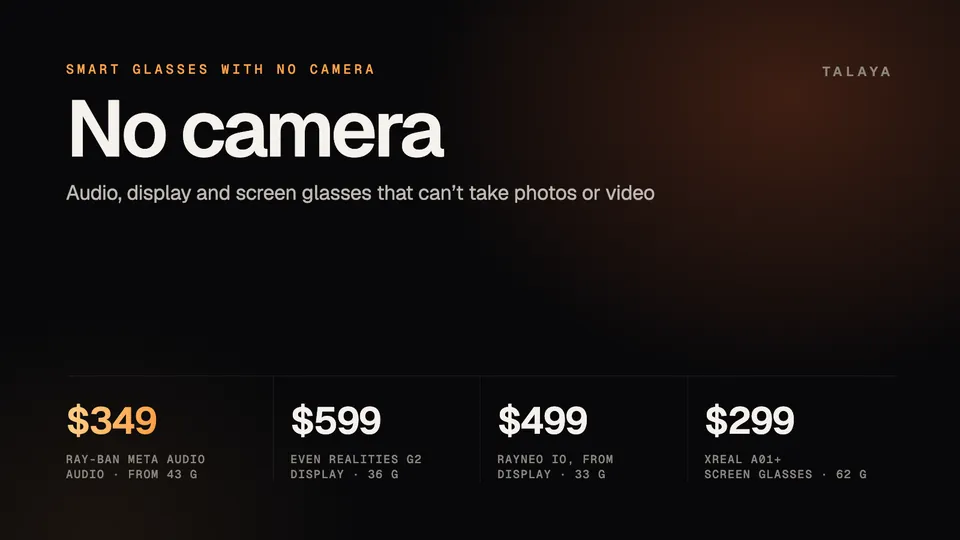
Smart glasses without a camera come in three kinds: audio glasses that talk to an assistant, display glasses that show text in the lens, and screen glasses that mirror a phone or laptop. On Oct. 25, 2026, Meta was shipping Ray-Ban Meta Audio ($349) and Even Realities' store listed the G2 at $599. RayNeo said its iO, from $499, would go on sale Sept. 4. Amazon.com listed Echo Frames as unavailable, and Vuzix's Z100, out of stock in December 2025, no longer has a product page.
This guide is based on the companies' own pages and our guides to each product, and we haven't tested any of the glasses.
Why people look for glasses without a camera
Privacy for other people comes first. Camera glasses look like ordinary frames, and Hamburg's data protection office found that Meta's white recording light is hard to see outdoors, as our bystander privacy guide explains. Glasses with no camera can't take pictures of anyone, and they have no recording light because there is nothing for it to signal.
Rules about places come next. Since July 20, New York's state courts have barred eyewear with "cameras, microphones or other recording technology," Syracuse.com reported. MSC Cruises bans devices "capable of covertly or discreetly recording or transmitting data (e.g. smart glasses)" in public areas of its ships, USA Today reported.
Workplaces set their own limits too. Employers "generally may restrict or prohibit AI-enabled glasses," the law firm Fisher Phillips wrote in March, as long as the policy supports a legitimate business interest. Some policies cover smart eyewear as a whole: Delta Air Lines bars employees from wearing or using it while working, it told USA Today, as our guide to recording laws notes.
Camera-free glasses at a glance
| Glasses | Type | Price | Weight | Microphones | Assistant |
|---|---|---|---|---|---|
| Ray-Ban Meta Audio | Audio | From $349 | As low as 43 grams | Six | Meta AI |
| Amazon Echo Frames (3rd Gen) | Audio | $269.99 at 2023 launch; unavailable on Amazon | 39.6 grams (Round) | Four | Alexa, Alexa+ |
| Even Realities G2 | Display | $599 | 36 grams | Four | Even AI |
| RayNeo iO | Display | From $499 | 33 grams | Four | RayNeo, with Google Gemini |
| Vuzix Z100 | Display | $499 at 2024 launch; no longer listed | 38 grams | None, per PCMag | Phone app (Vuzix Connect) |
Prices are US prices from each company's pages on Oct. 25, 2026, except the Echo Frames and Z100 launch prices. RayNeo's price and specifications come from its Sept. 3 blog, written before the iO went on sale.
Audio glasses: Ray-Ban Meta Audio and Echo Frames
Ray-Ban Meta Audio is Meta's first pair without a camera. It costs $349, weighs as little as 43 grams and is rated for up to 12 hours on a charge, plus up to 48 hours from its case. Meta's store FAQ describes it as "built for calls, music and voice assistance, with no camera or capture features." You say "Hey Meta" to start a call or a playlist, music and podcasts play through open-ear speakers, and live translation covers 20 languages when the glasses are connected. Meta says the frames are compatible with "a wide range" of prescriptions and publishes no figures. Our Ray-Ban Meta Audio guide covers styles, battery and lenses.
Without a camera, Audio gives up photos and video and the ability to ask Meta AI about what you're looking at. It also lacks Live AI, which keeps the camera and microphone on during a session, and the offline translation packs that other Ray-Ban Meta models support.
Amazon's Echo Frames are the other mainstream audio pair. The third generation, announced Sept. 20, 2023, has four microphones and two speakers, weighs 39.6 grams in the Round style and runs Alexa. Amazon rates it at up to six hours of continuous playback or up to 14 hours of moderate use, and the prescription-ready styles take lenses from an optician. Amazon lists no camera or display, so the trade-offs match Audio's. The listings we opened on Oct. 25 said "Currently unavailable" and showed no price, against launch prices of $269.99 for Echo Frames and $389.99 for the Carrera versions. Our Echo Frames guide has the details.
Display glasses: Even Realities G2 and RayNeo iO
The Even Realities G2 costs $599, weighs 36 grams and shows green text and simple graphics in both lenses on a 640 x 350 display. Even calls it "camera-free. By design." Its four microphones feed features such as Conversate, which shows context during a conversation and writes a summary afterward, plus translation in 35 languages, a teleprompter, navigation and notifications. Even says the battery lasts up to two days, and its custom prescription lenses run from -12.00 to +12.00. Without a camera, the assistant answers your voice but can't see what you're looking at, and the display is monochrome green and text-first. The G1, Even's 2024 first model, has no camera either, and both G1 styles are sold out on Even's store. Our Even Realities explainer compares the two models.
RayNeo's iO is a 33-gram pair with no camera, a monochrome green display with a 23.5-degree field of view, four microphones and bone-conduction audio. Its assistant combines RayNeo's software with Google's Gemini 3.1 Flash Lite, and live translation covers 55 languages. It starts at $499, or $658 with prescription lenses. RayNeo's blog gave those figures ahead of a Sept. 4 sale date, and our RayNeo guide covers the rest of its line.
Vuzix Z100: no camera, and no microphone
Vuzix's Z100 is the one pair in this group without a microphone, according to PCMag, so speech-to-text relies on your phone's. Vuzix's specification list shows no camera either. It weighs 38 grams, has a 640 x 480 green display and, Vuzix says, runs up to 48 hours on a charge. Vuzix priced it at $499 in November 2024 and pitched it to frontline workers as "safety glasses-certified." Vuzix's own pages no longer list it: its store said it was out of stock in December 2025, and the product page has since been replaced by a redirect. Our Vuzix guide covers the rest of its lineup.
Screen glasses: XREAL, Viture and RayNeo Air
Screen glasses do a different job. They plug into a phone, laptop or console over USB-C and display a large virtual screen of whatever the connected device sends. Several models have no camera: XREAL's a01+ ($299 on XREAL's US store, 62 grams), Viture's Luma ($399, which Viture lists without a front camera) and RayNeo's Air series. All need a USB-C source that outputs DisplayPort video. Our XREAL vs Viture comparison and XREAL lineup guide cover compatibility and prices.
Check the spec sheet: cameras behind other names
Several products that sound camera-free have a camera.
- Brilliant Labs' store page lists an "optical sensor for AI inference," and its hardware manual identifies a 640 x 480 color camera. See our Brilliant Labs guide.
- Google and Samsung call their coming glasses audio glasses, yet Google says they can "snap high-quality photos and videos," as our smart glasses explainer notes.
- XREAL sells a $99 camera, XREAL Eye, that clips onto One-series glasses. Viture's Luma Pro adds a front RGB camera, and its Luma Ultra has depth cameras.
- Vuzix's M400 captures images and video, and its LX1 can stream the wearer's view.
Microphones still matter
Four of the five pairs in the table have microphones. Even says the G2's Conversate feature "captures and transcribes every word" of a conversation, and that no data is stored in the cloud without your explicit consent. New York's court ban names microphones, so a camera-free pair with microphones can still fall under it. Venue and employer policies vary, and the safe step is to read the wording and ask. Our Ray-Ban Meta Audio guide makes the same point about Audio's six microphones.
How to choose
- For music, calls and an assistant in the lightest frames, Ray-Ban Meta Audio is the one that was shipping on Oct. 25, at $349.
- For text in the lens without a camera, look at the G2 or the iO. The G2 publishes the widest prescription range, and the iO costs $658 with prescription lenses.
- If a venue's rules name microphones, the Z100 is the only pair here without them, but Vuzix no longer lists it. Otherwise, read the policy's wording.
- For a big private screen on a flight or a laptop, XREAL's a01+ starts at $299.
Our best smart glasses guide compares camera, display and screen models across brands, and our upcoming smart glasses tracker lists what's due next.
Frequently asked questions
What are the best smart glasses with no camera?
On specs, price and availability, Ray-Ban Meta Audio ($349) is the pick for audio and an assistant, and Even Realities G2 ($599) is the pick for a display. RayNeo's iO, from $499, is the other display pair. Amazon's Echo Frames showed as unavailable on Oct. 25, 2026, and Vuzix's Z100 no longer has a product page.
Do camera-free glasses still have microphones?
Mostly yes. Ray-Ban Meta Audio has six, and Echo Frames, the Even G2 and the RayNeo iO have four each. Vuzix's Z100 has none, according to PCMag. Some venue rules name microphones, as New York's court ban does.
Do smart glasses without a camera have a recording light?
No. The light exists to signal a camera, and Ray-Ban Meta Audio and Even G2 have none, as our recording light guide notes. Both still have microphones.
Are there AI glasses with no camera?
Yes. Ray-Ban Meta Audio runs Meta AI, Echo Frames use Alexa, the Even G2 has Even AI and the RayNeo iO pairs RayNeo's software with Google's Gemini. Without a camera they answer by voice or text but can't see what you're looking at.
Can I wear camera-free glasses where smart glasses are banned?
Not always. Many rules are written about cameras, but some name microphones or smart glasses as a whole, and venues can ask you to take them off. Check the wording first. Our guide to recording laws covers courts, theaters, cruise ships and employers.
Can I get prescription lenses in camera-free glasses?
Yes. The Even G2 takes lenses from -12.00 to +12.00, the RayNeo iO costs $658 with prescription lenses, Echo Frames come in prescription-ready styles and Meta says Ray-Ban Meta Audio is compatible with "a wide range" of prescriptions without giving figures. Our prescription guide compares them.
Sources
- Meta Store: Ray-Ban Meta (Gen 3) and Ray-Ban Meta Audio styles and FAQ
- Meta Store: Compare AI glasses
- Meta: Introducing Ray-Ban Meta Audio and more AI glasses styles (Sept. 23, 2026)
- Even Realities: Even G2
- RayNeo blog: What new smart glasses are available now, and what's coming soon? (Sept. 3, 2026)
- XREAL US store: all products and prices (Oct. 25, 2026)
- Viture: Luma XR glasses series (read Oct. 25, 2026)
- Amazon: Echo Frames (newest model), Round in Blue Tortoise, listing with specifications (read Oct. 25, 2026)
- Amazon: Introducing Amazon's all-new lineup of smart glasses (Sept. 20, 2023)
- Vuzix: Vuzix announces general availability of Z100 smart glasses (Nov. 20, 2024)
- Vuzix: Z100 smart glasses product page, Internet Archive capture of Dec. 23, 2025
- PCMag: Vuzix Z100 smart glasses review (April 11, 2025)
- Syracuse.com: New York to ban smart glasses from all courthouses (July 7, 2026)
- USA Today: This cruise line banned smart glasses from public areas (Dec. 13, 2025)
- Fisher Phillips: AI glasses enter the workplace, FAQs for employers (March 11, 2026)
Join the conversation
Questions, or something to add? Talk about it with other smart glasses owners in r/Talaya, our community on Reddit.