Smart Glasses · Guide
Samsung smart glasses: what we know about the Gentle Monster and Warby Parker pairs
Samsung's first glasses, built with Google and designed with Gentle Monster and Warby Parker, have cleared the FCC. Reports conflict on timing: a Samsung official told The Korea Herald they launch in November, while Chosunbiz reports mid-December. Samsung still hasn't announced a price or a name, and some of the details come only from leaks.
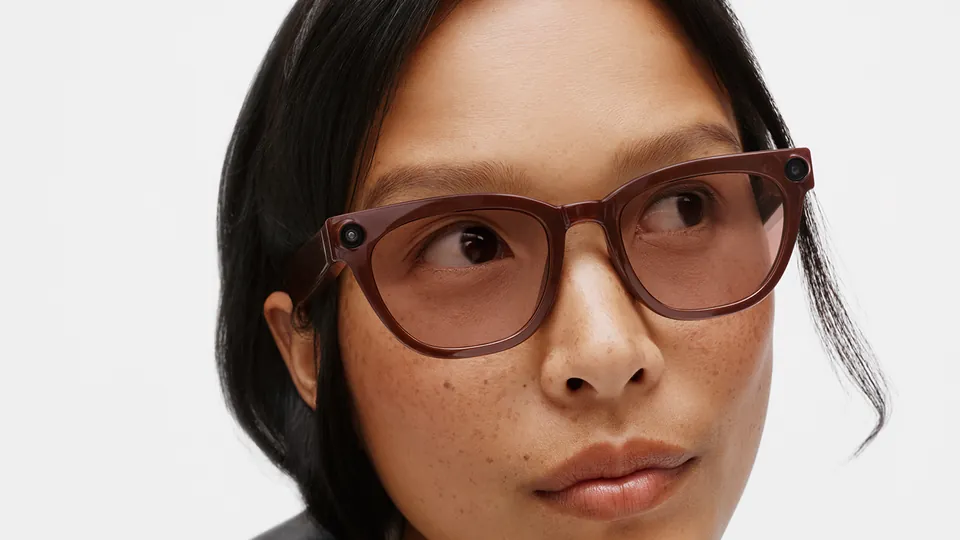
Samsung's first smart glasses are display-free Android XR glasses with a camera, speakers and Google's Gemini assistant, in frames designed with the eyewear brands Gentle Monster and Warby Parker. Samsung introduced them as "intelligent eyewear" at Galaxy Unpacked in London on July 22, two months after Google first showed the designs. The FCC certified a Samsung pair on Sept. 27. The launch date is disputed: a Samsung official told The Korea Herald on Oct. 1 that they will launch in November, but on Oct. 30 Chosunbiz reported, citing unnamed electronics-industry sources, that sales will start in mid-December in Korea and the US. Samsung has confirmed neither date, and it still hasn't announced a price or a product name.
This guide separates what Samsung and Google have announced from what has been reported or leaked, and names who reported it.
What Samsung has announced
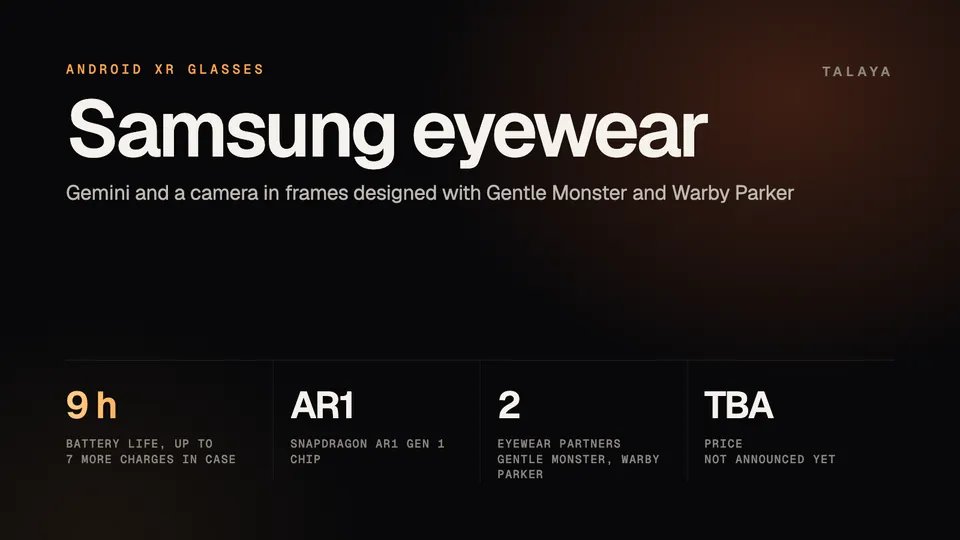
Samsung's July announcement describes a lightweight, slim frame with up to nine hours of battery life on a charge and up to seven more full charges from the case. A built-in camera gives Gemini visual context, and Qualcomm's Snapdragon AR1 Gen 1 chip runs the glasses. Samsung says the eyewear was built in partnership with Google on the Android XR platform.
The features Samsung listed are:
- Summaries of long messages, information read aloud and live translation.
- Capturing what you see, such as a whiteboard during a meeting, and organizing it in Samsung Notes.
- Directions and information about what's around you, based on your location.
- Follow-up questions that build on what you asked before.
- Sharing your view during a call or recording video from your point of view.
At Unpacked, Samsung showed one design from each partner. The Gentle Monster edition has a slim black frame with a straight upper rim and softly rounded lower edges. The Warby Parker style is brown, with a subtly upswept brow line. Samsung says both brands will offer a range of frame styles, colors and lens options.
"Intelligent eyewear creates a new point of interaction, bringing more personalized AI assistance naturally into the moments that make up everyday life," said Won-Joon Choi, chief operating officer of Samsung's mobile business.
Samsung's footnotes add conditions. You must be signed into Samsung and Google accounts and connected to "a compatible Samsung Galaxy AI phone" with data. Gesture controls work only through the Galaxy Watch9, and translation and navigation vary by language, region and app.
What Google has said
Google announced the partnership at Google I/O in May 2025, saying it was working with Samsung on "a software and reference hardware platform" for glasses, with Gentle Monster and Warby Parker as the first eyewear brands and Kering Eyewear to follow later. In December, Google described two types: AI glasses without a screen, which use speakers, microphones and cameras, and display AI glasses with a screen in the lens.
At Google I/O 2026 on May 19, Google showed the first Gentle Monster and Warby Parker designs and confirmed that the screenless type, which it now calls audio glasses, would launch first, "later this fall." The name refers to how they answer you. They still have a camera.
Google's list of features goes further than Samsung's. You say "Hey Google" or tap the frame, then ask Gemini about what you see, get turn-by-turn directions, manage calls and texts, take photos and edit them with Google's Nano Banana model, hear translations in a voice that matches the speaker's tone, or have Gemini handle multi-step tasks such as preparing a DoorDash order for you to confirm. Google also wrote that the "glasses pair with both Android and iOS phones," which sits awkwardly next to Samsung's requirement for a Galaxy AI phone. Neither company has explained how the two fit together.
Release date: what the FCC filing and reports say
The FCC record is the hardest evidence of a launch. Samsung Electronics received an FCC grant on Sept. 27 for a device described as "Smart Glasses," FCC ID A3LSMO200P, covering Bluetooth and Wi-Fi in the 2.4GHz, 5GHz and 6GHz bands. The application is dated July 22, the day of Unpacked. Samsung asked the FCC to keep the user manual and internal photos confidential until March 2027.
Android Authority reported on Sept. 30, citing Droid Life, that two models appear in the FCC database, SM-O200J and SM-O200P, each with several variants. The site suspects one is the Gentle Monster design and the other the Warby Parker design, which Samsung hasn't confirmed.
Two reports give different launch timing, and Samsung has confirmed neither publicly.
- November: The Korea Herald reported on Oct. 1 that a Samsung official had confirmed a November launch.
- Mid-December: Chosunbiz reported on Oct. 30, citing unnamed electronics-industry sources, that Samsung will begin its first sales in mid-December in Korea and the US. It says the price hasn't been set, and that Europe, China and Japan are excluded from the initial launch, with more regions to follow after Samsung checks demand and user reactions in the first two markets. Chosunbiz's English page is machine-translated.
We can't say whether the two reports describe the same launch or whether the date has slipped. Our news story on the Chosunbiz report has the details.
The Korea Herald also wrote that local media have reported a target weight up to 5 grams below Meta's 51-gram base Ray-Ban Meta model, though Samsung hasn't disclosed a final weight and at Unpacked described the glasses only as "lighter than most AI glasses." Samsung has said LEDs inside and outside the frame will show when the camera is recording, and that the camera turns off if the outside light is covered. South Korea's privacy regulator met Samsung in late July to discuss how bystanders should be alerted, according to the report.
What leaks say about specs and styles
The most detailed leak came from SammyGuru in October, as reported by 9to5Google. Samsung hasn't confirmed any of it. According to the leak:
- Depending on the style, the glasses weigh as little as 41 grams.
- They have 2GB of RAM and 64GB of storage.
- Battery life is nine hours, or 72 hours counting the case.
- The 12MP camera records 3K video at 30 frames per second.
- There are two speakers and four microphones.
- Basic functions work with Android phones and iPhones, while some Galaxy-only features need One UI 9 on the phone and Wear OS 7 on a Galaxy Watch.
- Warby Parker will offer three frames, called Alden, Reid and Wren, and Gentle Monster six, with prescription lenses available from Gentle Monster.
The leaked battery figures match Samsung's own: nine hours on a charge plus seven more charges from the case comes to 72 hours.
Price
Samsung hasn't announced pricing, and none of the reports above include it. The obvious benchmark is Meta's Ray-Ban Meta (Gen 3), which launched on Sept. 23 from $449 with up to nine hours of battery, a 12MP camera and 3K video. Our comparison of Meta's new Ray-Bans covers that side of the market.
The display model and what comes next
Google and Samsung have both said display glasses are coming, without a date. In September, The Elec reported that Samsung had requested new color microdisplays for future glasses and that the first Samsung model with a color display could launch toward the end of 2027, according to 9to5Google. The report says price and performance are still being weighed and that Samsung hasn't decided between a display over one eye or both.
What's still unknown
Samsung has left several basic questions open. It hasn't said what the glasses will be called or what they will cost. It hasn't confirmed a sale date or named the countries where they will go on sale, though Chosunbiz points to Korea and the US first. It hasn't said whether Warby Parker and Gentle Monster stores will sell them alongside Samsung. It hasn't published a weight, prescription ranges or a full spec sheet, and the conflict between Google's iPhone support and Samsung's Galaxy requirement is unresolved.
Why Samsung is entering now
Samsung is joining a market that has grown fast around exactly this kind of display-free glasses, and that one company dominates. Citing Counterpoint Research, The Korea Herald reported that global shipments of AI glasses rose 263% year over year in the first half of 2026, that models without a display made up 96% of them, and that Meta held 94% of that segment. Samsung's pitch against Meta rests on Gemini, the link to Galaxy phones and watches, two eyewear brands that aren't Ray-Ban and a promise of lighter frames.
Samsung's glasses vs Ray-Ban Meta, on paper
| Samsung intelligent eyewear | Ray-Ban Meta (Gen 3) | |
|---|---|---|
| Status | Launch date unconfirmed: November (per a Samsung official to The Korea Herald) or mid-December in Korea and the US (per Chosunbiz) | On sale since Sept. 23 |
| Price | Not announced | From $449 |
| Battery | Up to 9 hours, 7 more charges in the case | Up to 9 hours |
| Camera | Built in (12MP per the October leak) | 12MP, 3K video |
| Display | None | None |
| Assistant | Gemini | Meta AI |
| Frame brands | Gentle Monster, Warby Parker | Ray-Ban |
Samsung's pair is one of several Android XR devices arriving over the next year. Our guide to every Android XR device announced so far covers the others, including XREAL's Aura glasses.
Frequently asked questions
When is the Samsung smart glasses release date?
Samsung hasn't announced a date publicly, and two reports disagree. A Samsung official told The Korea Herald on Oct. 1 that the glasses will launch in November. On Oct. 30, Chosunbiz reported, citing unnamed electronics-industry sources, that sales start in mid-December in Korea and the US. The FCC certified the glasses on Sept. 27.
How much will Samsung's smart glasses cost?
Samsung hasn't said. For reference, Meta's Ray-Ban Meta (Gen 3), the best-known glasses of this type, start at $449.
Do Samsung's smart glasses have a display?
No. The first models answer through speakers in the frame. Google and Samsung have said display glasses will follow, and The Elec reported that Samsung's first model with a color display could arrive in late 2027.
Will Samsung's smart glasses work with an iPhone?
It isn't settled. Google says its intelligent eyewear pairs with Android and iOS phones, but Samsung's footnotes say the features require a compatible Galaxy AI phone. A leak reported by SammyGuru says basic functions will work with iPhones, with some features only on Galaxy devices.
Are they called Galaxy Glasses?
Samsung calls them intelligent eyewear and hasn't announced a product name. "Galaxy Glasses" is the name used in leaks and in much of the coverage.
Can I get Samsung's smart glasses with prescription lenses?
Samsung hasn't detailed lens options beyond saying each brand offers a range of frame styles, colors and lens options. The October leak reported by SammyGuru says Gentle Monster will offer prescription lenses.
Sources
- Samsung Newsroom: Samsung brings Galaxy ecosystem to everyday eyewear (July 22, 2026)
- Google: Intelligent eyewear is coming this fall (May 19, 2026)
- Google: The Android Show, a look at future devices (Dec. 8, 2025)
- Google: A new look at how Android XR will bring Gemini to glasses and headsets (May 20, 2025)
- FCC ID A3LSMO200P: Samsung smart glasses, grant of Sept. 27, 2026 (via fccid.io)
- Android Authority: Samsung's smart glasses just took their next step toward launch (Sept. 30, 2026)
- Chosunbiz: Samsung to begin first AI smart glasses sales in mid-December (Oct. 30, 2026)
- The Korea Herald: Samsung to launch first AI glasses in November (Oct. 1, 2026)
- 9to5Google: Samsung's first Android XR glasses leak in 25 styles (Oct. 13, 2026)
- 9to5Google: Samsung's first Android XR glasses with a color display may launch in late 2027 (Sept. 10, 2026)
- Meta: Introducing Ray-Ban Meta Audio and more AI glasses styles (Sept. 23, 2026)
Join the conversation
Questions, or something to add? Talk about it with other smart glasses owners in r/Talaya, our community on Reddit.