Smart Glasses · Guide
Android XR glasses and headsets: every device announced so far and its status
Google's Android XR runs on one headset you can buy today. XREAL's see-through Aura glasses are open for orders at launch pricing from $1,099 through the end of the year and ship in mid-November. Samsung's glasses are reported for mid-December, and glasses with a display have no date yet.

Android XR is Google's operating system for headsets and glasses, and nearly two years after its announcement it runs on exactly one shipping product: Samsung's Galaxy XR headset. XREAL's Aura, the first see-through glasses on the platform, is open for orders and starts shipping in mid-November. Samsung's first screenless glasses, designed with Gentle Monster and Warby Parker, will go on sale in mid-December in South Korea and the US, Chosunbiz reported on Oct. 30, citing unnamed industry sources. Samsung hasn't published a date, and a Samsung official told The Korea Herald on Oct. 1 that the launch would be in November. Google has also promised glasses with a display in the lens, without a date.
This list covers devices that Google or their makers have announced for Android XR, plus reports that we label as such. Prices and dates come from the companies unless we say otherwise.
Every Android XR device at a glance
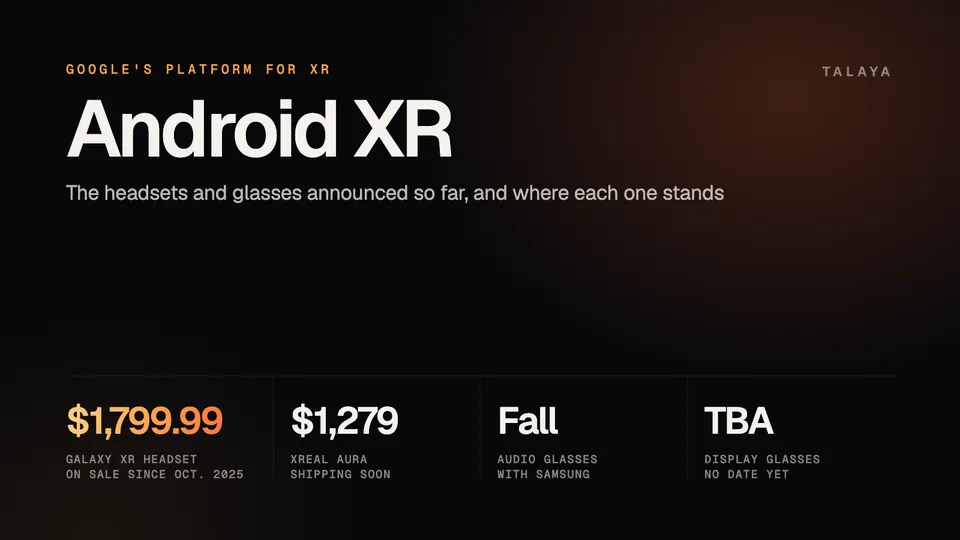
| Device | Maker | Type | Status | Price |
|---|---|---|---|---|
| Galaxy XR | Samsung | Headset with camera passthrough | On sale in the US and South Korea since October 2025, and in the UK since July 2026 | $1,799.99 |
| XREAL Aura | XREAL | See-through glasses wired to a compute puck | Orders open since Oct. 28 in the US, Canada and South Korea, and from Nov. 2 in Japan; shipments start in mid-November | Launch pricing from $1,099 through the end of the year; regular price $1,279, according to 9to5Google |
| Intelligent eyewear (Gentle Monster and Warby Parker designs) | Samsung | Glasses with a camera and speakers, no display | Certified by the FCC on Sept. 27; Chosunbiz reports mid-December sales in Korea and the US, while a Samsung official told The Korea Herald November | Not announced |
| Display AI glasses | Google and partners | Glasses with a display in the lens | Announced as a category, no date; a Samsung model is reported for late 2027 | Not announced |
| Gucci glasses | Kering Eyewear | Not disclosed | Planned for 2027, according to Reuters | Not announced |
Two other pairs have appeared on stage but aren't products: the prototype glasses Google used for its demos in 2025, and a reference design Magic Leap showed with Google in October 2025.
Three kinds of Android XR devices
Google built Android XR for several shapes of hardware at once. "One form factor doesn't fit all, so we're building Android XR to support a diverse range of devices," Shahram Izadi, the Google executive who runs the platform, wrote in December. In practice, that means three groups.
Headsets cover your eyes and show the room through cameras. Galaxy XR is the only one so far.
Wired XR glasses, Google's term for XREAL's category, have clear lenses that let you see the world directly and a cable to a separate computer. Google says they combine headset-like immersion with a view of the real world. Aura is the first.
AI glasses are meant to be worn all day and look like normal frames. Google splits them into audio glasses, which answer through speakers and use a camera to see what you see, and display glasses, which add a small private screen in the lens for things like directions and translation captions. Audio glasses come first.
Samsung Galaxy XR: the headset you can buy now
Galaxy XR launched in October 2025 at $1,799.99, or $149 a month, in the US and South Korea, as the first device on the platform. It runs apps from Google Play alongside versions of Google Maps, Photos, YouTube and Chrome rebuilt for XR, and Gemini can see what's on the screen and in the room to answer questions or act across apps. Updates since then have added PC Connect for Windows computers, a travel mode and Likeness, a realistic avatar for video calls. Samsung began selling it in the UK in July at £1,699, SamMobile reported. Our Galaxy XR explainer covers the specs and how it compares with Apple Vision Pro.
XREAL Aura: the first see-through Android XR glasses
XREAL first showed Aura as Project Aura at Google I/O in May 2025, and Google has since made XREAL a lead hardware partner for Android XR in a multi-year deal. The glasses weigh under 95 grams, show a 70-degree image through clear lenses and connect to a puck with Qualcomm's Snapdragon Reality Elite chip, which runs Android XR, Gemini and Google Play. Google said on Oct. 28 that orders are open in the US, Canada and South Korea, and in Japan from Nov. 2, with launch pricing starting at $1,099 through the end of the year. Shipments begin in mid-November, and you can order at xreal.com/aura or, in the US, at BestBuy.com. The $1,099 is a discount: according to 9to5Google, the 12GB model with 256GB of storage normally costs $1,279, and TechCrunch reports the 16GB model with 512GB at $1,499, or $1,299 at launch. Google and XREAL haven't said what the price will be after the launch window. Our XREAL Aura guide has the full details.
Samsung's glasses with Gentle Monster and Warby Parker
Samsung introduced its first glasses at Galaxy Unpacked on July 22. They have a camera, speakers, Qualcomm's Snapdragon AR1 Gen 1 chip and up to nine hours of battery life, plus seven more charges from the case, but no display. The FCC certified a pair under the model number SM-O200P on Sept. 27. Samsung hasn't published a launch date, and the reports conflict. A Samsung official told The Korea Herald on Oct. 1 that they will launch in November, but on Oct. 30 Chosunbiz reported mid-December sales in Korea and the US, citing unnamed industry sources, and said Europe, China and Japan are left out of the first launch. Samsung hasn't announced a price or a name. Our Samsung smart glasses guide explains what's confirmed and what has only leaked.
Display glasses: promised, not dated
Google's 2025 demos showed glasses with a display in the lens, but that type has the least certain timing. Google described them in December as AI glasses with an in-lens display that "privately shows you helpful information," such as turn-by-turn navigation or translation captions. At Google I/O in May it said only that audio glasses would launch first.
Two reports give the clearest hints. In September, The Elec reported that Samsung had requested color microdisplays for future glasses and that its first model with a color display could arrive toward the end of 2027, according to 9to5Google. In April, Reuters reported that Kering, the owner of Gucci, plans to launch Gucci-branded smart glasses with Google in 2027, The Verge wrote. Neither report says whether the Gucci pair will have a display. Google had named Kering Eyewear as a future partner when it announced its eyewear deals in May 2025.
What Android XR glasses can do
Google's I/O 2026 announcement gives the clearest list of what the first audio glasses will do. You start by saying "Hey Google" or tapping the frame. From there, you can ask Gemini about something you're looking at, such as a restaurant you're walking past or a confusing parking sign, and get turn-by-turn directions that take into account which way you're facing. You can manage calls and texts, have missed messages summarized, take photos and video and edit them with Google's Nano Banana model, and hear translations in a voice that matches the speaker's tone and pitch. Gemini can also carry out multi-step tasks in the background, such as preparing a DoorDash order that you only have to confirm, and work with phone apps like Uber and Mondly. Google says the glasses pair with both Android and iOS phones.
Who else is building for Android XR
When Google announced Android XR on Dec. 12, 2024, it said Qualcomm partners including Lynx, Sony and XREAL could build devices for it, and that it would keep working with Magic Leap on future AR products. Magic Leap extended its partnership with Google for three years in October 2025 and showed a prototype that it describes as a reference design for the Android XR ecosystem, using Google's Raxium microLED light engine, 9to5Google reported. In January 2025, Google also signed an agreement to bring part of HTC's Vive engineering team to Google to speed up work on the platform.
For developers, Google opened the Android XR SDK to glasses apps in December 2025, and at I/O in May it started the Android XR Developer Catalyst Program, which sends Aura developer kits to selected developers, XREAL said.
Android XR timeline
| Date | What happened |
|---|---|
| Dec. 12, 2024 | Google announces Android XR with Samsung and Qualcomm |
| May 20, 2025 | Google names Gentle Monster and Warby Parker as eyewear partners; XREAL unveils Project Aura |
| October 2025 | Galaxy XR goes on sale |
| Dec. 8, 2025 | Google describes screen-free and display AI glasses and gives a first look at Project Aura |
| May 19, 2026 | Google says audio glasses launch first, this fall |
| June 16, 2026 | XREAL opens reservations for Aura |
| July 22, 2026 | Samsung shows its glasses at Galaxy Unpacked |
| Sept. 27, 2026 | The FCC certifies Samsung's smart glasses |
| Oct. 7, 2026 | XREAL prices Aura at $1,279 and $1,499 |
| Oct. 28, 2026 | Aura orders open, with launch pricing from $1,099 and shipments from mid-November |
Android XR glasses arrive more than a decade after Google Glass. Our history of what happened to Google Glass explains how the first attempt ended.
Frequently asked questions
What is Android XR?
It's Google's operating system for headsets and glasses, announced in December 2024 with Samsung and Qualcomm. It runs Android apps from Google Play and builds in Gemini, which can see and hear what you do when you allow it.
Which Android XR glasses can I buy right now?
XREAL Aura is the only pair you can order, and it doesn't ship until mid-November. Google says orders are open in the US, Canada and South Korea, and in Japan from Nov. 2, with launch pricing from $1,099 through the end of the year. Samsung hasn't published a date for its glasses: Chosunbiz reports mid-December, while a Samsung official told The Korea Herald in October it would be November. The only Android XR device shipping today is the Galaxy XR headset.
Do Android XR glasses work with an iPhone?
Google says its intelligent eyewear pairs with both Android and iOS phones. Samsung's footnotes for its first pair, though, require a compatible Galaxy AI phone, and neither company has explained the difference.
Is XREAL Aura an Android XR device?
Yes. It runs Android XR on a compute puck connected to the glasses, with Gemini and Google Play, and Google calls it the first device in its wired XR glasses category.
When will Android XR glasses with a display come out?
Google hasn't given a date. The Elec reported in September that Samsung's first model with a color display could launch in late 2027.
Sources
- Google: Android XR, the Gemini era comes to headsets and glasses (Dec. 12, 2024)
- Google: Agreement with HTC (Jan. 23, 2025)
- Google: A new look at how Android XR will bring Gemini to glasses and headsets (May 20, 2025)
- Google: Introducing Galaxy XR, the first Android XR headset (Oct. 2025)
- Google: The Android Show, new features for Galaxy XR and a look at future devices (Dec. 8, 2025)
- Google: Intelligent eyewear is coming this fall (May 19, 2026)
- XREAL: XREAL unveils Project Aura at Google I/O (May 20, 2025)
- Google and XREAL: Google and XREAL extend strategic partnership (Jan. 6, 2026)
- Google: XREAL Aura, the first wired XR glasses with Android XR (Oct. 28, 2026)
- 9to5Google: XREAL Aura is coming in November with a launch discount (Oct. 28, 2026)
- TechCrunch: XREAL Aura is a new wired headset powered by Android XR (Oct. 28, 2026)
- XREAL: XREAL AURA starts at $1,279 (Oct. 7, 2026)
- XREAL Blog: Project Aura at Google I/O 2026
- Samsung Newsroom: Samsung brings Galaxy ecosystem to everyday eyewear (July 22, 2026)
- FCC ID A3LSMO200P: Samsung smart glasses (via fccid.io)
- The Korea Herald: Samsung to launch first AI glasses in November (Oct. 1, 2026)
- Chosunbiz: Samsung to begin AI glasses sales in mid-December (Oct. 30, 2026)
- SamMobile: Samsung launches Galaxy XR in the UK (June 2026)
- 9to5Google: Samsung's first Android XR glasses with a color display may launch in late 2027 (Sept. 10, 2026)
- The Verge: Gucci-branded Google smart glasses are coming next year (April 16, 2026)
- 9to5Google: Google shows off prototype Android XR glasses from extended Magic Leap deal (Oct. 30, 2025)
- Samsung: Introducing Galaxy XR, Opening New Worlds (Oct. 22, 2025)
Join the conversation
Questions, or something to add? Talk about it with other smart glasses owners in r/Talaya, our community on Reddit.