
Smart Glasses · Guide
Open-ear speakers in smart glasses explained: how they work and who can hear them
Open-ear speakers in the temples play sound toward your ear without sealing it. Meta, Amazon and Bose each say how much of that sound other people can hear, and Meta has added conversation focus and plans hearing software it says is FDA-cleared.

Part of our Explainers guide
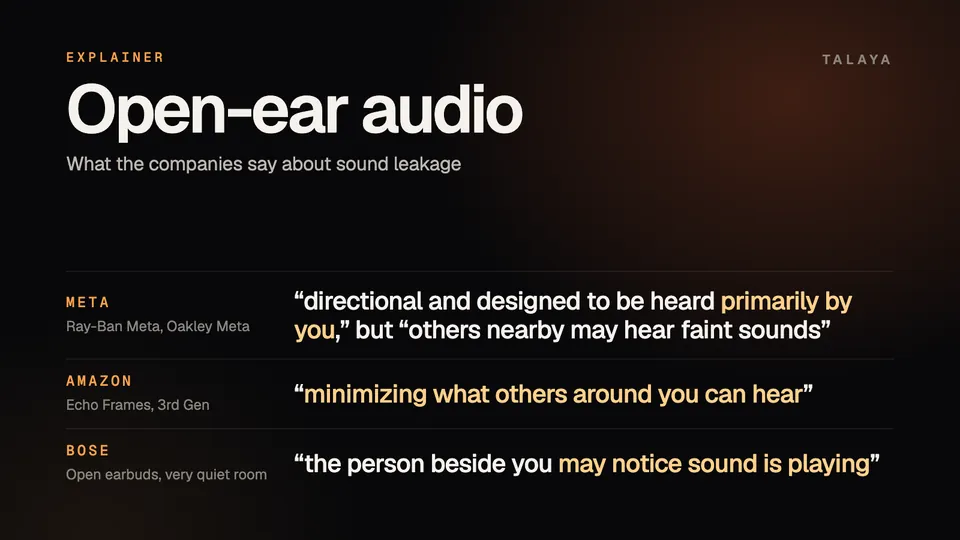
Open-ear speakers sit in the temples of the glasses and play sound toward your ear canal without sealing it. The short answer on who can hear them is mostly you. Meta says the audio from Ray-Ban Meta and Oakley Meta glasses "is directional and designed to be heard primarily by you," but in quiet places or at higher volumes "others nearby may hear faint sounds." None of the companies covered here publishes a distance or decibel figure for leakage in the pages we read.
This explainer is based on Meta's, Amazon's and Bose's own documentation, so the claims are theirs, and we haven't measured any of these speakers.
How open-ear speakers work
In-ear earbuds seal the ear canal. Open-ear speakers don't, which leaves your ears open to the room and makes the sound harder to keep private. Bose, which sells open earbuds, explains the engineering problem: bass and volume "have always depended on either proximity or a seal," so audio played near an open ear "normally sounds thin and quiet."
Bose's answer, for its earbuds, is "a precisely tuned transducer system that aims audio at your ear canal while minimizing sound in every other direction." It names dipole acoustics as the principle and says the design eliminates sound leakage to the people around you.
Meta and Amazon don't explain the mechanism in the pages we read. Meta calls its audio directional. Amazon says the speakers, one in each Echo Frames temple, "direct sound to your ears without covering them, while minimizing what others around you can hear," and that the third generation's custom driver delivers three times the bass of the previous generation, a comparison with its own earlier glasses, according to our Echo Frames guide.
Bone conduction is the other kind of open-ear audio. Bose describes it as "sending sound as vibration through bone into the inner ear," bypassing the ear canal and eardrum. Brilliant Labs' Halo has bone conduction speakers, according to our Halo guide, and RayNeo's iO lists bone-conduction audio, as our RayNeo guide notes. Bose, which sells air-conduction products, says bone conduction suits voices and podcasts but gives music a weaker bassline.
Who can hear what's playing
| Company | Product | What it says |
|---|---|---|
| Meta | Ray-Ban Meta, Oakley Meta | Audio "is directional and designed to be heard primarily by you." In quiet places or at higher volumes, "others nearby may hear faint sounds." Elsewhere Meta describes what bystanders hear as "only a faint hum" |
| Amazon | Echo Frames (3rd Gen) | The speakers, one in each temple, "direct sound to your ears without covering them, while minimizing what others around you can hear" |
| Bose | Open earbuds, not glasses | "In most environments and at typical listening volumes," people around you "typically hear nothing." In a very quiet room like a library at high volume, "the person beside you may notice sound is playing" |
The Bose comments describe earbuds, not glasses, but they show how a company that makes open-ear products frames the same trade-off.
None of the three gives a distance or decibel level, so the practical rule comes from the wording: in a quiet room, keep the volume down. Calls play through the same speakers, as our calls guide notes, so the same rule applies to them. Both Meta and Amazon also adjust the level for you. Meta's adaptive volume raises it in noisy places and lowers it in quiet ones, and battery saver turns that off, according to our Ray-Ban Meta Audio guide and microphone and speaker troubleshooting guide. Amazon's Auto Volume adjusts the level to the noise around you.
Microphones and calls
Open-ear glasses pick up your voice with microphones in the frame, and the counts differ by model.
| Glasses | Microphones | What the maker says |
|---|---|---|
| Ray-Ban Meta Gen 3 | Six | The array "cuts more than 90% of background noise," per Meta |
| Ray-Ban Meta Audio | Six | Calls "capture your voice more clearly than earbuds," per Meta |
| Meta Ray-Ban Display | Five, plus a contact microphone on the nose bridge | Ray-Ban's specification sheet |
| Oakley Meta Vanguard | Five | Tuned to cut wind noise, per Meta |
| Amazon Echo Frames | Four beamforming, two per temple | Microphones "are designed to respond to the voice of the person wearing the frames," per Amazon |
| Even Realities G2 | Four | Doubled from the G1, which matters for its Conversate transcripts |
| Rokid Glasses | Four | A four-microphone array and a speaker in each temple |
| RayNeo iO | Four | Plus bone-conduction audio |
| Vuzix Z100 | None | PCMag found speech-to-text uses your phone's microphone |
Beamforming means combining the signals from several microphones so that sound from one direction, here your mouth, is favored over the rest. Amazon's listing calls its microphones beamforming, while Meta describes its arrays by their count and what they filter out. The pages we read give no test conditions for either company's noise claims.
If people can't hear you on a call, Meta's first fix after checking the voice settings is a "Microphone troubleshooting" switch in the Meta AI app that changes the glasses to a different set of microphones. Our troubleshooting guide has the steps. Amazon lets you mute the microphones with a double press of a button.
Open-ear glasses compared with earbuds
On what the companies publish, open-ear design trades some bass, and in quiet rooms some privacy, for awareness of your surroundings. Bose says deep bass is the hardest sound to produce without a seal. Meta pitches Ray-Ban Meta Audio as high-quality sound "without closing you off from the world around you," and Bose says its earbuds allow "complete awareness of your surroundings." Meta also claims clearer voice pickup on calls than earbuds, though the pages we read give no test results. They compare neither battery life nor hearing safety with earbuds.
Hearing safety
Meta's help center warns that covering the speakers and your ears, for example with close-fitting hats, your hands or protective headphones, can push sound pressure to levels that could damage your hearing. It says to turn the volume down in those situations, and swiping back on the right temple's touchpad does that.
Hearing features: conversation focus and hearing enhancement
Conversation focus makes the voice of the person in front of you louder in noisy places. It arrived in Early Access with the v21 update announced on Dec. 16, 2025, for Ray-Ban Meta and Oakley Meta HSTN in the US and Canada first, and our Meta AI guide says it is free through Early Access in 21 countries. Meta's launch material for Ray-Ban Meta Audio doesn't say whether Audio gets it. To see what your pair supports, open the Meta AI app, tap Glasses, then Device settings, and scroll to Experiences.
At Connect in September, Meta announced two more audio options for every wearer of its AI glasses: audio balance, which shifts sound toward your left or right ear, and mono audio, which sends everything to one side.
Hearing enhancement is a different kind of feature, and our conversation focus and hearing guide covers both in detail. Meta describes it as FDA-cleared software that helps adults with perceived mild to moderate hearing loss hear better on supported AI glasses. It can be set up at home in minutes, with "no clinic or prescription needed," and it launches in the US later this year for $149.99 (HSA and FSA eligible) or with a Meta One subscription. Meta hasn't said which models are supported, and Engadget reported that it comes first to Meta Glasses and later to Gen 3 and Audio, as our Connect recap notes.
For the glasses themselves, see our guides to Ray-Ban Meta Audio, Amazon Echo Frames and smart glasses without a camera.
Frequently asked questions
Can people hear Ray-Ban Meta speakers?
Sometimes, faintly. Meta says the audio is directional and designed to be heard primarily by you, but in quiet places or at higher volumes others nearby may hear faint sounds. The pages we read give no distance or decibel figure.
Are open-ear glasses safe for your hearing?
Meta's help center warns that covering the speakers and your ears, for example with close-fitting hats, your hands or protective headphones, can push sound pressure to levels that could damage your hearing, and it says to turn the volume down. The pages we read make no hearing-safety comparison with earbuds.
Are smart glasses good for phone calls?
Meta says calls on Ray-Ban Meta Audio capture your voice more clearly than earbuds, and that Gen 3's six-microphone array cuts more than 90% of background noise. Amazon says Echo Frames' four beamforming microphones respond to the voice of the wearer. All of those are company claims.
What is conversation focus on Ray-Ban Meta?
A feature that makes the voice of the person in front of you louder in noisy places. It started in Early Access for Ray-Ban Meta and Oakley Meta HSTN in December 2025. Meta's launch material for Ray-Ban Meta Audio doesn't say whether Audio gets it.
Can Ray-Ban Meta glasses work as hearing aids?
Not yet. Meta is adding hearing enhancement, which it says is FDA-cleared software for adults with perceived mild to moderate hearing loss, to supported AI glasses in the US later this year for $149.99. Meta hasn't said which models will support it.
What is the difference between open-ear and bone conduction?
Open-ear glasses play sound through the air from speakers near your ear. Bone conduction, which Brilliant Labs' Halo and RayNeo's iO list, sends sound as vibration through bone to the inner ear, Bose explains.
Sources
Join the conversation
Questions, or something to add? Talk about it with other smart glasses owners in r/Talaya, our community on Reddit.