
Smart Glasses · Guide
Ray-Ban Meta conversation focus and Meta's hearing enhancement: what they do, who gets them
Conversation focus amplifies the voice of the person you're facing in noisy places and is free in Meta's Early Access program. Hearing enhancement is FDA-cleared hearing aid software that Meta says reaches the US later this year for $149.99.

Part of our Ray-Ban Meta guide
Conversation focus is a Meta AI glasses feature that amplifies the voice of the person you're facing in a noisy place. Meta lists it as free in its Early Access program and says it is not a hearing aid. Hearing enhancement is a separate feature: over-the-counter hearing aid software that the FDA cleared on July 13, 2026 for adults 18 and older with perceived mild to moderate hearing loss. Meta says it reaches the US later this year for $149.99 or with a Meta One subscription, and it hasn't said which glasses will support it.
This guide is based on Meta's help center, release notes, newsroom and blog, the FDA's database entry and clearance summary, and Engadget's reporting, all as of Oct. 26, 2026. We haven't tested either feature, and this is general information, not medical advice.
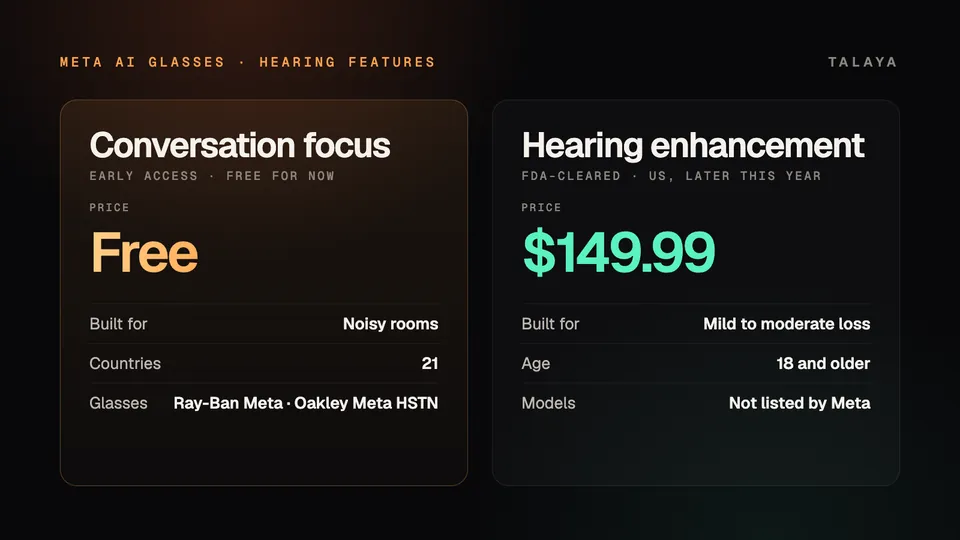
The two features side by side
| Conversation focus | Hearing enhancement | |
|---|---|---|
| What it is | An AI audio feature that amplifies the voice of the person you face | Over-the-counter hearing aid software |
| Meta says it is for | Normal-hearing people in noisy places | Adults with perceived mild to moderate hearing loss |
| Status | Early Access, free for now | FDA-cleared July 13, 2026; US launch "later this year" |
| Price | Free; Meta says it "may require a paid subscription in the future" | $149.99, or included with a Meta One subscription |
| Glasses | Ray-Ban Meta and Oakley Meta HSTN; not Ray-Ban Meta Optics, Meta Glasses or Meta Ray-Ban Display | Not listed by Meta; Engadget reported Meta Glasses first |
| Where | 21 countries in Meta's release notes (see below) | The US |
What conversation focus does
Meta announced conversation focus at Connect in 2025 and started rolling it out on Dec. 16, 2025, in its v21 software update. In its announcement, Meta says the feature "uses the open-ear speakers on your AI glasses to amplify the voice of the person you're talking to," and names a busy restaurant and commuting on a train as examples. Meta's help article, which we read in a copy archived Oct. 11, 2026, says the amplified voice sounds slightly brighter, which helps separate it from the background noise.
The feature uses the glasses' microphones, so it pauses when another feature needs them, such as a phone call or a video recording. It turns off when you take the glasses off and fold the arms. The sound comes out of the same open-ear speakers covered in our open-ear audio explainer, which also explains what people nearby can hear.
Which glasses and countries have it
Meta's December announcement names Ray-Ban Meta and Oakley Meta HSTN, and its Feb. 3, 2026 release note repeats that pairing for the US and Canada. The help article adds that the feature is not available on Ray-Ban Meta Optics, Meta Glasses or Meta Ray-Ban Display. None of the Meta pages we read mentions Ray-Ban Meta (Gen 3), Ray-Ban Meta Audio or Oakley Meta Vanguard, so Meta hasn't said whether those get it. Our Ray-Ban Meta Audio guide notes the same gap for Audio.
The country list is less settled. The help article says conversation focus is available in the US and Canada. Meta's release notes, in a copy archived Sept. 21, 2026, say that since June 29, 2026 it has been "available for free during the Early Access Program" in 21 countries: the US, Canada, the UK, Australia, Ireland, Austria, Belgium, Denmark, Finland, France, Germany, India, Italy, Japan, Mexico, the Netherlands, Norway, South Korea, Spain, Sweden and the United Arab Emirates. Because the two Meta pages disagree, open the Meta AI app, tap Glasses, then Device settings and scroll to Experiences to see what your own pair supports.
How to turn it on and use it
Conversation focus is part of Meta's Early Access program, which you join from the device settings in the Meta AI app. Our Meta AI app guide explains the program, and our updates guide covers why features reach different pairs at different times. Then, following Meta's help article:
- The first time, take the audio tour that sets up the feature.
- Say "Hey Meta, start conversation focus," or tap Glasses, then Conversation focus in the Meta AI app. You can also assign the touchpad's tap-and-hold gesture to it under Glasses, Device settings, Customize controls, Touchpad.
- Face the person you're talking to and stay 6 feet or less apart.
- To change the level, swipe forward on the touchpad for more amplification or back for less. In the app, choose Standard, which Meta describes as moderate amplification for natural-sounding voices, or Boosted, which adds amplification so speech sounds sharper in louder places, then use the plus and minus buttons.
- Tap the touchpad to pause and tap it again to resume.
- To stop, say "Hey Meta, stop conversation focus," tap Off in the app, or take the glasses off and fold the arms. If you assigned tap and hold, that gesture stops it too.
What conversation focus can't do
Meta's help article is direct about the limits. It says conversation focus "is not a hearing aid or medical device and does not diagnose, treat, or compensate for hearing loss," and calls it "an AI audio feature designed for normal-hearing users in noisy environments." The article adds that:
- It works best in noisy social settings, such as restaurants or work events, and isn't intended for extremely loud environments.
- It isn't designed to amplify whispers or faint speech in noisy places.
- It is meant for conversations you're actively part of and works best when you look directly at the person talking.
- It is free now and "may require a paid subscription in the future."
Hearing enhancement: what Meta and the FDA say
Meta's Sept. 23 blog post describes hearing enhancement as FDA-cleared software that helps adults with perceived mild to moderate hearing loss hear better on supported AI glasses. Meta says you can set it up at home in minutes with "no clinic or prescription needed." It launches in the US later this year and will be available to add to supported glasses for $149.99, which Meta calls HSA and FSA eligible, or with a Meta One subscription. Meta adds: "Check your plan to confirm eligibility." Our HSA and FSA guide explains why plan rules differ, and our Meta AI guide covers the Meta One subscription.
The FDA's database has an entry that matches. Meta's announcement doesn't cite a record number, but 510(k) K254044 belongs to Meta Platform Technologies, LLC, is listed as "Hearing assist" and is classified as air-conduction hearing aid software. The FDA received it on Dec. 17, 2025, and its decision on July 13, 2026 was "Substantially Equivalent." In the FDA's terms that is a clearance. The agency found the software substantially equivalent to a legally marketed device, and the device it names is Apple's Hearing Aid Feature.
The FDA's clearance summary, written by Meta, adds details the announcement leaves out. The software is an over-the-counter, self-fitting hearing aid for people 18 and older with perceived mild to moderate hearing loss, "adjusted by the user" without a hearing healthcare professional. It has two parts, an iPhone app and software on the glasses. You complete onboarding and self-fitting in the app while wearing the glasses, which builds your hearing profile. Volume and sharpness controls apply to both ears at once, and you can choose a standard, all-around microphone mode or a focus mode that favors sound from the front.
The summary says the software is designed to last at least three hours of continuous use on a fully charged pair. For evidence, it describes a clinical study of 142 adults at three US sites, including 14 days of home use. On the main measure, people who fitted the software themselves did no worse than people fitted by a licensed hearing care professional. Headache was the most commonly reported side effect, the summary reports no serious adverse device effects, and it says four serious adverse events in two participants were unrelated to the device or the study procedures.
The clearance covers the iPhone version. A change-control plan the FDA also cleared covers adding an Android app later, and Meta hasn't said when Android phones will be supported.
Engadget described the feature differently from Meta. Its Connect roundup says hearing enhancement is "designed more for people who can usually hear fine but might struggle in a noisy environment than hard-of-hearing folks who would benefit more from an actual hearing aid." Meta's own description and the FDA's indication both say perceived mild to moderate hearing loss.
Which glasses get it, and when
Meta says only that hearing enhancement will come to "supported AI glasses" in the US "later this year." Engadget reported that it arrives first on Meta Glasses, Meta's own line, and later on the third-generation Ray-Ban Meta and Ray-Ban Meta Audio. A separate Engadget story says the first wave "doesn't include the Ray-Ban models, at least to start." Engadget also reported a 30-day trial followed by a one-time fee, and a voice command, "Hey Meta, start hearing enhancement." Meta's blog post doesn't mention the trial or the command. Our Meta Glasses guide covers that line, and our Connect 2026 recap covers the rest of what Meta announced.
How it compares with AirPods Pro's Hearing Aid
Apple's Hearing Aid is the nearest comparison, and the FDA's summary uses it as the predicate. Apple's figures below come from our AirPods Pro 3 guide, and Meta's come from the sources above.
| Meta hearing enhancement | AirPods Pro Hearing Aid | |
|---|---|---|
| Design | Open-ear speakers in glasses | Earbuds with ear tips that sit in the ear canal |
| FDA route | 510(k) clearance, July 13, 2026, with Apple's feature as the predicate | De Novo authorization, Sept. 12, 2024 |
| Who it's for | Adults 18 and older with perceived mild to moderate hearing loss | The same |
| Availability | Not on sale; US, later this year | On AirPods Pro 2 and 3 |
| Price | $149.99 or with Meta One, plus the glasses | No separate fee in the pages we read; AirPods Pro 3 cost $249 |
| Phone | iPhone app in the cleared version; Android planned | iPhone, iPad or Mac, per Apple |
| Battery with the feature on | Designed for at least three hours of continuous use | Up to 10 hours of listening in Transparency on AirPods Pro 3, per Apple |
The FDA summary spells out the design difference itself: the glasses deliver amplified sound "without the device obstructing the ear canal," while the AirPods use an ear tip inside the ear canal.
What Meta hasn't published
- Which glasses are supported, and a launch date more specific than "later this year."
- Whether Android phones will work at launch.
- Battery life with the feature running. The FDA summary gives only a design minimum of three hours of continuous use.
- Whether conversation focus is coming to Ray-Ban Meta (Gen 3), Audio or Oakley Meta Vanguard.
- Whether the $149.99 is a one-time charge. Engadget described it that way, and Meta's post doesn't say.
If you have hearing loss
If you're having trouble hearing, a hearing professional can test your hearing and tell you what fits. Conversation focus is built for people with normal hearing, and hearing enhancement isn't on sale yet.
People who already use a hearing aid or another medical device should read Ray-Ban's safety guide (2023 edition) first. It says the glasses and charging case "contain magnetic material and components that emit radio waves, which could affect the operation of medical devices such as pacemakers or other implantable devices, hearing aids, or insulin pumps," and tells you to consult your doctor or the device's maker before using them.
Meta's glasses offer other help for deaf and hard-of-hearing people. Meta Ray-Ban Display can show live captions in the right lens, and Meta announced audio balance and mono audio for every pair of its AI glasses at Connect, as our open-ear guide notes. EssilorLuxottica, which makes Meta's Ray-Ban and Oakley frames, also sells Nuance Audio hearing glasses, which our analysis of its quarterly revenue mentions. Meta's FDA summary notes that the FDA had already cleared a glasses design with external speakers and microphones, under K243150. The FDA's record lists it as "Nuance Audio Hearing Aid Software" from applicant Luxottica Group S.P.A., with a decision of "Substantially Equivalent" on Jan. 31, 2025. Our Nuance Audio hearing glasses guide covers their price, battery life and how they differ from Meta's features.
Correction, Oct. 28, 2026: An earlier version said the FDA clearance K243150 was filed under the name Nuance. The FDA record lists Luxottica Group S.P.A. as the applicant, with Nuance Audio Hearing Aid Software as the device. We also removed the line saying we hadn't reviewed Nuance Audio's pages and added a link to our Nuance Audio guide.
Frequently asked questions
Does Ray-Ban Meta have conversation focus?
Ray-Ban Meta and Oakley Meta HSTN got it through Meta's Early Access program in December 2025. Meta's help article says it isn't available on Ray-Ban Meta Optics, Meta Glasses or Meta Ray-Ban Display, and no Meta page we read mentions Gen 3 or Audio. To check your pair, open the Meta AI app, tap Glasses, then Device settings, and scroll to Experiences.
How do I turn on conversation focus on Ray-Ban Meta glasses?
Join Early Access in the Meta AI app's device settings, take the first-time audio tour, then say "Hey Meta, start conversation focus" or tap Glasses, then Conversation focus. Swipe forward or back on the touchpad to change the level.
Can Ray-Ban Meta glasses work as hearing aids?
Conversation focus can't: Meta says it is not a hearing aid or medical device. Hearing enhancement is FDA-cleared hearing aid software, but it isn't on sale yet and Meta hasn't said which glasses will support it.
How much does Meta's hearing enhancement cost?
Meta says $149.99, or included with a Meta One subscription, when it launches in the US later this year. Meta calls it HSA and FSA eligible and tells you to check your plan. Engadget reported a 30-day trial before a one-time fee.
Is Meta's hearing enhancement FDA approved?
The FDA's records call it a clearance. Its database lists Meta's 510(k) K254044, "Hearing assist," with a July 13, 2026 decision of "Substantially Equivalent," and the clearance summary names Apple's Hearing Aid Feature as the predicate.
Does Meta's hearing enhancement work with Android phones?
The FDA-cleared version describes an iPhone app. A change-control plan the FDA also cleared covers adding an Android app later, and Meta hasn't said when Android phones will be supported.
Sources
- Meta Newsroom: Updates to Meta AI Glasses: Conversation Focus, Spotify Integration, and More (Dec. 16, 2025, updated Jan. 8, 2026)
- Meta Help Center: How to use conversation focus on AI glasses (archived copy of Oct. 11, 2026)
- Meta Help Center: AI glasses release notes (archived copy of Sept. 21, 2026)
- Meta blog: Your personal agent coming to AI glasses (Sept. 23, 2026)
- FDA: 510(k) Premarket Notification database, K254044, Hearing assist (decision July 13, 2026)
- FDA: 510(k) Premarket Notification database, K243150, Nuance Audio Hearing Aid Software (decision Jan. 31, 2025)
- FDA: K254044 clearance letter and 510(k) summary (PDF, July 2026)
- Engadget: Meta brings FDA-cleared hearing enhancement to its smart glasses (Sept. 23, 2026)
- Engadget: Everything announced at Meta Connect 2026 (Sept. 24, 2026)
- Ray-Ban: Ray-Ban Meta safety and warranty guide (2023 edition, PDF)
Join the conversation
Questions, or something to add? Talk about it with other smart glasses owners in r/Talaya, our community on Reddit.