Smart Glasses · Guide
Ray-Ban Meta Gen 3 vs Gen 2: what changed and who should upgrade
Gen 3 adds an hour of battery, a sixth microphone, an action button and two new styles for $70 more than Gen 2, while the camera and video specs match. Here is what changed and who should pay the difference.
Part of our Ray-Ban Meta guide
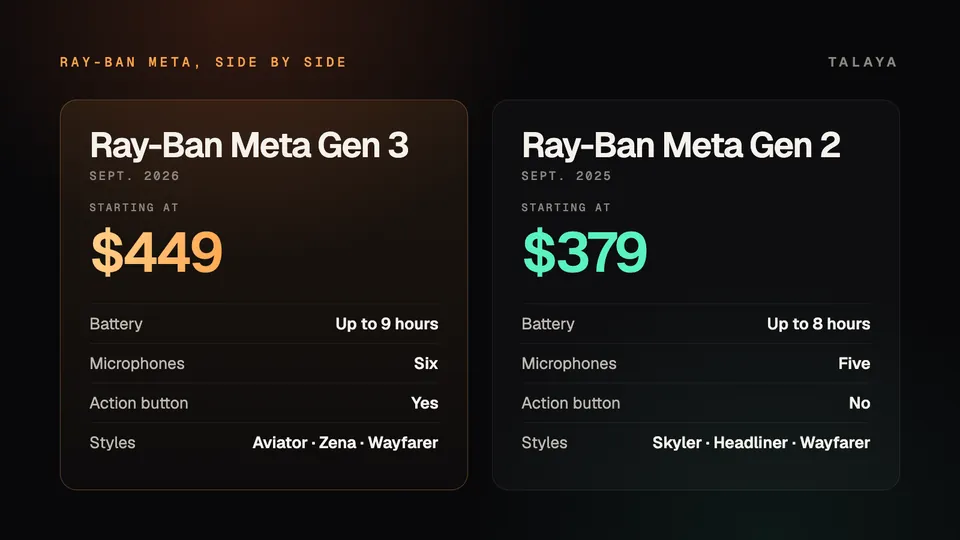
Ray-Ban Meta Gen 3, on sale since Sept. 23, 2026, costs $449 against $379 for Gen 2. For the extra $70, Meta adds an hour of battery (up to nine hours), a six-microphone array in place of five, a customizable action button, temple tips an optician can adjust and two new styles, the Aviator and Zena. The 12MP camera, up to 3K video and storage match on paper, so Gen 2 owners have little reason to switch on specs alone.
This comparison is based on Meta's announcements and store listings, EssilorLuxottica's brochures for opticians and Ray-Ban's US prices as listed on Oct. 25, 2026. We haven't tested either generation.
Gen 3 vs Gen 2 at a glance
| Ray-Ban Meta Gen 3 | Ray-Ban Meta Gen 2 | |
|---|---|---|
| Starting price (US) | $449 | $379 |
| Launched | Sept. 23, 2026 | Sept. 17, 2025 |
| Battery on the glasses | Up to 9 hours | Up to 8 hours |
| Extra from the case | Up to 50 hours | Up to 48 hours |
| Camera | 12MP | 12MP |
| Video | Up to 3K at 30 fps, 1080p at up to 60 fps | Up to 3K at 30 fps, 1080p at up to 60 fps |
| Microphones | Six | Five |
| Controls | Touchpad, capture button, customizable action button | Touchpad, capture button |
| Styles | Wayfarer (standard and large), Aviator, Zena | Wayfarer (standard and large), Skyler, Headliner |
| Storage | 32GB | 32GB |
| Prescription | Most prescriptions (Aviator: -6.00 to +4.00) | -12.00 to +6.00 |
What changed
Battery
Meta says Gen 3 lasts up to nine hours, an hour more than Gen 2, and its charging case adds up to 50 hours against 48 for Gen 2. Both are "up to" figures; Meta's Gen 2 launch post says "typical use." EssilorLuxottica's brochure gives Gen 2 up to five hours of continuous audio and 5.5 hours of continuous calls. We found no continuous-use figures for Gen 3, and Ray-Ban's FAQ describes its nine hours as "mixed use."
Microphones
Gen 3 has a six-microphone array that Meta says cuts more than 90% of background noise, so calls and voice commands stay clear on windy or crowded streets. EssilorLuxottica's brochure lists five microphones for the standard Gen 2 styles. The same brochure lists six for Gen 2's Optics frames, which Meta introduced in March for prescription wearers, so Gen 3 isn't the first Ray-Ban Meta with the larger array.
Action button and fit
Gen 3 adds "a new customizable action button for instant access to Meta AI," in Meta's words. You set what it does in the Meta AI app under Customize controls, and Ray-Ban's FAQ names live translation and quick connect among the actions. The standard Gen 2 styles have a touchpad and a capture button but no action button, although the Optics frames added one. Gen 3 also has temple tips an optician can adjust, and Meta calls the frames slimmer and more comfortable than before.
Styles
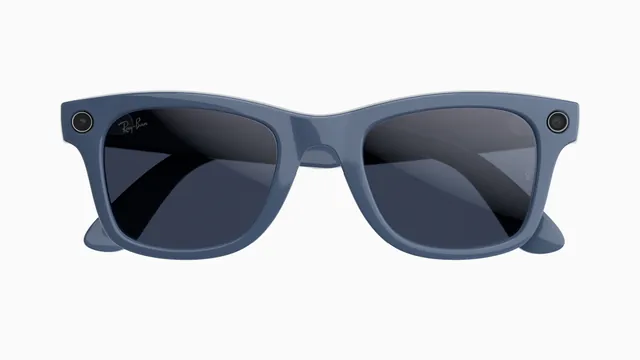
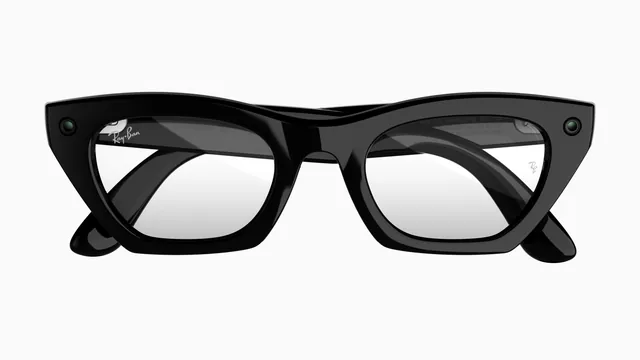
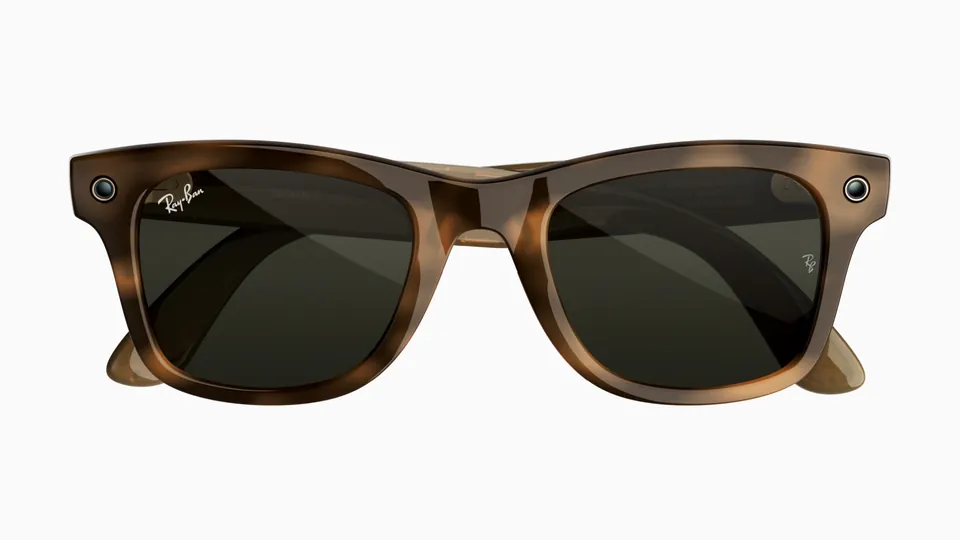
Gen 3 comes in 27 color and lens combinations across three styles: Wayfarer in standard and large sizes, Aviator and the cat-eye Zena. Gen 2 comes in Wayfarer, Skyler and Headliner, and Gen 3 doesn't offer the last two. Our price guide covers the $579 limited-edition Aviator.
Price
Ray-Ban's US store lists Gen 3 from $449 and Gen 2 from $379. Transitions lenses add $80 on the Gen 3 Wayfarer and Aviator ($529) and on a Gen 2 Skyler ($459), and polarized lenses add $30 on Gen 3.
What stayed the same
Meta's compare page lists a 12MP wide-angle camera for the Gen 3 Wayfarer, with video up to 3K at 30 frames per second and 1080p at up to 60. EssilorLuxottica's brochure lists a 12MP ultra-wide camera and the same video modes for Gen 2. Both carry 32GB of storage and an IPX4 rating, which Meta's help center says covers light rain but not submersion.
Meta's Gen 3 announcement does call out "new dynamic photos" that let you choose the best frame, and says Meta AI glasses will record Dolby Atmos video later this year without naming models.
Is Gen 2 still sold, and for how much?
Yes. Ray-Ban's US store still listed Gen 2 from $379 on Oct. 25, $70 below Gen 3. Meta's Spanish store sells the Gen 2 Wayfarer from €419 against €449 for Gen 3, and its Gen 2 page links to Gen 3 with the line "For newer styles and tech." Meta's Gen 3 announcement doesn't say Gen 2 is being retired.
Who should upgrade
If you own Gen 2
Probably not. The camera and video that most people buy these glasses for are the same on paper, and Meta's announcements don't say Gen 3 gets software that Gen 2 won't. Meta says Muse is coming to its AI glasses without naming models, and EssilorLuxottica told opticians in March that software updates are retroactive across Gen 1 and Gen 2.
Switching makes sense if you take calls or give voice commands on noisy streets and want the six-microphone array, want a one-press shortcut, prefer the Aviator or Zena, or need the extra hour. If you sell your Gen 2, factory reset it first, because the glasses pair with one Meta account at a time.
If you own Gen 1
The big jump is from Gen 1's four hours to Gen 2's eight, and Gen 3 adds one more. Our Gen 2 vs Gen 1 comparison covers what you would gain by going to either.
If you're buying new
On specs, Gen 3 is the better pair if $70 isn't a stretch: it has the longest battery life of the camera models, the six-microphone array and the action button. Gen 2 is the cheaper choice and the only one of the two in the Skyler and Headliner shapes. If you don't want a camera at all, look at Ray-Ban Meta Audio, and if you want a display, see Meta Ray-Ban Display vs Gen 3.
If you wear prescription lenses
Both generations take prescriptions. Meta's help center lists -12.00 to +6.00 for Ray-Ban Meta glasses and a narrower -6.00 to +4.00 for the Gen 3 Aviator. The Gen 2 Optics frames, built for prescription wearers, already have six microphones and an action button, and Ray-Ban sells Gen 3 versions of the Optics frames from $449. Our prescription guide covers lens types, prices and where to order.
For the full lineup, see our complete Ray-Ban Meta guide.
Frequently asked questions
Is Ray-Ban Meta Gen 2 being discontinued?
Meta hasn't said so. Ray-Ban's US store still listed Gen 2 from $379 on Oct. 25, and Meta's Spanish store sells it for €419 with a link to Gen 3 under the line "For newer styles and tech." Meta's Gen 3 announcement doesn't mention retiring it.
Does Ray-Ban Meta Gen 3 have a better camera than Gen 2?
Not on paper. Meta lists a 12MP ultra-wide camera and up to 3K video at 30 frames per second for Gen 3, and EssilorLuxottica's brochure lists the same video modes for Gen 2. Meta's Gen 3 announcement does highlight new dynamic photos, which let you choose the best frame.
How long does the Ray-Ban Meta Gen 3 battery last?
Meta says up to nine hours on the glasses, an hour more than Gen 2, plus up to 50 more hours from the charging case. Ray-Ban's FAQ describes the nine hours as mixed use, so heavy streaming or calls will drain it sooner.
Can I get Ray-Ban Meta Gen 3 with prescription lenses?
Yes. Meta says Gen 3 "supports most prescriptions," and its help center lists -12.00 to +6.00 for Ray-Ban Meta glasses, with the Gen 3 Aviator limited to -6.00 to +4.00. Our prescription guide covers lens types, prices and where to order.
Will Gen 2 glasses get new Meta AI features like Muse?
Meta hasn't named which glasses will get Muse. EssilorLuxottica told opticians in March that software updates are retroactive across Gen 1 and Gen 2, so updates have so far reached both generations, but Meta hasn't promised that for Muse.
Sources
- Meta: Introducing Ray-Ban Meta Audio and More AI Glasses Styles (Sept. 23, 2026)
- Meta: Ray-Ban Meta (Gen 2) Now With Up to 2X the Battery Life and Better Video Capture (Sept. 17, 2025)
- Meta: Compare AI glasses (Ray-Ban Meta Gen 3 Wayfarer listing)
- Meta Store: Ray-Ban Meta Wayfarer (Gen 2) listing
- EssilorLuxottica: Ray-Ban Meta (Gen 2) brochure for eye care professionals (March 2026)
- EssilorLuxottica: Ray-Ban Meta (Gen 2) Optics brochure for eye care professionals (March 2026)
- EssilorLuxottica: Ray-Ban Meta Optics styles press release (March 31, 2026)
- Ray-Ban India: Ray-Ban Meta FAQ
- Meta Help Center: How to order prescription lenses for AI glasses (archived copy of Aug. 31, 2026)
- Ray-Ban: Ray-Ban Meta glasses, US store (prices checked Oct. 25, 2026)
Join the conversation
Questions, or something to add? Talk about it with other smart glasses owners in r/Talaya, our community on Reddit.