Smart Glasses · Guide
Meta Orion AR glasses explained: specs, why they aren't for sale and what's next
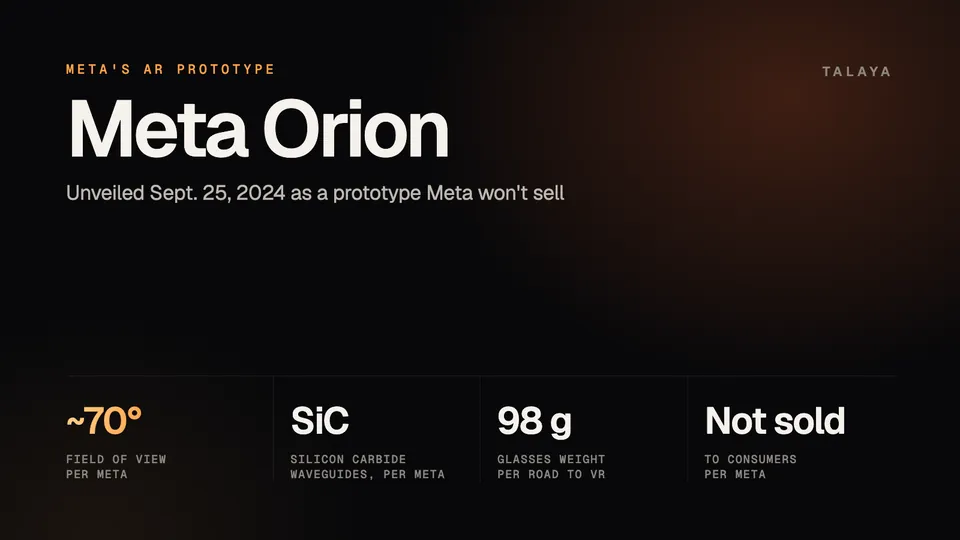
Orion is the AR glasses prototype Meta unveiled on Sept. 25, 2024 and has never sold. This explainer covers what Meta has said about its display, puck and wristband, why it stays in the lab and what Meta and the press say about consumer AR glasses.
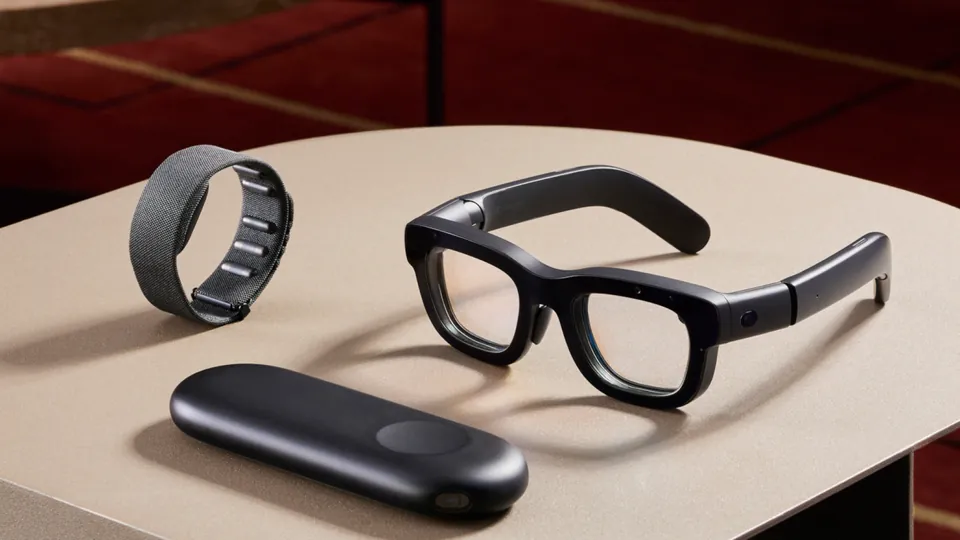
Orion is Meta's prototype pair of augmented reality glasses, shown at Connect on Sept. 25, 2024, and it isn't for sale. Meta calls it "the most advanced pair of AR glasses ever made." The glasses have a field of view of approximately 70 degrees, silicon carbide waveguides, a wireless compute puck that fits in a pocket and an EMG wristband for input. Meta says Orion won't reach consumers and that it is working on a consumer version, and it hasn't given a date or a price.
This explainer is based on Meta's newsroom and blog posts as of Oct. 26, 2026, with press reports attributed by name and date.
What Orion is
Meta unveiled Orion in 2024 and says it was previously codenamed Project Nazare. It describes the glasses as combining "the look and feel of a regular pair of glasses with the immersive capabilities of augmented reality," and its Orion page calls the project "nearly a decade in the making." Meta says the team thought it had "less than a 10% chance of pulling it off successfully."
Meta separates AR glasses from the Ray-Ban Meta line it sells. In its announcement, AR glasses combine "the benefits of a large holographic display and personalized AI assistance in a comfortable, all-day wearable form factor." With a large display, Meta says, "you can use the physical world as your canvas, placing 2D and 3D content and experiences anywhere you want." Meta AI runs on Orion and "understands what you're looking at in the physical world." Meta's examples were a recipe suggestion based on what's in your refrigerator, hands-free video calls and WhatsApp and Messenger messages. Through the transparent lenses, it said, you can still see other people's eyes and expressions, which it contrasted with mixed reality headsets.
Orion's specs: what Meta and the press have said
| Part | What's known | Source |
|---|---|---|
| Field of view | Approximately 70 degrees, which Meta calls the widest in an AR glasses form factor to date | Meta |
| Waveguides | Optical-grade silicon carbide, one plate per lens, refractive index of 2.7 | Meta |
| Projectors | uLED (microLED) | Meta |
| Frame | Lightweight magnesium | Meta |
| Input | Voice, eye tracking, hand tracking and an EMG wristband | Meta |
| Compute | Wireless puck with its own battery, a system on a chip and a Meta-designed AI co-processor | Meta |
| Weight | 98 grams | Road to VR, summarizing a Tested interview with Meta CTO Andrew Bosworth |
| Resolution | 13 pixels per degree in the main demo; Meta's goal for a product is 30 | Road to VR |
| Brightness | 300 to 400 nits reaching the eye | Road to VR |
| Battery | About three hours for the glasses; "all day" for the puck | Road to VR |
| Cost | Around $10,000 a unit | UploadVR; Road to VR calls it "purported" |
The display and waveguides
Meta says its work on optical-grade silicon carbide made the roughly 70-degree view possible. In a Quest blog post, its waveguide team says silicon carbide has a refractive index of 2.7, which it calls the highest known for an optical application, against about 2.3 for lithium niobate and 1.8 for the glass the team started with. A higher index lets a waveguide carry a wider view. Meta says silicon carbide let it use a single plate per lens, where glass needed several, and cut the rainbow-colored artifacts that wide views tend to produce.
The projectors are microLED. Road to VR reported that Meta says the projectors output hundreds of thousands of nits, with 300 to 400 nits reaching the eye after the optical path. Road to VR noted that this is a long way from what it estimated outdoor use needs, around 3,000 nits. Our explainers on waveguide displays and field of view cover what these terms mean.
The compute puck
Orion offloads its processing to a puck. Meta's blog post on the puck says it connects wirelessly to the glasses and the wristband and has its own high-capacity battery, a high-performance system on a chip and a custom Meta-designed AI co-processor. A Meta product director quoted there says the puck is "smaller than the average phone." Meta says the puck holds the wireless connectivity, computing power and battery, which helps reduce the weight of the glasses and spreads heat over a larger surface. In the early days the puck was codenamed Omega and was imagined as a neck band wired to the glasses.
Road to VR reported that the puck talks to the glasses over a custom Wi-Fi 6 protocol with a range of about 10 feet, and that the glasses run for up to three hours while the puck is said to last all day.
The EMG wristband
Meta says it combined voice, eye tracking and hand tracking with EMG in "a comfortably worn wristband for subtle, socially acceptable input," which it says works in low light or in public "without requiring your hands in view of sensors." EMG reads the electrical signals your wrist muscles make when you move your fingers. Our Neural Band explainer covers how the band Meta sells with its display glasses works.
Weight
Road to VR reported that Orion weighs 98 grams, just under the 100-gram mark Meta believes separates glasses from goggles. For comparison, our guides list the Gen 3 Wayfarer at 51.5 grams, Meta Ray-Ban Display at 69 grams and the Even G2 at 36 grams. XREAL says its Aura, which keeps the computer in a tethered puck, weighs under 95 grams.
Why Orion isn't for sale
Meta says Orion "won't make its way into the hands of consumers." It describes the glasses as "one of the most polished product prototypes we've ever developed" and "truly representative of something that could ship to consumers," and it wrote that "rather than rushing to put it on shelves, we decided to focus on internal development first." Meta gave Orion to its employees and "select external audiences" to learn from. It listed three things it was working on next: a sharper display, a smaller form factor and "building at scale to make them more affordable."
Cost is the other reason Meta's posts point to. Meta's waveguide team says silicon carbide "has always been expensive" and that early on "the non-recurring engineering costs were very high, so the resulting substrate was quite expensive." It adds that supply of optical-grade silicon carbide has grown since Orion was built, with suppliers moving from four-inch to eight-inch wafers, and that "the cost of the substrate has started to come down."
UploadVR wrote in January 2025 that Meta "freely admits" Orion's field of view relies on components and materials that "aren't yet possible to affordably manufacture at scale" and that each unit would cost around $10,000 to make. Road to VR called the $10,000 figure "purported" and reported that Meta planned to build about 1,000 units for internal testing. Meta hasn't published a unit cost in the pages we read.
What Meta has said since about consumer AR glasses
- Sept. 25, 2024: In its Orion announcement, last updated Sept. 12, 2025, Meta said it was opening Orion to employees and select outside audiences to build toward "our consumer AR glasses product line, which we plan to begin shipping in the near future." It added that "in the next few years, you can expect to see new devices from us that build on our R&D efforts."
- Sept. 17, 2025: When it launched Meta Ray-Ban Display, Meta listed augmented reality glasses as the third type of glasses it makes and wrote: "We're continuing to work on a consumer version of our Orion prototype that we showed at Connect last year, so stay tuned."
- Sept. 24, 2026: Meta's recap of Connect 2026 doesn't mention Orion or AR glasses. Its headline hardware was Meta VR Glasses, a virtual reality device of about 100 grams that goes on sale in spring 2027 for $1,299.99, as our Connect recap and VR Glasses guide explain.
In the posts we read, Meta hasn't named a product, a date or a price for consumer AR glasses.
What the press has reported about Meta's next AR glasses
These are reports from unnamed sources and interviews, and Meta hasn't confirmed them in anything we read.
- Road to VR, Oct. 7, 2024: Summarizing a Tested interview with Bosworth, Road to VR reported that Meta expected a consumer version of Orion before 2030, at a price of around $1,500.
- Bloomberg, Jan. 21, 2025: Mark Gurman reported, as Engadget and UploadVR relayed it, that Orion won't get a commercial release and that Meta plans a different AR product as early as 2027, codenamed Artemis. Engadget wrote that sources described the prototypes as lighter than Orion and more advanced. UploadVR added that Gurman reported Meta would offer Orion to developers in 2026, and that earlier reports indicated Artemis would have a narrower field of view than Orion.
The same Bloomberg report projected a price of $1,000 for Meta's display glasses, Engadget noted. Meta launched Meta Ray-Ban Display at $799, so reported figures can move before a launch. The Meta posts we read don't mention a wider Orion developer program.
How Orion relates to Meta Ray-Ban Display and the Neural Band
When it launched Meta Ray-Ban Display, Meta sorted its AI glasses into three types: camera AI glasses such as Ray-Ban Meta and Oakley Meta, display AI glasses such as Meta Ray-Ban Display, and AR glasses. Meta described the last group this way: "AR glasses, like our Orion prototype, feature a large holographic display and digital experiences that augment the world around you."
| Orion | Meta Ray-Ban Display | |
|---|---|---|
| Status | Prototype, not sold | On sale from $799 with the Neural Band, in six countries |
| Display | Approximately 70-degree field of view | 20 degrees, full color, right lens only |
| Weight | 98 grams (Road to VR) | 69 grams |
| Compute | Separate wireless puck | In the glasses |
| Input | Voice, eye tracking, hand tracking, EMG wristband | Neural Band, touchpad, voice |
| Battery | About three hours for the glasses (Road to VR) | Up to six hours, plus up to 24 from the case |
Meta describes the Display screen as placed "off to the side" and designed for "short interactions." Orion's wide view is meant to hold multitasking windows, big-screen entertainment and what Meta calls life-size holograms of people.
The Neural Band brings the same kind of wrist-based EMG input to a product Meta sells. Meta says it is "the product of years of surface electromyography (EMG) research with nearly 200,000 research participants" and that it shared a look at its wrist-based EMG work four years before the Display launch. For now the band works only with Meta Ray-Ban Display. Our Display guide has the full specifications.
If you want AR glasses now
No AR glasses from Meta are on sale. Among see-through AR glasses, XREAL says Aura has a 70-degree field of view at under 95 grams with a tethered puck, starts at $1,279 and ships soon in the US, Canada, Japan and South Korea. Snap's Specs have a 51-degree field of view, cost $2,195 and are due this fall in the US, UK and France. Our XREAL Aura guide and Snap Specs guide cover each, and our release date tracker lists what's due next. For how AR differs from the display glasses Meta sells today, see our explainer on AI, AR and display glasses, and for the history, our smart glasses timeline.
Frequently asked questions
Can you buy Meta Orion?
No. Meta says Orion "won't make its way into the hands of consumers," and its Orion page describes it as not available to the public. Meta gave access to its own employees and select external audiences.
When will Meta release consumer AR glasses?
Meta hasn't said. It wrote in 2024 that it plans to begin shipping a consumer AR line "in the near future" and said on Sept. 17, 2025 that it is "continuing to work on a consumer version" of Orion. Bloomberg's Mark Gurman reported in January 2025 that a product codenamed Artemis could come as early as 2027, and Meta hasn't confirmed that.
How much does Meta Orion cost?
It isn't for sale, and Meta hasn't published a unit cost in the pages we read. UploadVR reported in January 2025 that each unit would cost around $10,000 to make, and Road to VR called that figure purported and said Meta planned about 1,000 units for internal testing.
What is the Orion compute puck?
A pocket-size device that handles the glasses' processing. Meta says it connects wirelessly to the glasses and the wristband and has its own battery, a system on a chip and a Meta-designed AI co-processor, which lets the glasses themselves be lighter.
How does Orion's field of view compare with other AR glasses?
Meta says approximately 70 degrees. XREAL publishes 70 degrees for Aura, Snap publishes 51 for Specs, and the screen on Meta Ray-Ban Display covers 20 degrees. See our field of view explainer.
Is Orion the same as Meta Ray-Ban Display?
No. Meta groups Orion with AR glasses and Meta Ray-Ban Display with display AI glasses. Display is on sale, has a smaller screen in one lens and no separate puck, and comes with the Neural Band. Our Display guide has the specifications.
Sources
- Meta: Introducing Orion, our first true augmented reality glasses (Sept. 25, 2024, updated Sept. 12, 2025)
- Meta: Orion AI glasses, the future of AR glasses technology (read Oct. 26, 2026)
- Meta Quest Blog: Orion's compute puck, the story behind the device that helped make our AR glasses possible
- Meta Quest Blog: Crystal clear, our silicon carbide waveguides and the path to Orion's large field of view
- Meta: Meta Ray-Ban Display, AI glasses with an EMG wristband (Sept. 17, 2025)
- Meta: The Biggest News From Connect 2026 (Sept. 24, 2026)
- Meta: Introducing Meta VR Glasses (Sept. 23, 2026)
- Road to VR: Meta Orion interview dives deep into details like resolution, battery life and more (Oct. 7, 2024)
- UploadVR: Meta will reportedly offer Orion AR glasses to developers next year (Jan. 22, 2025)
- Engadget: Report, Meta could release its first true AR headset as soon as 2027 (Jan. 21, 2025)
- XREAL: XREAL Aura starts at $1,279 (Oct. 7, 2026)
- Snap Inc.: Snap debuts SPECS augmented reality glasses (June 16, 2026)
Join the conversation
Questions, or something to add? Talk about it with other smart glasses owners in r/Talaya, our community on Reddit.