Smart Glasses · Guide
Can kids and teens use Ray-Ban Meta glasses? Age limits, safety and fit
Ray-Ban's safety guide says the glasses are for people 13 and older, and Meta's terms set the same minimum age for the Meta account you need to use them. Here is what else the sources say about kids, teens, fit and privacy.
Part of our Ray-Ban Meta guide
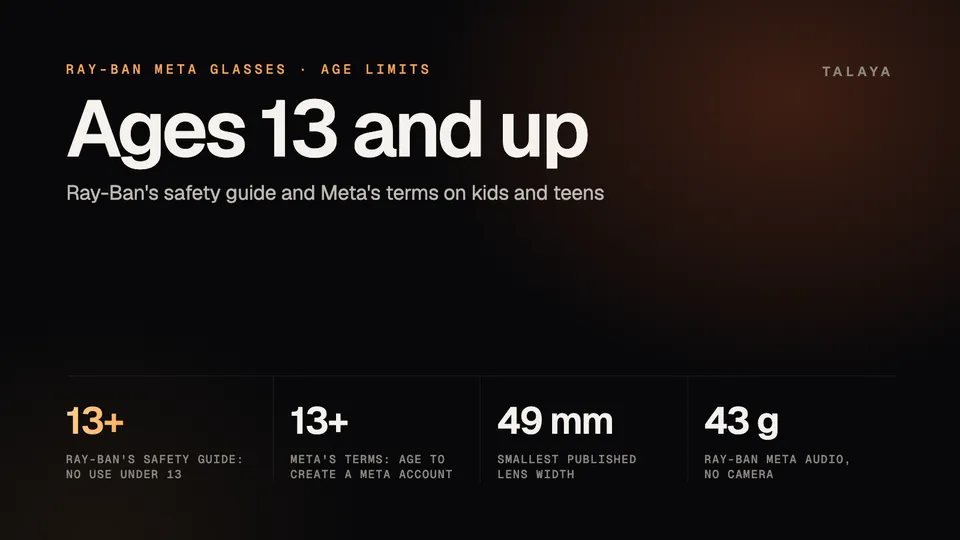
Ray-Ban Meta glasses are for people 13 and older. Ray-Ban's safety and warranty guide says the glasses are "intended only for use by persons age 13 or older" and tells owners: "Do not allow anyone under 13 to use the Product." Meta's terms set the same floor for the Meta account the glasses need.
This guide is based on the 2023 edition of Ray-Ban's safety guide, Meta's supplemental terms for its hardware products, Ray-Ban's FAQs and the published sizes. We found no teen mode or parental controls for the glasses in those pages. We haven't tested the glasses.
What Ray-Ban and Meta say about age
| Source | What it says |
|---|---|
| Ray-Ban safety and warranty guide (2023 edition) | "For ages 13 and up." Do not allow anyone under 13 to use the glasses. Children can choke or suffocate if they swallow the product, so keep it away from them. |
| Meta's Supplemental Meta Platforms Technologies Terms of Service (updated April 29, 2025) | You must be at least 13 to create a Meta account for Meta's hardware products. Parents can create accounts for children ages 10 to 12, but those accounts "may not be supported on all MPT Products, including Meta Wearable Products." |
| Ray-Ban's FAQ | The Meta AI app needs a Meta account, and sign-up asks for your name, birthday and email address. |
Meta lists those supplemental terms among its AI glasses legal documents, next to the AI glasses terms of service and the health and safety information. In the terms, "MPT Products" is shorthand for Meta Platforms Technologies products. The sentence about wearables doesn't say which products count, but Ray-Ban's guide leaves no room for children under 13 on the glasses either way. That edition of the guide predates Gen 3 and Audio, and Meta's terms are newer.
The Meta AI app, where you set up and manage the glasses, needs a Meta account too, so the account's age rule applies there as well. If a teen links Facebook or Instagram to share captures, those apps come with their own limits: Meta's terms say using other Meta company products is "subject to the relevant terms and conditions, including minimum age requirements, for those Meta Company Products."
Who is responsible for a teen's use
Meta's terms put the responsibility on the account holder. They say "You are responsible for the activities of all users of your MPT Products" and "We encourage you to monitor others who use your MPT Products." Ray-Ban's FAQ says a pair of glasses can pair with only one Meta account at a time, so whoever's account is on the glasses is the one those terms point to. Decide who that is before a teen takes a pair out of the house.
Handing a pair to someone else takes a factory reset, which erases all captures and the link to the old Meta account, Ray-Ban's FAQ says. Our factory reset guide has the steps.
Small parts, batteries and the case
Right after the age rule, Ray-Ban's guide adds a warning for young children: "Children can choke or suffocate in case of swallowing of this Product. Keep this Product away from children." It describes the battery as lithium-ion and "not user replaceable," says the battery "may present a fire or chemical burn hazard if misused," and warns against disassembling, crushing or puncturing it, or leaving the glasses in a car in direct sunlight.
The same section has rules worth passing on to a younger wearer. Use only the provided charging accessories, and "do not wear or clean the Product while you are charging it." The charging case "is not water resistant," and the glasses aren't designed to resist submersion; our water resistance guide explains the IPX4 rating. On sound, the guide warns that "exposure to loud sound may damage your hearing and could distract you." For teens who drive, it says to "use caution when operating a motor vehicle while wearing the Product" and to follow local laws on phone use at the wheel.
A pair with prescription lenses "is intended only for use by the prescribed user," and Ray-Ban says use by anyone else "may provide inadequate vision correction or vision that is worse than normal," so a prescription pair isn't a hand-me-down.
Fit for smaller faces
We found no children's size for any Ray-Ban Meta style. The smallest lens width we found published is 49 mm, on the Zena (Gen 3) and the Scriber Optics (Gen 2). The Wayfarer comes in 50 and 53 mm and the Blayzer Optics in 50 and 54 mm. Our styles and sizes guide found no published widths for the Skyler, Headliner, Clubmaster or Burbank and has every other figure.
Some styles come with nose fit options. EssilorLuxottica describes the low-bridge Headliner as made "for petite and flatter noses." Each Gen 3 nose pad can be set to one of three positions, and the Optics frames ship with high-bridge and low-bridge pads in the box. Meta lists adjustable or swappable nose pads for Audio, which it puts at 43 grams. Ray-Ban's FAQ says Gen 3 temple tip adjustments "should only be performed by an optician."
If a pair doesn't fit, the Meta Store allows returns within 30 days of delivery and Ray-Ban.com within 45 days of receipt. Our warranty and returns guide has the rules.
Privacy, recording and school rules
Meta's terms leave the responsibility for recording with the wearer. They say users may not "tamper with the MPT Products, or otherwise obscure or modify any features that are intended to signal to others that the product is recording," and they make the wearer responsible for "providing any notice to or obtaining any consents from other individuals" where recording or privacy laws require it. Those laws vary by state: roughly a dozen require everyone's consent to record a conversation, and every state restricts hidden cameras in private places such as bathrooms and changing rooms. Our guide to recording laws goes state by state, and our bystander privacy guide explains the capture light.
We found no school policy published by Meta or Ray-Ban, so ask the school before a teen brings camera glasses. Our complete Ray-Ban Meta guide notes that Meta advises switching the glasses off in places such as doctors' offices, changing rooms and schools. A privacy FAQ that Sunglass Hut hosts for its customer-facing specialists takes up the question of schools, gyms and hospitals. Its answer is that users must follow all applicable laws and rules and use the glasses respectfully, as they would any recording device, including a phone.
Data matters for parents too. Meta says voice recordings are stored and the option to turn storage off is gone, though you can delete them. Photos and videos stay on the glasses until imported, while a picture used to answer a Meta AI question goes to Meta's cloud. Our Meta AI guide lists the settings.
If a camera is the concern, Ray-Ban Meta Audio is the one line without it. Meta lists the Clubmaster and Burbank frames as audio-only, with no camera, and our Gen 3 vs Audio comparison covers what you give up.
Frequently asked questions
What is the minimum age for Ray-Ban Meta glasses and the Meta AI app?
Thirteen. Ray-Ban's safety guide says not to let anyone under 13 use the glasses, and Meta's terms require you to be at least 13 to create a Meta account. The Meta AI app, where you set up the glasses, needs that account. Meta publishes separate Meta AI Terms of Service for the assistant itself, which we couldn't read, so we can't say whether they add a limit.
Can a 12-year-old use Ray-Ban Meta glasses with a parent-created account?
Ray-Ban says no: its guide tells owners not to allow anyone under 13 to use the glasses. Meta lets parents create Meta accounts for children ages 10 to 12, but its terms say those accounts "may not be supported on all MPT Products, including Meta Wearable Products."
Do Ray-Ban Meta glasses come in kids' sizes?
We found no children's size for any Ray-Ban Meta style. The smallest published lens width is 49 mm, on the Zena and the Scriber Optics. Our styles and sizes guide lists the widths, nose pad options and weights.
Are there parental controls for Ray-Ban Meta glasses?
We found none in the Meta and Ray-Ban pages we read. Meta's terms make the account holder responsible for "all users of your MPT Products" and encourage monitoring them, and a pair of glasses pairs with only one Meta account at a time.
Can kids wear Ray-Ban Meta glasses at school?
That is up to the school. Meta advises switching the glasses off in places such as schools, according to our complete Ray-Ban Meta guide, and a Sunglass Hut privacy FAQ says users must follow all applicable laws and rules. Ask the school before bringing camera glasses.
Sources
- Ray-Ban: Ray-Ban Meta safety and warranty guide (2023 edition)
- Meta: Supplemental Meta Platforms Technologies Terms of Service (archived copy of Oct. 10, 2026; last updated April 29, 2025)
- Meta: AI glasses legal documents (archived copy of June 9, 2026)
- Ray-Ban: Ray-Ban Meta FAQ, India store
- Ray-Ban: Ray-Ban Meta FAQ, US (archived copy of Nov. 14, 2025)
- Sunglass Hut: Privacy on Meta AI glasses FAQ for customer-facing specialists (June 18, 2026, PDF)
- Meta: Introducing Ray-Ban Meta Audio and More AI Glasses Styles (Sept. 23, 2026)
Join the conversation
Questions, or something to add? Talk about it with other smart glasses owners in r/Talaya, our community on Reddit.