Smart Glasses · Guide
Oakley Meta or Ray-Ban Meta: which smart glasses to get in 2026
Oakley Meta and Ray-Ban Meta run the same assistant and the same app. They differ in the frame: water resistance, lenses, microphones, prescription range and the fitness features only Vanguard has.

Part of our Oakley Meta guide
Oakley Meta and Ray-Ban Meta come from the same partnership between Meta and EssilorLuxottica. They use the same Meta AI assistant, pair with the same Meta AI app and shoot 12MP photos and 3K video. So the choice comes down to the frame and what it's built to survive.
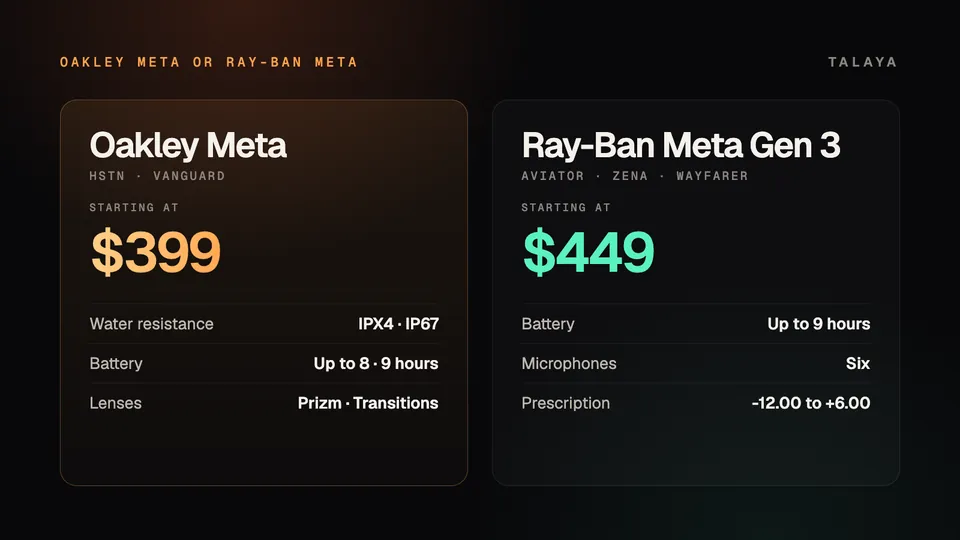
Ray-Ban's latest camera model, Ray-Ban Meta Gen 3, went on sale Sept. 23, 2026, starting at $449. Oakley Meta HSTN starts at $399, and Oakley Meta Vanguard costs $499.
This comparison is based on the specifications and prices Meta and Oakley publish. We haven't tested these glasses against each other.
The short answer
Get Oakley Meta Vanguard if you run, ride or ski seriously, want the training features Meta built it around, or need glasses that can take a dunking. Get Oakley Meta HSTN if you like the Oakley look, want the cheapest of the three, play some sport and may want prescription lenses. Get Ray-Ban Meta Gen 3 if these will be your everyday glasses: it has the most microphones, the most styles and the widest prescription range.
Specs side by side
| Ray-Ban Meta Gen 3 | Oakley Meta HSTN | Oakley Meta Vanguard | |
|---|---|---|---|
| Starting price | $449 | $399 | $499 |
| On sale since | Sept. 23, 2026 | Aug. 26, 2025 | Oct. 21, 2025 |
| Styles | Aviator, Zena, Wayfarer | HSTN | Vanguard wraparound |
| Camera | 12MP, 3K video | 12MP, 3K video | Centered 12MP, 122-degree lens, 3K video |
| Battery | Up to 9 hours | Up to 8 hours | Up to 9 hours |
| Extra from the case | Up to 50 hours | Up to 48 hours | Up to 36 hours |
| Microphones | Six | Five | Five, tuned for wind |
| Water rating | IPX4 | IPX4 | IP67 |
| Lenses | 27 color and lens combinations | Prizm, Prizm Polarized, Transitions, clear | Swappable Prizm, Prizm Transitions |
| Prescription | -12.00 to +6.00 total power (Aviator: -6.00 to +4.00) | -6.00 to +4.00 (Oakley) | Not available |
| Garmin and Strava | Strava overlays | Listed by Garmin and Strava | Yes |
Strava's help center says its overlays work on all Oakley Meta and Ray-Ban Meta glasses, and Garmin's Oakley Meta page names both Oakley models. Gen 3's case figure comes from Meta's compare page, and its IPX4 rating is the one Meta's help center gives Ray-Ban Meta glasses as a group. The Ray-Ban prescription ranges come from Meta's help center. The HSTN range is from Oakley's Oakley Meta page. For Vanguard, Oakley's US store marks only HSTN as available with prescription lenses, and Meta's prescription FAQ on Best Buy's Meta page says Vanguard is not available with them. The same FAQ lists HSTN at -12.00 to +6.00 SPH+CYL, wider than Oakley's figure, so confirm the range with the seller.
What they have in common
All three answer to "Hey Meta," take photos and video hands-free, play music through open-ear speakers, handle calls and messages and have a white capture LED that blinks while recording. In December 2025, Meta added a Spotify feature for both Ray-Ban Meta and Oakley Meta that plays a song to match what you're looking at, in English in 19 countries. The same update brought conversation focus, which raises the voice of the person you're talking to, to Ray-Ban Meta and HSTN for Early Access users in the US and Canada.
More is coming, but Meta hasn't said to which models. Its Muse AI agent is headed to Meta's AI glasses "in the coming months," and hearing enhancement, FDA-cleared software for adults with perceived mild to moderate hearing loss, will launch in the US later this year on "supported" glasses for $149.99, according to Meta's Connect 2026 roundup.
Why you'd pick Ray-Ban Meta Gen 3
Gen 3 is the newest of the three and the one designed to be worn all day as ordinary glasses. Meta says it has a slimmer, more comfortable design, with temple tips an optician can adjust, and it lasts up to nine hours, an hour more than Gen 2. A new six-microphone array cuts more than 90% of background noise on calls and voice commands, according to Meta. There's a customizable action button for quick access to Meta AI, and dynamic photos let you pick the best of several frames.
It also comes in the most shapes. Gen 3 is sold as the Aviator, the Zena (a new cat-eye), and the Wayfarer, which also comes in a large size, across 27 color and lens combinations. A limited-edition Aviator in Milky Beige with brown Transitions lenses costs $579.
Why you'd pick Oakley Meta HSTN
HSTN is the cheapest of the three at $399 and looks like a pair of Oakley sunglasses. Meta's buying guide aims it at "the everyday athlete." It has a lightweight O Matter frame, and its IPX4 rating covers sweat and light rain. The lens choice is the main draw: Prizm lenses for contrast, Prizm Polarized for glare ($449), and Transitions that darken outside ($479). Oakley added Prizm Dark Golf lenses in March 2026, and HSTN can be ordered with single-vision or progressive prescription lenses.
The trade-offs against Gen 3 are an hour less battery, one fewer microphone and no action button announced.
Why you'd pick Oakley Meta Vanguard
Vanguard is the specialist. It's rated IP67, which Meta says covers temporary submersion in up to a meter of water, and it's shaped to fit under cycling helmets. Meta made its speakers six decibels louder than HSTN's for windy roads and tuned its five microphones to cut wind noise. The camera sits in the center of the frame behind a 122-degree lens, with Slow Motion, Hyperlapse and adjustable stabilization.
Meta launched its Garmin and Strava integration with it: live stats by voice, a status LED that shows whether you're on target, automatic clips when you hit milestones and Strava overlays on your photos and videos. Garmin's page now names HSTN too, and Strava's overlays work on every Oakley Meta and Ray-Ban Meta pair. The lenses swap out for $85 each. The downsides are the price, the sport-focused design and the lack of a listed prescription option.
If you wear prescription glasses
Ray-Ban Meta is the safer bet. Meta's help center says most Ray-Ban Meta frames support prescriptions from -12.00 to +6.00 total power, though the Gen 3 Aviator is limited to -6.00 to +4.00. You can order them with prescription lenses from Ray-Ban.com and participating retailers, or add prescription lenses later at participating retailers.
HSTN is the Oakley option. Oakley sells it with single-vision or progressive prescription lenses, and its Oakley Meta page gives an eligible range of -6.00 to +4.00, the same as the Gen 3 Aviator and narrower than other Ray-Ban Meta frames, although Meta's prescription FAQ on Best Buy's site lists HSTN at -12.00 to +6.00. Our Oakley Meta prescription guide covers both figures. Vanguard isn't available with prescription lenses, according to the same FAQ. In Canada, Meta.com has taken prescription orders for Ray-Ban Meta, Ray-Ban Meta Optics, Oakley Meta and Meta Glasses since Sept. 23, 2026.
Other Meta glasses worth a look
If you mostly want audio and the assistant, Ray-Ban Meta Audio drops the camera, weighs 43 grams and costs $349; we compare it with Gen 3 in Ray-Ban Meta Gen 3 or Ray-Ban Meta Audio. Meta's most affordable glasses are now the Meta Adventurer, at $249 with a plug-in case. And if you want a screen in the lens, Meta Ray-Ban Display costs $799 with the Meta Neural Band.
For more on each Oakley model, see our Oakley Meta guide, the HSTN page and the Vanguard page.
Frequently asked questions
Do Oakley Meta and Ray-Ban Meta use the same app?
Yes. All of them pair with the Meta AI app on iPhone or Android, use the same Meta AI assistant and get software updates the same way. The app is required to set them up.
Which Meta glasses are best for running or cycling?
On paper, Oakley Meta Vanguard. It's rated IP67, fits under cycling helmets, has speakers Meta designed for 30 mph wind and connects to Garmin and Strava. Meta's own guide recommends it for high-intensity training.
Which has the longest battery life?
Ray-Ban Meta Gen 3 and Oakley Meta Vanguard are both rated for up to nine hours, and HSTN for up to eight. HSTN's case holds the most extra charge, up to 48 hours, against 36 hours for Vanguard's.
Are Oakley Meta glasses good for golf?
Oakley added Prizm Dark Golf lenses for both HSTN and Vanguard in March 2026, and Meta's guide names golf as one of HSTN's uses. You can also ask Meta AI about wind conditions before a shot.
Is Ray-Ban Meta Gen 3 water resistant?
Meta's Gen 3 announcement doesn't list a water-resistance rating. If you need one, Oakley Meta HSTN is rated IPX4 for sweat and light rain, and Vanguard is rated IP67.
Sources
- Best Buy: Meta AI glasses with prescription lenses (Meta's prescription FAQ)
- Strava Help Center: Meta glasses and Strava
- Garmin: Oakley Meta AI glasses
- Meta Help Center: About water resistance on AI glasses
- Meta Store: Compare AI glasses
- Meta: Introducing Ray-Ban Meta Audio and more AI glasses styles (Sept. 23, 2026)
- Meta blog: Ray-Ban Meta Audio and our deepest lineup of AI glasses yet (Sept. 23, 2026)
- Meta: The biggest news from Connect 2026 (Sept. 24, 2026)
- Meta Help Center: How to order prescription lenses for AI glasses
- Meta: Introducing Oakley Meta glasses, a new category of performance AI glasses (June 20, 2025)
- Meta: Athletic intelligence is here, meet Oakley Meta Vanguard (Sept. 17, 2025)
- Meta: Which AI glasses are right for you? (May 8, 2026)
- Meta: Updates to Meta AI glasses, conversation focus and Spotify (Dec. 16, 2025)
- Oakley: Oakley Meta performance AI glasses and gear
- Oakley: Oakley Meta Vanguard debuts Prizm Transitions in new colorway launch (March 31, 2026)
- Oakley: Oakley Meta HSTN product page
- Oakley: The new Oakley Meta AI glasses (US landing page)
Join the conversation
Questions, or something to add? Talk about it with other smart glasses owners in r/Talaya, our community on Reddit.