Smart Glasses · Analysis
China's AI glasses boom: the main players, prices in yuan and what's sold abroad
Mainland China shipped nearly one million AI glasses in 2025, and Chinese brands hold two of the top three spots worldwide. Prices at home start near 1,900 yuan, and only some of the brands sell outside China.
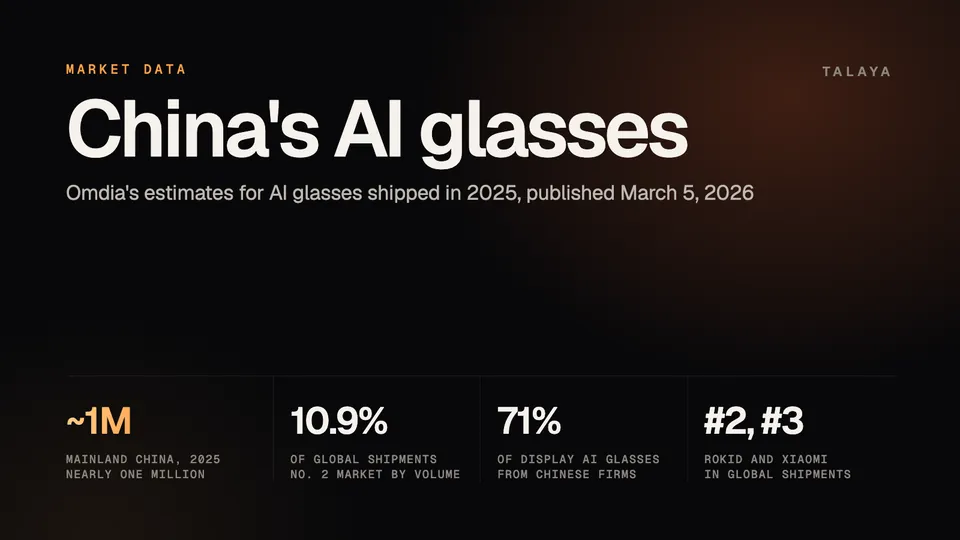
Mainland China shipped nearly one million AI glasses in 2025, according to Omdia, about 10.9% of the 8.7 million sold worldwide and the second-largest national market after the United States. Meta has no direct presence there. Local brands filled the gap: Omdia ranks Rokid and Xiaomi second and third in the world, and says Chinese companies, including Rokid, Alibaba and Even Realities, accounted for 71% of the AI glasses with displays.
This analysis is based on company announcements, analyst releases and credible outlets, with dollar amounts converted at the rate each source used, so they are approximate, and we haven't tested any of these glasses.
What the analysts count
Omdia's March 5 release is the most complete count of 2025.
| Measure, 2025 | Omdia's figure |
|---|---|
| AI glasses shipped worldwide | 8.7 million, up 322% |
| Meta's share | 85.2%, or 7.4 million units |
| Shipped in Mainland China | Nearly one million, 10.9% of the world |
| Glasses with displays | 730,000 units, 8.4% of the total |
| Display glasses from Chinese companies | 71% |
| Forecast for 2026, worldwide | More than 15 million |
Omdia credits "numerous product launches, a wave of new entrants, and aggressive pricing strategies" for China's growth. Its analyst Qiran Ju called Rokid "a dark horse contender in the AI glasses race," and said Chinese vendors "tend to design AI glasses with displays supported by a differentiated go-to-market strategy." Omdia also points to smartphone and car makers joining in, naming Xiaomi and Li Auto, and expects the market to consolidate around companies that offer value beyond a standalone device.
Other trackers use different definitions, so their numbers don't line up with Omdia's. IDC, as reported by the South China Morning Post through tech360, counted audio, camera, AR and VR frames together and forecast in mid-2025 that China's smart glasses market would pass 2.9 million units that year, up 121%. For the first quarter of 2026, ChinaBiz Insider reports that Counterpoint Research put RayNeo at 23.7% of global AR glasses shipments and IDC at 24.7% globally and 31.7% in China. ChinaBiz notes that the trackers diverge on product classification and sales channels, so those shares don't map onto Omdia's AI glasses count. At world scale, Counterpoint says display-less models made up 96% of AI glasses shipped in the first half of 2026, as our explainer on AI, AR and display glasses reports.
The main players and what they cost
Prices are as reported on the dates shown. The dollar column uses each source's own conversion where it gave one, and an approximate figure at a similar rate where it didn't.
| Brand and product | Price in China | Approximate US dollars | What the sources say |
|---|---|---|---|
| Xiaomi AI Glasses | 1,999 yuan at launch, June 26, 2025 | About $278 | 12MP camera, translation, links to Xiaomi devices and cars |
| Alibaba Quark AI Glasses S1 (now Qwen Glasses) | From 3,799 yuan at launch, Nov. 27, 2025 | About $536 | Lenses act as screens |
| Alibaba G1 | 1,899 yuan at launch; "as low as" 1,997 yuan after subsidies in March 2026 | About $265 to $275 | The main difference from the S1 is the display |
| Baidu Xiaodu AI Glasses Pro | 2,299 yuan on JD.com, Nov. 2025 | About $315 | 39 grams, prescription lenses possible |
| RayNeo GT (screen glasses) | 1,899 yuan, about 1,614 after subsidy | About $264, or $224 after subsidy | $329 on RayNeo's US store |
Xiaomi
Xiaomi's AI glasses went on sale on June 26, 2025, at 1,999 yuan, according to the South China Morning Post as summarized by tech360. They have a 12MP ultra-wide camera for first-person video, simultaneous translation and links to other Xiaomi devices and electric vehicles, and they use the same Qualcomm chip as Meta's AI glasses. A Xiaomi executive said about 50,000 units had sold since the launch, several times the company's projection, and that Xiaomi aims to sell more than 5 million a year within three years. The same report mentions competition from ByteDance and Huawei. The sources we read give no verified Huawei price or specification, so we list none.
Alibaba
Alibaba put its Quark AI Glasses on sale in China on Nov. 27, 2025, in two models, the S1 from 3,799 yuan and the G1 at 1,899 yuan, CNBC reported. The glasses have a camera in the frame and run Alibaba's Qwen AI models. CNBC says the lenses are effectively screens, and Alibaba said the main difference between the two models is the display. Alibaba's examples include translation, AI meeting notes and a photo of a product that brings up its price on Taobao.
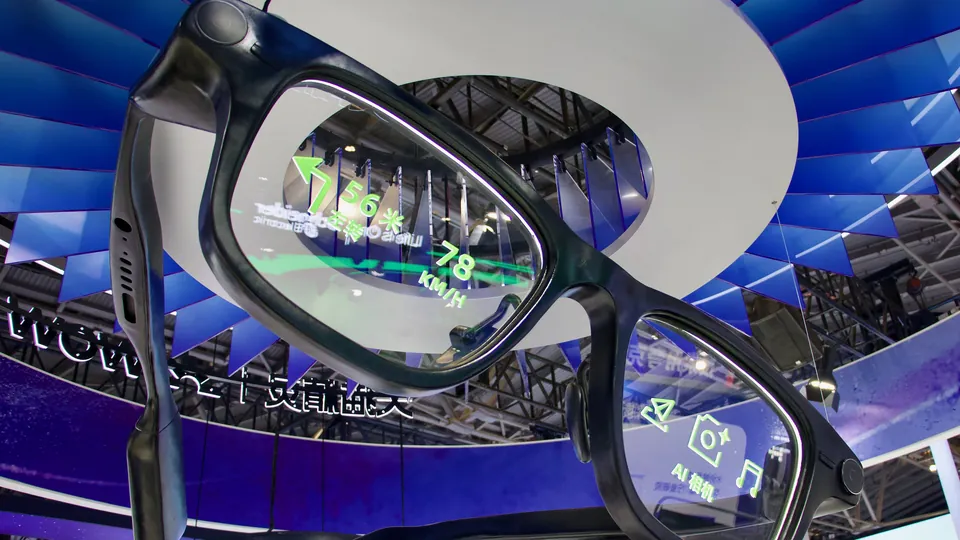
In March 2026 Alibaba presented the line as Qwen Glasses at MWC Barcelona, under its unified Qwen brand, and said official sales would begin March 8 in China. It put the G1 series at "as low as RMB 1,997 (approximately $275)" once national consumer incentives and platform subsidies are applied. That is a different basis from the launch price, so check the current listing before comparing. Alibaba also said features such as ordering food delivery, booking hotels or hailing rides by voice would roll out in phases from late March for users in China.
Baidu
Baidu's Xiaodu AI Glasses Pro went on sale in early November 2025 on JD.com at a discounted 2,299 yuan, Pandaily reported. They weigh 39 grams, record from a first-person view and can be fitted with prescription lenses. The launch came nearly a year after Baidu first showed them.
Rokid
Rokid sells its display model, 49 grams with a 12MP camera, for $699 at B&H Photo in the US, and its camera-only Style for $399, according to our Rokid guide. Rokid says it sold more than 15,000 Style units by Feb. 2, 2026, and its 2025 Kickstarter closed at $4,028,111. The pages we read give no Chinese prices for either model.
RayNeo, XREAL and the screen-glasses makers
RayNeo leads the AR glasses category as Counterpoint and IDC count it. ChinaBiz Insider says its GT screen glasses sell for 1,899 yuan, falling to about 1,614 yuan after China's consumer electronics subsidy, and RayNeo's US store lists the GT at $329. Our RayNeo guide also covers the X3 Pro ($1,299) with a camera and display, and the camera-free iO (from $499). CNBC counted XREAL among Alibaba's domestic rivals, and the CINNO ranking ChinaBiz cites has RayNeo, Rokid, XREAL, Alibaba's Qianwen and Xiaomi as China's top five for the first quarter of 2026. The same ranking had Star-Magic Meizu and Viture in the top five a year earlier.
Why China looks different
Prices are low. Most of the glasses above list at roughly 1,900 to 2,300 yuan, and Alibaba and ChinaBiz both describe subsidies that cut the effective price further. Displays are common. Chinese companies shipped 71% of the display glasses in Omdia's count, and ChinaBiz says Rokid and Alibaba reached China's top five mainly with single-color display glasses, the kind our waveguide explainer describes. The assistants also tie into ecosystems. Alibaba's glasses link to the Qwen app, Taobao and tasks such as ordering food delivery or hailing a ride, and Xiaomi's connect to its other smart devices and electric vehicles.
Can you buy them outside China?
| Brand | Sold outside China? | What the sources say |
|---|---|---|
| Rokid | Yes | $699 for the display model at B&H Photo, Style on Amazon US, its own international store |
| RayNeo | Yes | Own US store and Amazon, priced in dollars |
| XREAL | Yes | Own US store, as our XREAL lineup guide lists |
| Even Realities | Yes | G2 at $599 on its own store, which ships to the US, Canada, the UK and other countries |
| Xiaomi | Not in the sources we read | Sold through Xiaomi's online and physical retail channels; the report names no other countries |
| Alibaba | Not in the sources we read | CNBC: "initially go on sale in China"; the March 2026 sales date is for China |
| Baidu | Not in the sources we read | The report names only JD.com |
Alibaba's feature list is built around Chinese services, and it says the food delivery, hotel and ride features are for users in China. Rokid's assistant, by contrast, can use ChatGPT or Gemini, according to B&H, and RayNeo's X3 Pro uses Gemini, as our guides note.
For a buyer in the US, the nearest comparison is Meta. Its cheapest camera glasses, the $249 Meta Adventurer, sit just below the roughly $265 to $315 that Xiaomi, Alibaba's G1 and Baidu charge at home, and Ray-Ban Meta Gen 3 starts at $449. Omdia expects worldwide shipments to pass 15 million in 2026, with Meta raising production and local players rising in India, Japan and South Korea. Our best smart glasses guide compares what US buyers can get today.
Frequently asked questions
How much do Xiaomi AI glasses cost?
Xiaomi priced them at 1,999 yuan, about $278, when they launched on June 26, 2025, according to the South China Morning Post as summarized by tech360. They have a 12MP camera and translation. The sources we read name no other country.
What are Alibaba's Quark AI glasses called now?
Alibaba showed the S1 and G1 series as Qwen Glasses at MWC Barcelona in March 2026, under its unified Qwen brand, and said official sales would begin March 8 in China. They launched in November 2025 as Quark AI Glasses.
Can you buy Chinese AI glasses in the US?
Some, yes. Rokid sells through B&H Photo and Amazon, RayNeo through its US store and Amazon, and XREAL and Even Realities through their own US stores. The Xiaomi, Alibaba and Baidu glasses we found are described as on sale in China.
How big is the AI glasses market in China?
Omdia says Mainland China shipped nearly one million AI glasses in 2025, 10.9% of the 8.7 million worldwide and the second-largest market after the US. IDC, which counts audio, camera, AR and VR frames together, forecast in mid-2025 that China's smart glasses market would pass 2.9 million units that year.
Who sells the most smart glasses in China?
It depends on the category. Omdia ranks Rokid and Xiaomi second and third worldwide among AI glasses, behind Meta. For AR glasses as Counterpoint and IDC count them, RayNeo is first, with 23.7% and 24.7% of global shipments in the first quarter of 2026, ChinaBiz Insider reports.
Sources
- Omdia: Global AI glasses shipments reach 8.7 million units with Mainland China emerging as the fastest-growing market (Mar. 5, 2026)
- CNBC: Alibaba's AI glasses to rival Meta go on sale for $500 (Nov. 27, 2025)
- Alibaba Cloud: Alibaba unveils Qwen Glasses at MWC Barcelona, accelerating AI hardware ambitions
- Pandaily: Baidu's Xiaodu AI Glasses Pro now available, priced at 2,299 yuan (Nov. 11, 2025)
- tech360: Xiaomi AI glasses see strong sales, eye 5 million annual units amid surging demand (July 31, 2025, citing the South China Morning Post)
- ChinaBiz Insider: China's smart glasses war reshapes as Alibaba's Qianwen and Xiaomi crack the top five (June 23, 2026)
Join the conversation
Questions, or something to add? Talk about it with other smart glasses owners in r/Talaya, our community on Reddit.