Wearables · Guide
Whoop vs Oura: price over two years, sleep, battery and who each suits
Whoop is a screenless band sold as a membership from $199 a year, and Oura is a ring from $399 plus $69.99 a year for most features. This guide compares their cost over two years, sleep and health features, FDA status and who each suits.

Part of our Whoop guide
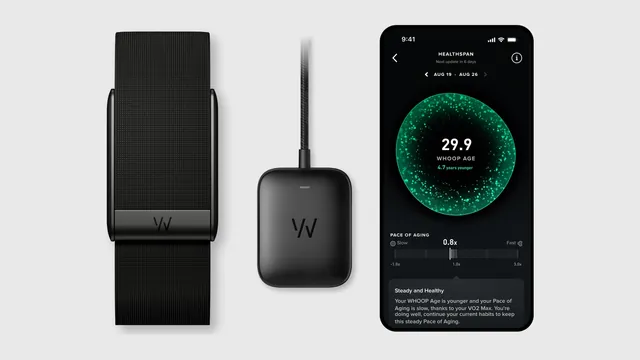
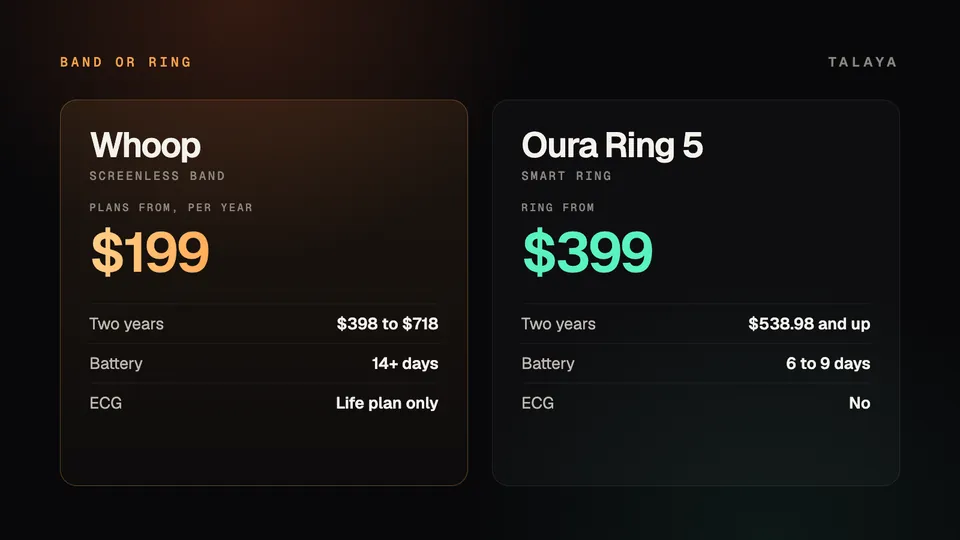
Whoop and Oura both track sleep, activity and recovery from a wearable with no screen, and they differ most in what you pay and in whether you wear a band or a ring. Whoop is a band sold as a membership: the band comes with a plan that costs $199 (One), $239 (Peak) or $359 (Life) a year. Oura is a titanium ring that costs $399 or $499 up front, and most of what its app shows needs a membership at $5.99 a month or $69.99 a year. Over two years that comes to $398 for Whoop One and $538.98 for an Oura Ring 5 in Silver or Black, before tax.
Whoop lists the longer battery rating, 14+ days against six to nine days for Oura Ring 5, and its top plan adds an ECG and rhythm notifications that Oura doesn't list. On the pages we read, Oura documents more of its sleep tracking, and it costs less each year once the ring is paid for.
This comparison is based on Whoop's and Oura's own pages as of Oct. 26, 2026, FDA records and our Whoop and Oura Ring guides for US prices, and we haven't tested either wearable.
A band or a ring: the hardware
Which Whoop band you get depends on your plan. One and Peak include Whoop 5.0, and Life includes Whoop MG, the medical grade version. Oura Ring 5 is the current ring, and the 2024 Oura Ring 4 still has a page on Oura's store, though Oura says availability depends on inventory.
| Whoop 5.0 | Whoop MG | Oura Ring 5 | Oura Ring 4 | |
|---|---|---|---|---|
| Form | SuperKnit band | SuperKnit Luxe band with Platinum Medical Grade Compatible Metals | Titanium ring | Titanium ring (a zirconia ceramic version exists) |
| How you get it | Included with One or Peak | Included with Life | Bought separately | Bought separately |
| Rated battery | 14+ days | No separate rating found | Six to nine days | Five to eight days |
| ECG | No | Yes | None listed | None listed |
| Size | Not published on the pages we read | Not published on the pages we read | 6.09 mm wide, 2.28 mm thick, from 2 grams; sizes 6 to 13 | 7.90 mm wide, 2.88 mm thick, 3.3 to 5.2 grams; sizes 4 to 15 |
Oura lists red and infrared LEDs for blood oxygen, green and infrared LEDs for heart rate, heart rate variability and respiration rate, a digital temperature sensor and an accelerometer. The Whoop pages we could read name what the band reports (heart rate variability, resting heart rate and respiratory rate on Peak, plus ECG on MG) but give no sensor list, weight or water rating, so we can't compare those line by line. Our Ring 5 vs Ring 4 comparison covers what changed in Oura's ring.
What each costs over one and two years
| Hardware | Each year | Year one | Two years | |
|---|---|---|---|---|
| Whoop One (Whoop 5.0) | Included | $199 | $199 | $398 |
| Whoop Peak (Whoop 5.0) | Included | $239 | $239 | $478 |
| Whoop Life (Whoop MG) | Included | $359 | $359 | $718 |
| Oura Ring 5, Silver or Black | $399 | $69.99 | $468.99 | $538.98 |
| Oura Ring 5, other finishes | $499 | $69.99 | $568.99 | $638.98 |
These are US list prices before tax, and they assume the yearly prices don't change. Whoop's rates come from its pricing article, last published June 24, 2026, and Oura's from its membership page, with ring prices according to CNET. Oura includes the first month, and the first annual payment covers the 12 months after it.
The gap closes with time. Whoop One stays cheaper than a Silver or Black Ring 5 through year three ($597 against $608.97), and Oura is cheaper from year four. Peak passes Oura during year three and Life during year two.
The commitments differ too. Whoop says new members can choose a 24-month membership at sign-up and that month-to-month billing is no longer a standard sign-up option, and its monthly rates ($25, $30 and $40) apply to members who have finished 12 months. Oura bills monthly or yearly and lets you cancel, though it gives no partial refunds on annual plans once the included month is over.
Without an active membership, Oura says, the app shows only your Readiness, Activity and Sleep scores, the ring's battery, basic profile details, settings and Explore content. The Whoop pages we read don't say what the band does after a membership ends, so read Whoop's terms first. Our Oura membership guide has the details on the ring side.
Oura Ring 4 launched at $349, and Oura says its availability now depends on inventory. We couldn't confirm a current US price for it, so the table uses Ring 5. Oura also sells an optional $99 Charging Case, while Whoop includes a corded charger with One and a Wireless PowerPack with Peak and Life.
Features compared
Both apps boil the day down to a few scores. Whoop's are Recovery, Sleep and Strain, and Oura's are Sleep, Readiness and Activity.
| Whoop | Oura Ring 5 | |
|---|---|---|
| Sleep | Sleep score and insights on every plan, plus a haptic alarm | Sleep Score, sleep stages, overnight blood oxygen sensing, bedtime guidance, Nighttime Breathing |
| Strain or activity | Strain, heart rate zones, VO2 max, Strength Trainer, two-way Strava sync | Activity Score, steps and calories, workouts started from the phone, third-party Bluetooth heart rate monitors, Strava among 100+ apps |
| Recovery or readiness | Recovery score; Peak adds Stress Monitor and Health Monitor | Readiness Score; Symptom Radar looks for early signs of a cold or flu |
| Heart health | Heart rate variability, resting heart rate and respiratory rate on Peak; ECG and irregular rhythm notifications on Life | Heart rate and heart rate variability around the clock; cardiovascular age; no ECG listed |
| Blood pressure | Blood Pressure Insights on Life | Blood Pressure Signals, a 30-day assessment, plus a log for cuff readings |
| Women's health | Women's Hormonal Insights on every plan; Natural Cycles integration | Cycle tracking; Pregnancy Insights |
| AI | AI coach on every plan | Oura Advisor |
| Medical status | ECG has an FDA 510(k) decision of substantially equivalent; Blood Pressure Insights is a wellness feature | Described as wellness features; no FDA clearance claimed on the pages we read |
Sleep: how Whoop and Oura compare
If sleep is why you're shopping, Oura documents more of it. Its Sleep Score draws on total sleep, heart rate variability, nighttime movement and sleep regularity. The app adds sleep stages (deep, REM and light), overnight blood oxygen sensing, bedtime guidance and Nighttime Breathing, a 30-day view of how often breathing is disrupted during sleep.
Whoop's membership page lists sleep scores and insights on every plan and a haptic alarm, which wakes you with vibration. It doesn't spell out sleep stages or overnight blood oxygen. We haven't compared the accuracy of the two, and the accuracy claims on both sides come from the companies. Oura Ring 5 weighs from 2 grams, and Oura sends a free sizing kit first (see our smart ring sizing guide).
Heart health, blood pressure and what the FDA says
Whoop's top plan carries the regulated medical features. The FDA's 510(k) database lists the "WHOOP ECG (electrocardiogram) Feature (1.0)" under K243236, with a decision on April 4, 2025 of "Substantially Equivalent," the decision that clears a 510(k) device. Whoop calls irregular heart rhythm notifications a medically regulated feature too. The FDA record we reviewed covers the ECG, and Whoop's pages don't point to a separate record for the notifications. Both need a Life membership and Whoop MG and are for people 22 and older, and the notifications aren't for anyone with a known AFib diagnosis.
Blood Pressure Insights has a different status. Whoop says it "is not a medical device and cannot diagnose or manage medical conditions." The FDA sent Whoop a warning letter dated July 14, 2025. In a closeout letter dated June 17, 2026, it said that, based on changes Whoop made to the feature and its labeling, it "does not intend to enforce the device statutory and regulatory requirements for your BPI product as modified." That is an enforcement decision, not a clearance.
Oura labels its comparable features as wellness features. Its Health Radar help page, last updated Oct. 16, 2026, says Health Radar "does not diagnose or monitor any conditions, or replace medical care," calls Nighttime Breathing a wellness feature and says Blood Pressure Signals "cannot diagnose or rule out any condition" and is "for wellness use only." The page makes no claim of FDA clearance, and the Oura pages we read list no ECG. Blood Pressure Signals runs a 30-day assessment, and a separate log lets you record cuff readings. Among the rings in our best smart rings guide, only the Circular Ring 2 has an on-demand ECG.
Women's health
Whoop includes Women's Hormonal Insights on every plan. It says Menstrual Cycle Insights "is not a medical device or medical advice and should not be used for conception or contraception," and that all phases, including the ovulatory phase, are estimates. Its membership page also lists a Natural Cycles integration. Oura lists women's health among the areas its app covers, offers cycle tracking and mentions a Pregnancy Insights feature in its help pages. The pages we read don't detail Oura's cycle features, so check Oura's own description for what you need.
Battery, charging and phones
Whoop lists 14+ days of battery life and gives Whoop MG no separate rating on the pages we read. Oura rates Ring 5 at six to nine days, depending on ring size and use, and Ring 4 at five to eight. Ring 5 charges in about 80 minutes on its standard charger.
Both run through an app on iPhone and Android. Whoop lists iPhone 6s or newer for the 5.0 and iPhone 8 or newer for MG, with iOS 18 or higher recommended, and Android 11 or higher, which MG requires, according to its software requirements page. Oura's app needs iOS 16 or later, or Android 11 or later with Google Play services, and a phone with Bluetooth 5.0. Oura shares data with Apple Health and Health Connect and works with more than 100 other apps, and Whoop's membership page lists a two-way Strava sync. Whoop's Life plan also includes priority phone support.
HSA and FSA
Both companies say their products are HSA or FSA eligible. Oura says the ring, the membership, extra chargers, shipping and taxes qualify in the US, subject to your provider's rules. Whoop offers a Truemed checkout at join.whoop.com and in its app and lets you submit eligible purchases for reimbursement. It lists One, Peak and Life memberships bought for one or 12 months and says monthly payments after the initial commitment aren't eligible.
The IRS added a wearables answer to its FAQ on Sept. 23, 2026: a watch, ring or band counts as a medical expense if you buy and use it primarily to help diagnose, cure, mitigate, treat or prevent a specific disease. Tracking health information in general isn't enough. Your plan administrator makes the final call, and our HSA and FSA guide covers each maker's rules and how medical necessity letters work.
Who each suits
Whoop fits people who want a screenless band with the longer battery rating, can accept a 12- or 24-month commitment and plan to use its coaching and trend data. Peak costs $40 more a year than One and Life $120 more than Peak, so Life makes sense mainly for the ECG, the rhythm notifications, Blood Pressure Insights or priority phone support.
Oura fits people who would rather wear a ring, want the sleep features Oura documents in the most detail and can pay $399 or $499 up front. The yearly cost after that is lower, and the ring stays usable without a membership, though the app then shows only three scores.
If you'd rather not pay a subscription, see our guides to smart rings without a subscription and Oura vs Galaxy Ring vs Ultrahuman, and our smart ring vs smartwatch guide for the case for a watch.
Frequently asked questions
Is Whoop or Oura better for sleep?
On the pages we read, Oura documents more of its sleep tracking: a Sleep Score, sleep stages, overnight blood oxygen sensing, bedtime guidance and a 30-day Nighttime Breathing view. Whoop lists sleep scores and insights on every plan and a haptic alarm. We haven't compared their accuracy, and the accuracy claims on both sides come from the companies.
Which costs more over two years, Whoop or Oura?
An Oura Ring 5 in Silver or Black costs $538.98 over two years on the annual plan, more than Whoop One ($398) or Peak ($478) and less than Whoop Life ($718), all before tax. Whoop One stays cheaper through year three, $597 against $608.97.
Does Whoop or Oura have an ECG?
Whoop does, on its Life plan with the Whoop MG band, and the FDA's database lists the ECG feature as substantially equivalent (K243236, decision April 4, 2025). The Oura pages we read list no ECG. Among the rings in our best smart rings guide, only the Circular Ring 2 has one.
Do I need a subscription for Whoop or Oura?
Whoop is sold as a membership that includes the band. An Oura Ring works without a membership, but the app then shows only the Readiness, Activity and Sleep scores, the ring's battery, basic profile details, settings and Explore content, according to Oura.
Do Whoop and Oura work with iPhone and Android?
Yes. Whoop's app supports iPhone 6s or newer for the 5.0 and iPhone 8 or newer for MG, and Android 11 or higher. Oura's app needs iOS 16 or later, or Android 11 or later with Google Play services, and a phone with Bluetooth 5.0.
Can I pay for Whoop or Oura with HSA or FSA money?
Both companies say yes, with conditions. Whoop offers a Truemed checkout for HSA and FSA payments, and Oura accepts HSA and FSA cards on its US store. The IRS decides what counts as a medical expense and your plan administrator makes the call, as our HSA and FSA guide explains.
Sources
- Whoop Support: Membership Pricing (published June 24, 2026)
- Whoop: Membership options (read on Whoop's Spain site, Oct. 26, 2026; euro prices not used)
- Whoop Support: WHOOP App Minimum Software Requirements
- Whoop Support: FSA/HSA Eligibility (published June 17, 2026)
- FDA: 510(k) Premarket Notification K243236, WHOOP ECG (electrocardiogram) Feature
- FDA: WHOOP, Inc. closeout letter (June 17, 2026)
- Oura: Introducing Oura Ring 5 (May 28, 2026)
- Oura: Oura Ring 5 product page and technical specifications (read Oct. 26, 2026)
- Oura: Oura Ring 4 product page and technical specifications (read Oct. 26, 2026)
- Oura Help Center: Oura Ring 4 (last updated Oct. 16, 2026)
- Oura Help Center: Health Radar (last updated Oct. 16, 2026)
- Oura Help Center: Oura Membership
- Oura: Oura Membership page, with prices by country
- Oura: Oura Ring is FSA and HSA eligible (published Sept. 30, 2025)
- CNET: Oura Ring 5 first look, with US pricing and availability (May 28, 2026)
- IRS: Frequently asked questions about medical expenses related to nutrition, wellness and general health (Question 15 added Sept. 23, 2026)
Join the conversation
Questions, or something to add? Talk about it with other smart glasses owners in r/Talaya, our community on Reddit.