Smart Glasses · Guide
Where smart glasses are banned or restricted: the written rules, venue by venue
Wearing smart glasses in public is generally legal in the US, but courts, test providers, cruise lines and venues write their own rules. Some name smart glasses; others name cameras or recording devices and leave the call to staff.
Wearing smart glasses in public is generally legal in the US. The restrictions come from the places that write their own rules: courts, test providers, cruise lines, stadiums, casinos and employers. The clearest written rules name smart glasses outright. New York's courts, the SAT and Royal Caribbean do. Others, such as an NFL stadium's list or ETS's test-room rule, name cameras or recording devices, and whether your pair counts is up to staff on the day.
This guide is based on the policies each organization publishes, read Oct. 26, 2026, and on our earlier guides. We haven't tested how any venue enforces them, and rules change, so check the venue's own page before you go. For the law on recording, see our state-by-state guide.
The rules at a glance
| Place | What the written rule says | Names glasses? | Source |
|---|---|---|---|
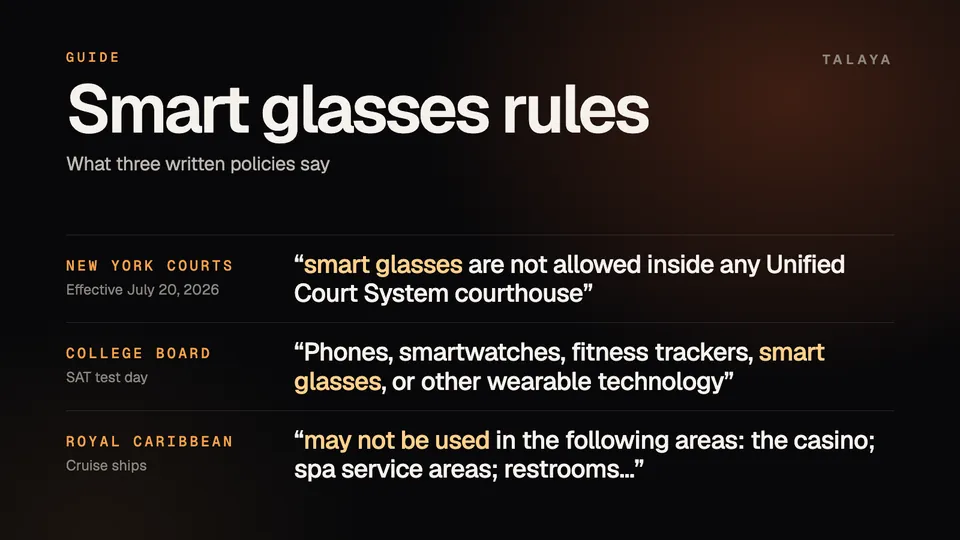
| New York courts | "Smart glasses are not allowed inside any Unified Court System courthouse" since July 20, 2026 | Yes | NY courts poster |
| SAT | Smart glasses are on the prohibited devices list; an approved accommodation is the only exception | Yes | College Board |
| TOEFL | No "phones, watches or any other electronic, recording, listening, scanning or photographic devices" in the testing room | No, it names devices | ETS |
| Royal Caribbean | Smart glasses allowed onboard but not in the casino, spa service areas, restrooms, locker rooms, medical facilities and other listed areas | Yes | Royal Caribbean |
| Lincoln Financial Field | "Wearable video cameras including Go Pros" not permitted | No, it names cameras | Eagles list |
| Nevada casinos | 2013 Gaming Control Board statement encourages licensees to bar Google Glass from gaming floors | Names Google Glass | Card Player copy |
| MSC Cruises and Carnival | USA Today reported that MSC bars smart glasses in public areas and Carnival restricts "Google-type glasses" at gangways | Yes, per USA Today | USA Today |
| Employers | Employers generally may restrict or prohibit AI glasses | Depends on the policy | Fisher Phillips |
Courts
New York's courts have the most explicit rule. The state court system's own poster is headed "NO SMART GLASSES" and says that, effective July 20, 2026, "smart glasses are not allowed inside any Unified Court System courthouse." The poster is in capitals; we've used normal case. For people who wear smart glasses with prescription lenses, it says to "bring a regular pair of glasses to use while you are in the courthouse."
The court system's amended memo to administrative judges and chief clerks, dated July 1, 2026, gives the definition. We read a copy hosted by the Workplace Privacy Report. It treats "smart glasses" as "eyewear or headwear containing a camera, microphone, computer or other technology that permit the user to record video or audio," prescription or not, and bars them from any court facility. Anyone carrying a pair may enter only if they "voucher the smart glasses for safekeeping by uniformed personnel" while they're inside. The memo applies to "litigants, attorneys, witnesses, family members, UCS employees, and all other individuals," and says the aim is to ensure that people "cannot surreptitiously record court proceedings in violation of the New York State Civil Rights Law and applicable court rules."
Syracuse.com added that the ban reaches more than 1,240 courts and that courts in Wisconsin and Pennsylvania have also banned smart glasses. In federal court, Rule 53 of the Federal Rules of Criminal Procedure bars photography and broadcasting from the courtroom in criminal proceedings and doesn't mention glasses, as our recording guide explains.
Standardized tests and schools
The College Board's SAT page lists "Phones, smartwatches, fitness trackers, smart glasses, or other wearable technology" among the items students can't access during the test or breaks unless they have a College Board-approved accommodation. The same list includes "Any cameras or recording devices." The page says that a prohibited device that makes noise, or that you're seen with at any time, including during breaks, can lead to dismissal, canceled scores and confiscation of the device, whose contents may be inspected. Test staff are required to collect prohibited devices, have students keep them in backpacks away from their desks, or deny admission to anyone who has one.
ETS's TOEFL iBT page, for test-center testing, says: "If it's not an approved item, don't bring it into the testing room. This includes phones, watches or any other electronic, recording, listening, scanning or photographic devices." That wording names devices and doesn't mention glasses. The page sends test takers to the TOEFL iBT Information Bulletin for the full prohibited list, which we didn't read, and we read only the TOEFL page, not ETS's other tests.
We couldn't locate ACT's own prohibited items page from our network, so we don't quote it. Check ACT's current list before test day.
School and campus rules are set district by district and campus by campus. We found no district or college policy that names smart glasses on a page we could read, so check the school's device and recording rules and ask before you wear camera glasses.
Cruise lines
Royal Caribbean's prohibited items page puts smart glasses in a category it calls items with use restrictions in designated spaces: "Smart glasses may be brought onboard; however, they may not be used in the following areas: the casino; spa service areas; restrooms; locker rooms; medical facilities; security screening locations; youth facilities; during back-of-house tours; crew areas; or any location where there is a reasonable expectation of guest or crew privacy." The page says use in restricted areas violates the policy and may result in confiscation. Cruise Critic reported the addition on Oct. 9.
MSC Cruises bans devices "capable of covertly or discreetly recording or transmitting data (e.g. smart glasses)" in public areas of its ships, USA Today reported in December 2025, while Carnival allows "Google-type glasses" in public areas but not at gangway operations. We didn't find the smart glasses wording in MSC's guest conduct policy PDF, so we're relying on USA Today for both lines.
Casinos
The clearest casino rule we read is Royal Caribbean's: smart glasses may not be used in its casinos. On land, we found no casino operator page that names smart glasses. Nevada's regulator addressed the question in 2013, when its Gaming Control Board said it had received inquiries about Google Glass on casino floors. In a statement that Card Player published in full, the Board said "there is nothing specifically illegal regarding the possession and/or general use of these devices." It warned that such devices could be used to share card information in poker and other table games in violation of state law, citing NRS 465.075 and 083, and it "encourages all nonrestricted gaming licensees to prohibit the wearing and use of Google Glass...while on the gaming floor or while playing any gambling game." Policies for other areas were left "to the discretion of the licensee."
The statement is about Google Glass, and we found no newer Nevada notice that names smart glasses. Each casino sets its own rule, so ask before you sit down.
Stadiums and concert venues
The Philadelphia Eagles' prohibited items list for Lincoln Financial Field, updated Aug. 18, 2026, says it follows NFL best practices and is "strictly enforced during Eagles home football games and other stadium events." It doesn't mention smart glasses. It bars "Laptop computers, video recorders, tripods and wearable video cameras including Go Pros" and "Cameras with lenses longer than 5 inches," and it says the stadium "reserves the right to expand or modify the prohibited items at any time in its sole discretion and/or based on the event." Whether a pair of camera glasses counts as a wearable video camera is the stadium's call, and the list doesn't say.
We found no concert venue's written rule that names smart glasses. Rules differ by venue and sometimes by tour, so check the venue's prohibited items list and your ticket page before you go.
Workplaces
Employers "generally may restrict or prohibit AI-enabled glasses," the law firm Fisher Phillips wrote in March, as long as the policy supports a legitimate business interest such as safety, confidential information or customer privacy. Delta Air Lines bars employees from wearing or using smart eyewear while working, it told USA Today. There is a limit: under the National Labor Relations Act, recording working conditions can count as protected activity when it documents safety problems, harassment, discrimination or union organizing, Fisher Phillips notes. Your own employer's written policy is the one that applies.
Hospitals, clinics, gyms and locker rooms
We didn't find a US hospital, clinic or gym page that names smart glasses, so there is no written rule to quote here. What we did find points the same way:
- Meta advises wearers to switch the glasses off in places such as doctors' offices, changing rooms and schools, according to our Ray-Ban Meta guide.
- Royal Caribbean's list above includes medical facilities, spa service areas and locker rooms.
- Every state restricts hidden cameras in private places such as bathrooms and changing rooms, according to the Reporters Committee for Freedom of the Press, as our recording guide explains. A California bill that would have named smart glasses and covered changing rooms and doctors' offices was vetoed on Sept. 30, the Associated Press reported, and the governor noted that state law already bars recording people without consent in private spaces.
Norway's planned ban
Outside the US, Norway's government said on Oct. 5 that it plans a temporary ban on camera-equipped glasses in parks, beaches, museums, shopping centers, schools, daycare centers, health facilities, gyms and public events, while private use would stay allowed, The Guardian reported. It isn't law yet. The governing Labour party needs other parties to pass it, and an expert group will draft permanent rules in the meantime. Our analysis of the regulatory pushback has the details.
When a rule doesn't name glasses
Several of the rules above name cameras, recording devices or wearable cameras and don't mention glasses. The venues don't say whether camera glasses count, and Lincoln Financial Field says it can expand its list "in its sole discretion," so the person at the door decides. A rule that names smart glasses can still carry an exception, as the SAT's accommodation clause does, or a workaround, as New York's poster does for prescription wearers.
A camera-free pair avoids the camera question but not always the whole rule. Ray-Ban Meta Audio has no camera and has six microphones, and New York's memo defines smart glasses as eyewear with a camera, microphone, computer or other technology that lets the wearer record video or audio. We found no statement from the court system about Ray-Ban Meta Audio in particular. Our Ray-Ban Meta Audio guide and camera-free glasses guide cover those models. For pairs with a camera, Meta says the capture light has no off switch, and our recording light guide explains what the light does and doesn't tell people nearby.
Frequently asked questions
Can you wear Meta glasses in a casino?
It depends on the casino. Royal Caribbean's written rule bars smart glasses from its ship casinos. On land, Nevada's Gaming Control Board said in 2013 that there was nothing "specifically illegal" about Google Glass but encouraged licensees to prohibit it on gaming floors, and we found no newer notice naming Meta's glasses. Ask the property before you sit down.
Are smart glasses allowed at concerts?
We found no concert venue rule that names them. Lincoln Financial Field's list, which covers football and other stadium events, bars "wearable video cameras including Go Pros." Check the venue's prohibited items list and your ticket page.
Can you wear smart glasses on the SAT?
No. The College Board lists smart glasses among prohibited devices, and the only exception is an approved accommodation. A prohibited device can get you dismissed, your scores canceled and the device confiscated.
Can you wear Ray-Ban Meta glasses into a New York courthouse?
No. Since July 20, 2026, the state court system's poster says smart glasses are not allowed inside any Unified Court System courthouse, and it tells people with prescription smart glasses to bring a regular pair.
Are smart glasses banned in hospitals?
We found no US hospital page that names them. Meta advises switching its glasses off in places such as doctors' offices, and Royal Caribbean bars them from medical facilities on its ships. Ask the facility before you wear camera glasses.
Is it illegal to wear smart glasses in public?
Generally no. Recording laws focus on what you record and where, not on the glasses themselves, but property owners can ask you to take them off. Our recording guide covers the state rules.
Sources
- New York State Unified Court System: No smart glasses poster (PDF, June 2026)
- New York State Unified Court System: amended memo, Prohibition against smart glasses in court facilities (July 1, 2026, PDF copy hosted by the Workplace Privacy Report)
- Syracuse.com: New York to ban smart glasses from all courthouses (July 7, 2026)
- College Board: SAT prohibited devices (read Oct. 26, 2026)
- ETS: Test center testing for the TOEFL iBT test (read Oct. 26, 2026)
- Royal Caribbean: What items are prohibited on a Royal Caribbean cruise ship? (read Oct. 26, 2026)
- Cruise Critic: Royal Caribbean adds smart glasses to restricted items list (Oct. 9, 2026)
- USA Today: This cruise line banned smart glasses from public areas (Dec. 13, 2025)
- Philadelphia Eagles: Lincoln Financial Field permitted and prohibited items (PDF, updated Aug. 18, 2026)
- Card Player: Nevada recommends casinos ban Google Glass, with the Gaming Control Board statement (June 24, 2013)
- Fisher Phillips: AI glasses enter the workplace, FAQs for employers (March 11, 2026)
- The Guardian: Norway plans temporary ban on smart glasses in some public places (Oct. 5, 2026)
- Associated Press via US News: Newsom vetoes measure that would have penalized secret recording with smart glasses (Sept. 30, 2026)
- Reporters Committee for Freedom of the Press: Introduction to the Reporter's Recording Guide
Join the conversation
Questions, or something to add? Talk about it with other smart glasses owners in r/Talaya, our community on Reddit.