Smart Glasses · Analysis
XREAL Aura reviews: what critics liked and what they didn't
Six outlets reviewed the XREAL Aura on Nov. 17. They praised its weight, comfort and display, mostly criticized the hand controls, and split on real work and gaming. Here is where they agree and where they don't.

We read six reviews of the XREAL Aura, all published on Nov. 17, 2026, by 9to5Google, CNET, Gizmodo, WIRED, Android Headlines and TechRadar. Most reviewers liked how light and comfortable the Aura is, plus its display, and five of the six criticized the hand controls. Four mentioned that the puck or the glasses run warm. They split on whether it can handle real work and whether it can stand in for a VR headset.
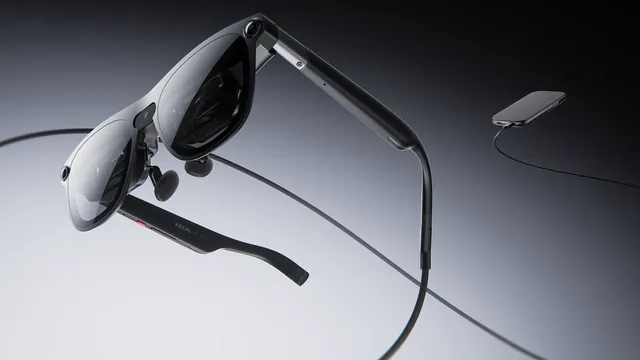
The Aura is a pair of Android XR glasses tethered to a compute puck. For the order dates and the launch offer, see our Aura on-sale piece. For specs, apps and rivals, see the XREAL Aura guide.
How long reviewers used it
- 9to5Google calls its piece an "Initial Review" and says it covers a brief review period. It promises a long-term review later.
- CNET describes its piece as a prelaunch review and says it reviewed the 256GB version.
- Android Headlines used the glasses for a week of work, video and workouts. It says XREAL sent the unit, and that XREAL and Google provided a $100 Google Play credit. It also says the review is not sponsored.
- TechRadar spent a week with the glasses.
- Gizmodo and WIRED do not state how long they used them in the text we read. WIRED says it wrote almost half its review with the glasses as its screen.
Where reviewers agree
Light and comfortable, with caveats
The glasses weigh 95 g and the puck weighs 265 g, according to XREAL's US page. 9to5Google said they are "comfortable for much longer periods of time" and not nearly as annoying to put on. Android Headlines watched a full basketball game on the couch without issues, and Gizmodo listed "lightweight and easy to carry around" among its pros. TechRadar wore the frames for hours at a time and said they feel somewhat like heavy sunglasses.
WIRED was less kind. It called the glasses chunky, said they start to heat up after a few minutes and said they leave red marks on the bridge of the nose. It still rated them much comfier than a VR headset.
The display and the sound
WIRED said the 1920 x 1200 pixels per eye are noticeably better than other XREAL glasses it has worn, and listed a vibrant display and good sound quality in its verdict box. Gizmodo called the display decent, and 9to5Google said the speakers are pretty good too.
The field of view is the limit
XREAL lists a 70 degree field of view. CNET noted that this is bigger than the largest size on the XREAL One Pro, which it put at 57 degrees. Others measured it against headsets instead. 9to5Google said the 70 degrees somewhat breaks the illusion, and Gizmodo, which found it tighter than it would like, compared it with the Quest 3S at 96 degrees.
Hand controls are the weak spot
Five of the six reviews flagged the controls. 9to5Google called the gestures hit or miss at times and named the back-to-home gesture as the worst. Gizmodo listed shaky hand and eye tracking among its cons and said hand tracking gets noticeably worse in low lighting. WIRED's verdict box also says the hand gestures are hit or miss. Android Headlines said hand tracking works well in good light and needs a lit room. TechRadar said the lack of eye tracking made it struggle at times to find its target.
The puck runs warm
CNET listed a puck that can get hot when venting air among its cons. TechRadar said the puck gets warm, and WIRED said the glasses run hot. Android Headlines said the puck does get pretty warm, but that its fans keep it from overheating.
Where they disagree
Is it a work device?
TechRadar called the Aura versatile, powerful, productive and fun, though it found productivity with a Bluetooth LE keyboard and the puck trackpad unnecessarily awkward. CNET called keyboard performance in Chrome and Docs fantastic, using a separately sold keyboard, but said the puck trackpad ranged from OK to poor depending on the app.
Android Headlines said that anyone who wants to replace a laptop and monitor every day will find the Aura is not there yet, and that it would probably not use it for daily work. WIRED wrote almost half its review on the glasses before swapping back to a desktop to rest its eyes.
Games and apps
Gizmodo said Android XR and the Google Play Store are nowhere near the catalog of Meta's Quest Store, and found it too much business and not enough play. 9to5Google was not sold on the glasses as a replacement for something like a Meta Quest. CNET noted that there is no VR controller support and that Android XR still lacks many truly unique apps. WIRED, by contrast, listed fun immersive experiences among its pros. Google says the glasses run more than 150 apps made for XR, per its launch post.
Gemini
TechRadar called the Gemini integration top-notch. Gizmodo said Gemini can't do things such as close all your tabs or adjust the tint of the lenses.
What reviewers measured
- Battery. WIRED described the puck powering the glasses for roughly four to five hours of constant use. Android Headlines measured more: after a little over four hours working in Google Docs it had over 40% left, and after about 30 minutes of working out it saw the battery drop about 15%. CNET listed a battery that lasts longer than most VR headsets among its pros.
- Display. WIRED's resolution comparison and the field of view numbers above are the main display findings. None of the reviews we read gave a brightness measurement.
- Heat. Described by all four outlets above, but none reported a temperature.
Verdicts and scores
Each outlet's score is shown as it printed it. The scales differ, so the numbers are not comparable, and Talaya gives no score of its own.
| Outlet | Printed score | Conclusion, in short |
|---|---|---|
| 9to5Google | None in the text we read | Initial review: Android XR solved XREAL's biggest problem, with hit-or-miss gestures |
| CNET | 7.0 | "It's often fascinating, and more often frustrating." |
| Gizmodo | 3.5 | The future, but with work still to do |
| WIRED | 6/10 | Comfier than a VR headset with a vibrant display, held back by controls and the puck; "If only they could get a pinch more usable." |
| Android Headlines | 4.5 out of 5 | The most comfortable way it has used Android XR, not yet a daily work tool |
| TechRadar | Not found in the text we read | Called it "the best example so far of Android XR's promise" |
Who it is for, and who should wait
This section is Talaya's reading of the reviews, not a test result.
It fits people who want a large virtual screen for video, light work or workouts and who value a frame light enough to wear for hours. Weight, comfort and the display held up across most of the reviews.
Waiting makes sense if you expect to replace a laptop, if you want a deep game library, or if you need precise hand controls. The reviews are all from launch day, and 9to5Google has promised a long-term review. Durability, software updates and battery aging are not covered yet. For alternatives, see our XREAL vs Viture comparison, our comparison of Ray-Ban Meta glasses and the XREAL One and our list of the best smart glasses of 2026.
What we don't know
- XREAL's US page does not give a battery runtime, only the 4,455 mAh capacity. The hours above are the reviewers' own.
- The US page gives US prices only. TechRadar says UK and Australia pricing and availability are still to be confirmed.
- Two of the six pieces are labeled initial or prelaunch, so early software may change.
Specs and price
| XREAL's published details | |
|---|---|
| Launch price | $1,099 (12GB + 256GB) and $1,299 (16GB + 512GB) through the end of the year |
| Listed beside the launch price | $1,279 and $1,499 |
| Buyers who already purchased | Refund of the hardware price difference based on the original prices: $180 and $200 |
| Weight | Glasses 95 g, puck 265 g |
| Display | Sony Micro-OLED, 1920 x 1200 pixels per eye, up to 120Hz, up to 1050 nits peak |
| Field of view | 70 degrees |
| Compute | Snapdragon Reality Elite, 4,455 mAh (34.84Wh) |
| Dimming | Five levels of transparency, electrochromic |
| Camera | High-resolution, with privacy LED indicator |
The source is XREAL's US Aura page, read Nov. 17, 2026. The page carries no date. Orders opened Oct. 28 in the US, Canada and South Korea, and Nov. 2 in Japan, per Google's launch post.
Talaya hasn't tested the XREAL Aura. This summary is based on reviews from 9to5Google, CNET, Gizmodo, WIRED, Android Headlines and TechRadar, published on Nov. 17, 2026, and on XREAL's published specifications and launch offer.
Frequently asked questions
Is the XREAL Aura comfortable to wear for hours?
Reviewers mostly said yes. Android Headlines watched a full basketball game in them without issues, and 9to5Google said they are "comfortable for much longer periods of time". WIRED said they leave red marks on the bridge of the nose and start to heat up after a few minutes.
How long does the XREAL Aura battery last?
XREAL's US page gives the puck's capacity, 4,455 mAh, but no runtime. WIRED described roughly four to five hours of constant use. Android Headlines still had over 40% left after a little over four hours working in Google Docs, and saw about 15% drop per 30 minutes of working out.
Can the XREAL Aura replace a laptop and monitor?
Not yet, according to Android Headlines, which said it would probably not use the Aura to work every day. WIRED wrote almost half its review on the glasses but went back to a desktop to rest its eyes. CNET praised the keyboard experience in Chrome and Docs.
Has Talaya tested the XREAL Aura?
No. This summary is based on published reviews and on XREAL's published specifications.
Sources
- 9to5Google: XREAL Aura initial review (Nov. 17, 2026)
- CNET: Google and XREAL Aura glasses review (Nov. 17, 2026)
- Gizmodo: XREAL Aura review (Nov. 17, 2026)
- WIRED: XREAL Aura review (Nov. 17, 2026)
- Android Headlines: XREAL AURA review (Nov. 17, 2026)
- TechRadar: Xreal Aura review (Nov. 17, 2026)
- XREAL: Aura (US page)
- Google: XREAL Aura launch post (Oct. 28, 2026)
Join the conversation
Questions, or something to add? Talk about it with other smart glasses owners in r/Talaya, our community on Reddit.