Smart Glasses · Analysis
Smart glasses market in 2026, in numbers: shipments, share and forecasts
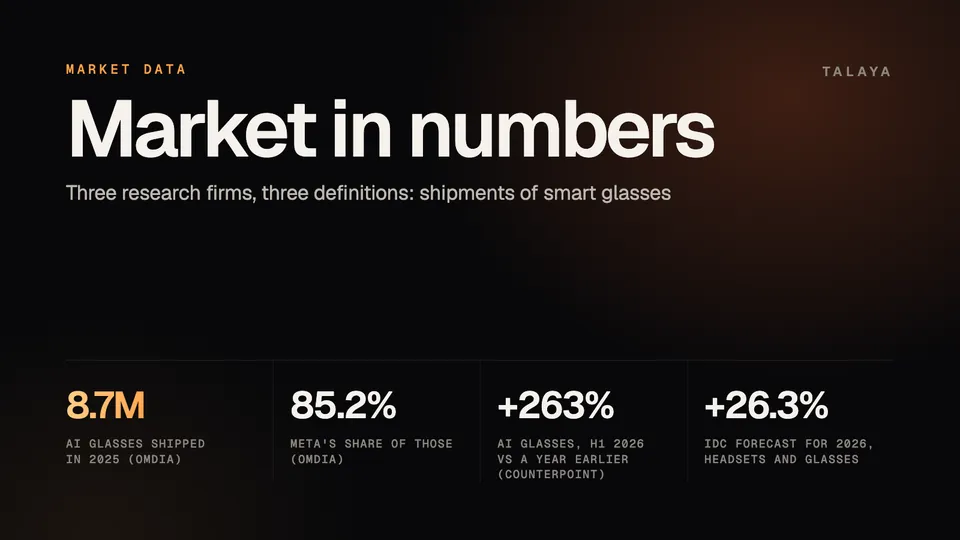
Omdia counted 8.7 million AI glasses shipped in 2025, IDC puts Meta at 68.7% of headsets and glasses in the second quarter of 2026, and Counterpoint reports 263% growth in the first half. The totals differ because each firm counts different products.

How many smart glasses are sold depends on who is counting. Omdia said 8.7 million AI glasses shipped worldwide in 2025, up 322%, with Meta at 85.2% of them. IDC, which counts headsets alongside glasses, put Meta at 68.7% of shipments in the second quarter of 2026. Counterpoint reported that AI glasses shipments rose 263% in the first half of 2026. The figures don't conflict, because the firms count different products over different periods, and the latest results from Meta and EssilorLuxottica give no unit count for the glasses.
This analysis is based on the research firms' public releases and blog posts and the companies' own results; we haven't seen the paid reports, so each figure carries its date and what it counts.
The numbers at a glance
| Source and date | What it counts | Latest figure |
|---|---|---|
| Omdia, March 5, 2026 | AI glasses with and without displays, worldwide, in 2025 | 8.7 million shipped, up 322%; Meta 85.2% (7.4 million); 730,000 with displays (8.4%); more than 15 million forecast for 2026 |
| IDC, Sept. 16, 2026 | Audio glasses, display glasses and headsets, second quarter of 2026 | Shipments up 35.3% (130.2% in the first quarter); audio glasses 70.3% of units; Meta 68.7% |
| Counterpoint, first half of 2026 | AI glasses, including display-less and AR and AI glasses | Shipments up 263%; display-less models 96% |
| EssilorLuxottica, Oct. 20, 2026 | Revenue from wearables (AI glasses and Nuance Audio), third quarter | Up 20% at constant exchange rates; no units given |
| Meta, Oct. 21, 2026 | Reality Labs segment, third quarter | Revenue $443 million; operating loss $4,129 million |
| The Guardian, Oct. 5, 2026 | Ray-Ban glasses Meta has sold since the start of 2023 | At least 9 million pairs |
Why the firms disagree
The first difference is what gets counted. Omdia's "AI glasses" include models with and without a display. IDC's trackers cover audio glasses, display glasses and headsets, so headsets are in the denominator of every IDC share. Counterpoint's summary counts "display-less and AR & AI glasses." The same company therefore gets three different shares:
| Source | Period | What it counts | Meta's share |
|---|---|---|---|
| Omdia | 2025 | AI glasses, with and without displays | 85.2% (7.4 million units) |
| IDC | Second quarter of 2026 | XR headsets and glasses | 68.7% |
| Counterpoint, as The Korea Herald reported | First half of 2026 | Display-less AI glasses | 94% |
IDC's split shows what is in its total. Audio glasses, the display-less category that includes Ray-Ban Meta, were 70.3% of second-quarter shipments, up from 61.9% a year earlier. Display glasses were 14.3%, up from 11%, and headsets held the remaining 15.4%. By our arithmetic from IDC's figures, headsets were about 27% a year earlier.
The second difference is the period and the measure. Omdia's figure is a full year, IDC's is one quarter and Counterpoint's is half a year. The research firms count units shipped, which is what makers send out and not necessarily what customers buy, while EssilorLuxottica reports revenue.
Even one market gets different totals. Omdia said mainland China shipped nearly one million AI glasses in 2025. IDC forecast in mid-2025, as reported by the South China Morning Post through tech360, that China's smart glasses market, counting audio, camera, AR and VR frames together, would pass 2.9 million units that year.
The share of glasses with displays shows the same effect. Displays were 8.4% of Omdia's 2025 AI glasses, including 84,000 Meta Ray-Ban Display. By subtraction from Counterpoint's 96%, they were 4% of its first-half 2026 count. IDC puts display glasses at 14.3% of its second-quarter total, and it credits RayNeo's rank to "its low-cost, personal-theater-style devices," so plug-in screen glasses are in IDC's count. Our explainer on AI glasses, AR glasses and display glasses covers the terms.
What EssilorLuxottica and Meta report
EssilorLuxottica, which makes Meta's Ray-Ban and Oakley glasses with Meta, said on Oct. 20 that third-quarter group revenue reached €7,486 million, up 7.2% at constant exchange rates. Revenue from wearables, a line that covers AI glasses and its Nuance Audio hearing glasses, rose 20% at constant exchange rates too. The release gives growth rates, not units or euro amounts, for the category, and the line doesn't separate Meta's glasses from Nuance Audio. Chairman and CEO Francesco Milleri and Deputy CEO Paul du Saillant cited "the strong momentum behind this emerging category we continue to lead" and said new AI glasses launches and Nuance Audio Plus "are further strengthening our wearable portfolio."
Meta's third-quarter release, dated Oct. 21, reports Reality Labs as a single segment, which it describes as "virtual and augmented reality related consumer hardware, software, and content." Reality Labs revenue was $443 million in the quarter, down from $470 million a year earlier, and its operating loss was $4,129 million, against $4,432 million. For the first nine months, revenue was $1,276 million, from $1,252 million, and the loss was $12,775 million, from $13,171 million. Reality Labs was under 1% of Meta's $64.6 billion in quarterly revenue.
Meta now expects Reality Labs losses to decline from 2025 to a range of $18-19 billion in 2026, and to narrow to around $15 billion in 2027 as it reallocates investment toward other priority areas, "primarily AI." On the earnings call, according to the Yahoo Finance transcript, the revenue drop was put down to lower Quest headset sales, partly offset by "continued strong growth in AI glasses revenue." The same transcript quotes the call as saying "glasses sales continue to grow rapidly" and that Meta priced its devices "not to make a large profit on the hardware." Neither the release nor the transcript gives glasses sales in units or dollars.
How many Ray-Ban Meta glasses have been sold?
The release doesn't break the segment down by product, and EssilorLuxottica gives no units, so neither company's results can be turned into a count of glasses sold. For units you have to rely on outside estimates: Omdia's 7.4 million Meta AI glasses shipped in 2025, and The Guardian's report that Meta has sold at least 9 million pairs of its Ray-Ban glasses since the start of 2023. Our analysis of the sales boom and the privacy pushback covers the regulators' response.
China's share
Mainland China shipped nearly one million AI glasses in 2025, according to Omdia, which is 10.9% of its worldwide count and the second-largest national market after the US. Chinese companies accounted for 71% of AI glasses with displays, and Omdia ranked Rokid and Xiaomi second and third worldwide, behind Meta.
IDC's second-quarter ranking has RayNeo second with a 3.6% share, up 83.3% from a year earlier, and Alibaba third with 2.6%, with XREAL and Xiaomi completing the top five. IDC says Xiaomi's share nearly halved as competition at home intensified. For AR glasses in the first quarter of 2026, ChinaBiz Insider reported, RayNeo ranked first with 23.7% of global shipments by Counterpoint's count and 24.7% by IDC's, and a CINNO ranking cited in the same report lists RayNeo, Rokid, XREAL, Alibaba's Qianwen and Xiaomi as China's top five. Our China AI glasses analysis covers the brands and their prices in yuan.
Price bands
The free summaries we read don't break shipments down by price, so these bands are our grouping of US list prices on Oct. 25, 2026, taken from the companies' stores and announcements. They aren't research-firm data.
| Band | What sits there |
|---|---|
| Under $300 | Meta Adventurer ($249), Ray-Ban Meta Gen 1 clearance (from $224), plug-in screen glasses such as XREAL a01+ and Viture Pro 2 ($299 each) |
| $300 to $499 | Ray-Ban Meta Audio ($349) and Gen 2 ($379), Oakley Meta HSTN, Meta Glasses editions and Rokid AI Glasses Style ($399 each), Ray-Ban Meta Gen 3 ($449), Oakley Meta Vanguard and RayNeo iO ($499) |
| $500 to $999 | Even Realities G2 ($599), Rokid Glasses ($699 at B&H), Meta Ray-Ban Display ($799 with the Neural Band) |
| $1,000 and up | XREAL Aura (from $1,279), RayNeo X3 Pro ($1,299), Meta VR Glasses ($1,299.99, due spring 2027), Snap Specs ($2,195) |
Meta fills the range from $249 to $499 with camera and audio glasses and keeps its display model at $799. Each Ray-Ban Meta generation has launched at a higher price than the last: $299 in 2023, $379 for Gen 2 in September 2025 and $449 for Gen 3 in September 2026, while Meta also added the $249 Adventurer. IDC said Meta's second-quarter growth came partly from prescription lines and "lower-cost options that skip the fashion branding EssilorLuxottica normally provides." In China, Omdia credits "aggressive pricing strategies" for the market's growth, and most of the glasses in our China guide list at about 1,900 to 2,300 yuan, roughly $265 to $315 at the conversion rates it uses. Our price guide has every Ray-Ban Meta model, and the under-$400 guide covers the cheaper pairs.
What analysts forecast
Omdia expects more than 15 million AI glasses to ship in 2026, which would be growth of at least 72% on its 2025 count. IDC forecasts that total unit shipments of XR headsets and glasses will grow 26.3% in 2026, then 40.5% in 2027 and 26.4% in 2028. It expects audio glasses to keep leading, with display glasses and headsets ramping alongside them, and says growth will come from "a wider range of products, price points, and channels, plus the spread of AI and friction-reducing use cases like easy photo and video capture." The two forecasts cover different products, so they can't be compared directly.
IDC points to the launches ahead as the next wave: Snap's Specs, Samsung's audio glasses and XREAL's Aura, both on Android XR, and Meta's Connect products. Our release tracker lists their dates and prices. IDC also names privacy as a risk to the growth curve, writing that Meta added protections "only after public backlash forced its hand."
Before quoting any smart glasses number, check what it counts, whether it is units or revenue, and which period it covers. The 85.2%, 68.7% and 94% for Meta all differ for those reasons.
Frequently asked questions
How many smart glasses were sold in 2025?
Omdia counted 8.7 million AI glasses shipped worldwide in 2025, up 322% from 2024. IDC counts XR headsets and glasses together, and its September post gives growth rates and shares rather than a 2025 total, so the two sets of figures aren't interchangeable.
What is Meta's share of the smart glasses market?
It depends on the count. Omdia put Meta at 85.2% of AI glasses shipped in 2025, IDC at 68.7% of XR headsets and glasses in the second quarter of 2026, and Counterpoint, as The Korea Herald reported, at 94% of display-less AI glasses in the first half of 2026.
How many Ray-Ban Meta glasses have been sold?
Neither Meta's third-quarter release nor EssilorLuxottica's third-quarter release gives a unit count. Omdia estimates Meta shipped 7.4 million AI glasses in 2025, and The Guardian reported on Oct. 5 that Meta has sold at least 9 million pairs of its Ray-Ban glasses since the start of 2023.
How fast is the smart glasses market growing?
Counterpoint reports 263% growth in AI glasses shipments in the first half of 2026. IDC measured 130.2% growth in XR headsets and glasses in the first quarter and 35.3% in the second. EssilorLuxottica's wearables revenue rose 20% in the third quarter at constant exchange rates.
What do analysts forecast for smart glasses?
Omdia expects more than 15 million AI glasses in 2026. IDC forecasts growth in total XR headset and glasses shipments of 26.3% in 2026, 40.5% in 2027 and 26.4% in 2028. The two cover different products.
How big is China in the smart glasses market?
Omdia says mainland China shipped nearly one million AI glasses in 2025, 10.9% of the worldwide total and the second-largest market after the US. Our China AI glasses analysis covers the main brands.
Sources
- Omdia: global AI glasses shipments reach 8.7 million units (March 5, 2026)
- IDC: Smart glasses growth cools to 35% as Meta doubles down on distribution (Sept. 16, 2026)
- Counterpoint Research: global AI glasses shipments surge 263% YoY in H1 2026
- The Korea Herald: Samsung to launch first AI glasses in November (Oct. 1, 2026)
- EssilorLuxottica: Q3 2026 revenue (Oct. 20, 2026)
- Meta: Meta Reports Third Quarter 2026 Results (Oct. 21, 2026)
- Meta: Third Quarter 2026 Results, press release PDF with segment tables (Oct. 21, 2026)
- Yahoo Finance: Meta Platforms Q3 2026 earnings call transcript (call of Oct. 21, 2026)
- The Guardian: Norway plans temporary ban on smart glasses in some public places (Oct. 5, 2026)
- ChinaBiz Insider: China's smart glasses war reshapes as Alibaba's Qianwen and Xiaomi crack the top five (June 23, 2026)
- tech360: Xiaomi AI glasses see strong sales, eye 5 million annual units (July 31, 2025, citing the South China Morning Post and IDC)
- Ray-Ban: Ray-Ban Meta glasses, US store (prices checked Oct. 25, 2026)
- Meta: Introducing Ray-Ban Meta Audio and more AI glasses styles (Sept. 23, 2026)
- XREAL US store: all products and prices (Oct. 25, 2026)
- RayNeo: Products and prices (read Oct. 25, 2026)
- Even Realities: Store (prices and availability, Oct. 25, 2026)
- Snap Inc.: Snap debuts SPECS augmented reality glasses (June 16, 2026)
Join the conversation
Questions, or something to add? Talk about it with other smart glasses owners in r/Talaya, our community on Reddit.