AI · Guide
Meta AI glasses privacy: what gets sent to Meta, and what Private Processing is
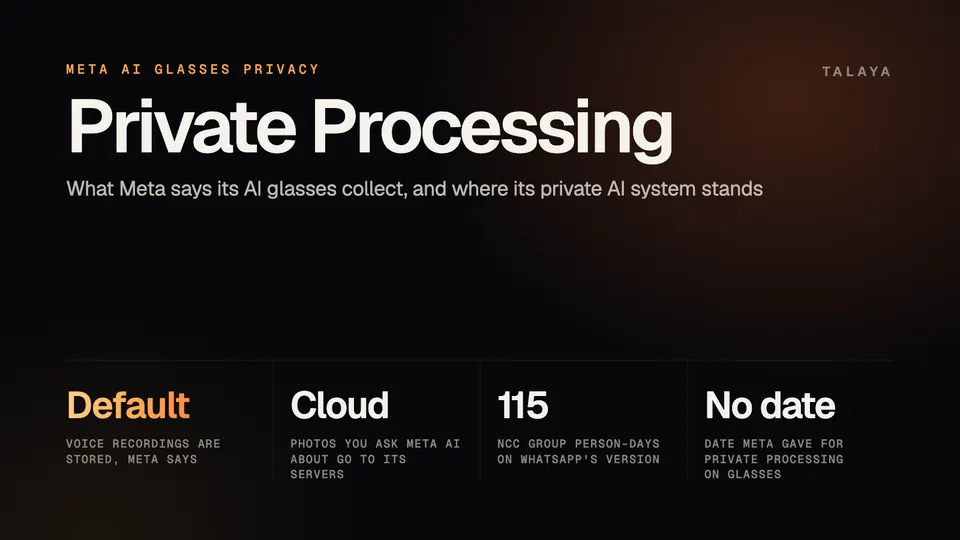
Meta's own policies say what its AI glasses collect and send: voice recordings stored by default, photos processed in the cloud when you use Meta AI, and media that may be used to improve its AI. Private Processing, announced for glasses at Connect, has no date yet.
Meta's own documents say its AI glasses store your voice recordings by default, and that photos and video go to Meta's servers when you use Meta AI or turn on cloud features. The wearables section of Meta's supplemental privacy policy, effective June 29, 2026, says that when you use the Meta AI service on the glasses, "your information, like Media and audio recordings of your voice, may be used to improve Meta products, including the Meta AI service and the models that power it." At Connect in September Meta announced a system called Private Processing for the glasses, but it gave no date.
This guide is based on Meta's policies and help pages, read in the archived copies named in the sources list, plus Meta's engineering post on Private Processing and NCC Group's published report. It reports what Meta says and notes where its documents are silent. We haven't tested what the glasses send.
Voice recordings: stored by default
The policy says the Meta AI service on AI glasses "stores text transcripts and audio recordings of your voice interactions by default to help improve Meta's products." That includes improving the Meta AI service and "training and improving our speech technologies." Meta says it uses machine learning and trained reviewers to process the data and shares it with third-party vendors and service providers. You can access and delete recordings and transcripts in the Meta AI app.
A voice interaction is broader than a question. Meta counts what you say after the wake word, some commands said without it, requests triggered by mistake and background sound while voice services are on. Its voice privacy notice, effective July 22, 2025, says it keeps stored recordings and transcripts for up to one year and deletes the recordings of accidental activations that it detects within 90 days, as our privacy settings guide reports. Meta's app FAQ says "the option to disable voice recordings storage is no longer available." The delete option is in the Voice activity log, and the same guide has the taps.
Photos and videos: on the glasses, in the app and with Meta AI
On the glasses, Meta's newsroom Q&A says photos and videos you capture for your gallery are stored privately on the glasses until you import them to your phone, and that only you can see them unless you share them. You can also use them with Meta AI, as the same Q&A notes.
In the app, the policy says the media is captured on the glasses and sent to the Meta AI app. Meta processes it when you turn on cloud processing, use the Meta AI service or upload it to services such as Facebook or Instagram. With cloud processing on, photos and videos go from the app to Meta's servers "to support additional photo and video features," and Meta's help center says those copies are deleted after 30 days. The policy says you can change the cloud processing choice at any time in Settings.
With Meta AI, asking about what you see sends an image to Meta's cloud for an answer, our guide reports from Meta's help center, and you can review the request, image and answer in the app under Chats. The policy adds that Meta AI may process media to understand what you are looking at, which may include your general location. Meta may share the prompt or the photo you use with third parties described in its AI Terms, and it lists them in its Privacy Center. Meta has also said it sometimes uses contractors to review content shared with Meta AI "for the purpose of improving people's experience," TechCrunch reported in March, and that it filters the data "to help prevent identifying information from being reviewed." Our bystander privacy guide covers the reports about contractors.
Live AI
In a live AI session, available in English in the US and Canada, the camera and microphone stay on until you pause or stop, per Meta's help page as summarized in our Meta AI guide. The policy we read doesn't name Live AI, and the documents don't give a separate retention period for the camera frames it processes. The general Meta AI language applies: media and voice recordings may be used to provide the service and to improve it.
How long Meta keeps the data
| Data | What Meta says | Where |
|---|---|---|
| Voice recordings and transcripts | Kept up to one year unless you delete them sooner | Voice privacy notice |
| Recordings of accidental activations | Detected ones deleted within 90 days | Voice privacy notice |
| Cloud media copies | Deleted automatically after 30 days | Help center |
| Audio from live captions and translation | Recordings deleted when you finish using the feature | Supplemental policy |
| Live stream video and audio | Not stored on the glasses or in the app after the session | Supplemental policy |
| Crash logs | Retained only to diagnose and fix problems | Supplemental policy |
| Photos you use to ask Meta AI a question | No retention period in the documents we read; you can review them in Chats | Help center |
What Meta says about AI training
Meta's policy uses "improve" in three places. Voice transcripts and recordings are stored by default to improve products, including speech technologies. Media and voice recordings from using Meta AI may be used to improve the Meta AI service and its models. And Additional Data, the optional usage analytics you choose to share at setup, is used for improvement only if you opt in.
The policy's improvement language ties to using the Meta AI service and to Additional Data. It doesn't mention cloud media copies, so it doesn't say whether photos you send to the cloud and never use with Meta AI go into training. Hamburg's data protection commissioner, in a report on the glasses, said that when a wearer hasn't objected to AI training on their interactions, the wearer and Meta become joint controllers of that data, as our privacy pushback analysis summarizes.
What you can turn off
You can switch off cloud media in Glasses privacy, decide whether to share Additional Data and delete voice recordings in the Voice activity log. Meta's app FAQ says disabling "Hey Meta" deactivates Meta AI's camera use. You can't turn off voice storage, and the capture light has no off switch. Our privacy settings guide walks through each setting, and our Hey Meta guide covers the wake word.
What Private Processing is
Meta's engineering team described Private Processing in April 2025 as an optional capability for WhatsApp. You start a request to a confidential, secure environment, and AI processes your messages there, for example to summarize unread threads or suggest writing. Meta says no one, including Meta and WhatsApp, can access the messages. The system uses confidential computing built on a trusted execution environment, a hardware-protected environment where the AI models run.
Meta lists the design requirements. Processing must be confidential, the guarantees must fail closed or become publicly discoverable if anyone alters them, and users and researchers must be able to audit the behavior. An attacker shouldn't be able to target one user without attacking the whole system. And the system must not keep access to messages after a session ends.
In Meta's description, a request reaches the system in these steps:
- The app gets anonymous credentials to prove it is a real WhatsApp client.
- It connects through a third-party relay that hides your IP address from Meta.
- It checks the system's software against a third-party log before sending anything.
- It sends the request encrypted end to end with a key Meta can't access.
- The AI model processes it in a confidential virtual machine without storing the messages, and the response comes back encrypted.
Meta also said in April 2025 that it would publish components of the system, include it in its bug bounty program and release a security paper, and that it would add an in-app log of requests.
What Meta announced for glasses, and what has been reviewed
In its list of Connect 2026 software updates, Meta says it is bringing Private Processing to AI glasses to deliver AI features "without anyone, including Meta, seeing your data." It listed the feature as coming soon, without a date, and the pages we read don't say which glasses features would use it. Our Connect recap has the full list.
The independent review is for WhatsApp. NCC Group says Meta engaged it in late January 2025 to assess the WhatsApp message summarization service, which is part of Private Processing. The remote review took 115 person-days in the first half of 2025, with teams for cryptography, hardware and embedded security, and AI and machine learning security. Its public report page, dated Aug. 27, 2025, names Cloudflare as keeper of the transparency logs and Fastly as the relay. We haven't read the report's findings, and the page doesn't cover glasses.
What outside reviewers have found
Hamburg's commissioner took a first-generation Ray-Ban Meta apart and published a final report on Sept. 10. It found that on second-generation glasses the recording light doesn't turn on when you only ask Meta AI about your surroundings, and that faces in images Meta returned had been covered with gray circles, though the investigators couldn't confirm whether that happened before the images reached Meta. In February, Swedish newspapers reported that workers at a Kenya-based contractor, Sama, had seen footage from the glasses that included nudity, and Meta ended its contract with Sama in April, Ars Technica reported. A class action filed in March accuses Meta and Luxottica of America of misleading buyers about privacy. Details are in our bystander guide.
What the documents don't say
- How long Meta keeps photos you send with Meta AI questions, or camera frames from Live AI.
- Whether cloud media copies are used to train AI.
- Which glasses features will run through Private Processing, and when.
- Whether Private Processing will change how voice recordings are stored.
Frequently asked questions
Does Meta use Ray-Ban Meta photos for AI training?
Meta says photos and videos you capture for your gallery stay on your glasses until you import them. Its supplemental privacy policy says that when you use Meta AI, your media and voice recordings may be used to improve Meta AI and the models behind it. The policy doesn't say whether cloud media copies you never use with Meta AI are used for training.
Are Ray-Ban Meta voice recordings stored?
Yes, by default. Meta's voice notice says it keeps transcripts and recordings for up to one year unless you delete them sooner, and Meta says the option to turn off voice storage is no longer available. You can delete recordings in the Meta AI app.
What is Meta's Private Processing?
It's a confidential computing system Meta built for WhatsApp so AI can process requests without Meta or WhatsApp being able to read them, according to Meta's engineering team. At Connect 2026, Meta said it is bringing Private Processing to AI glasses.
Is Private Processing available on Ray-Ban Meta glasses?
Not yet. Meta listed it among glasses updates coming soon and gave no date. Our Connect 2026 recap has the full list.
Has anyone independently checked Private Processing?
Meta engaged NCC Group, which reviewed WhatsApp's message summarization service for 115 person-days in the first half of 2025 and published a report in August 2025. That report covers WhatsApp, not glasses.
Can people at Meta hear what I say to Meta AI?
Meta says it processes stored voice recordings with machine learning and trained reviewers, and that reviewers hear recordings with the pitch changed. It has also said it sometimes uses contractors to review content shared with Meta AI, TechCrunch reported, and that it filters that data to help prevent identifying information from being reviewed.
Sources
- Meta: Supplemental Meta Platforms Technologies Privacy Policy (effective June 29, 2026; archived copy of Oct. 22, 2026)
- Meta: AI Glasses Voice Privacy Notice (effective July 22, 2025; archived copy of Sept. 21, 2026, as read for our settings guide)
- Meta: AI glasses legal documents
- Meta Newsroom: Meta's AI glasses, your questions answered (July 7, 2026)
- Meta Help Center: Meta View app is now the Meta AI mobile app (archived copy of June 12, 2026, as read for our settings guide)
- Meta Help Center: Learn more about cloud media on AI glasses (archived copy of July 10, 2026, as read for our settings guide)
- Meta Help Center: Ask Meta AI about what you see on AI glasses (archived copy of Sept. 21, 2026, as read for our settings guide)
- Meta Engineering: Building Private Processing for AI tools on WhatsApp (Apr. 29, 2025)
- NCC Group: Public Report, Meta WhatsApp message summarization service (Aug. 27, 2025)
- Meta: Muse personal agent and AI glasses updates (Connect 2026)
- Hamburg Commissioner for Data Protection: final report on Ray-Ban Meta AI Glasses (Sept. 10, 2026, PDF)
- TechCrunch: Meta sued over AI smart glasses privacy concerns (Mar. 5, 2026)
Join the conversation
Questions, or something to add? Talk about it with other smart glasses owners in r/Talaya, our community on Reddit.