AI · Guide
What happened to the Humane AI Pin and Rabbit R1, from launch to 2026
Humane stopped selling its AI Pin on Feb. 18, 2025, cut off its service 10 days later and sold most of the company to HP for $116 million. Rabbit's $199 R1 still works and is still sold, but Rabbit's new focus is software that runs on other devices.
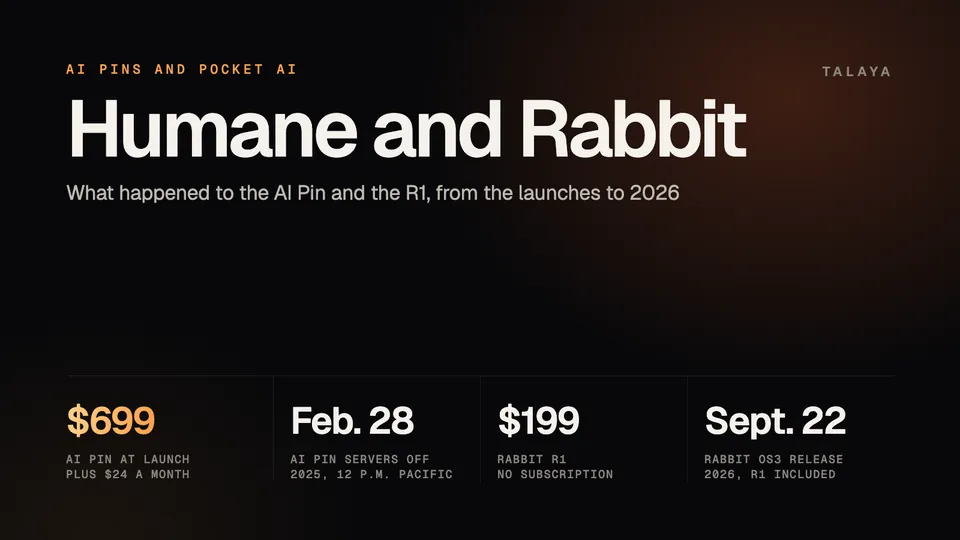
The Humane AI Pin is discontinued and the Rabbit R1 is not. Humane stopped selling the Pin on Feb. 18, 2025. At noon Pacific time on Feb. 28, it stopped connecting to Humane's servers, which ended calling, messaging and AI answers. HP agreed to pay $116 million for Humane's software, engineers and patents. Rabbit's R1, which launched in January 2024 at $199, is still on sale at Rabbit's site and still receives software updates, although Wired reports that Rabbit has stopped manufacturing it.
This guide draws on HP's, Humane's and Rabbit's own announcements and pages, with reviews and reporting credited to the outlets that published them.
The two devices at a glance
| Humane AI Pin | Rabbit R1 | |
|---|---|---|
| Launch | April 2024 | Announced Jan. 9, 2024 with pre-orders; US shipments planned from late March |
| Price | From $699 plus $24 a month; $499 after a $200 cut in October 2024 | $199, with "no additional monthly subscription required" at launch |
| Status on Oct. 25, 2026 | Discontinued; stopped connecting to Humane's servers on Feb. 28, 2025 | On sale at $199; Wired reports it is no longer manufactured |
| Company | Most assets sold to HP for $116 million | Independent; about 15 employees, according to CEO Jesse Lyu |
The Humane AI Pin
What it was and what it cost
Humane, founded by former Apple employees Bethany Bongiorno and Imran Chaudhri, sold the AI Pin as a small wearable that attaches to clothing and responds to voice. Its homepage called it "the first multi-modal device that is wearable and easy to use" and said it would act as "your assistant and second brain." Humane said the Pin activates "only on command, with no wake words," and that a "Trust Light" shows when it is capturing.
Humane's store page, as the Internet Archive captured it on May 31, 2024, listed the complete system from $699 and said the Pin "requires an active subscription" at $24 a month. The subscription covered "unlimited Ai queries, unlimited talk, text, data & cloud storage." Sales were limited to the United States, and the page said new orders would ship in June. TechCrunch dates the Pin's launch to April 2024.
Reviews, returns and a price cut
The Verge's report on the shutdown says the Pin "finally launched in April 2024 to scathing reviews." It recalls that its own David Pierce said "it just doesn't work" and that the reviewer MKBHD called it "the worst product I've ever reviewed." The Verge had reported in August 2024 that daily returns were outpacing sales, and Humane cut the price in October, by $200 according to TechCrunch. TechCrunch also noted that Humane told customers to stop using the Pin's charging case because of battery fire concerns.
Humane had raised more than $230 million, TechCrunch reported. TechCrunch also cited Bloomberg's report that in May 2024 Humane sought a buyer at between $750 million and $1 billion. HP's price, nine months later, was $116 million.
HP's $116 million deal
HP announced on Feb. 18, 2025 that it had agreed to acquire "key AI capabilities from Humane, including their AI-powered platform Cosmos, highly skilled technical talent, and intellectual property with more than 300 patents and patent applications." HP expected the deal to close at the end of February. Humane's engineers, architects and product staff were to form a new HP group called HP IQ, which HP described as an "AI innovation lab focused on building an intelligent ecosystem across HP's products and services for the future of work."
HP's Tuan Tran said Cosmos would help HP build "an intelligent ecosystem across all HP devices from AI PCs to smart printers and connected conference rooms." HP's release doesn't mention the AI Pin. It quotes Humane's co-founders on joining HP.
What owners were told
Humane's notice to customers is dated Feb. 18, 2025. The PenumbraOS project archived it from Humane's support site, which we couldn't reach. It says Humane was "winding down the consumer Ai Pin" and that new purchases were discontinued effective immediately. The rest of what owners were told, from the notice, Humane's FAQ and the press:
- The Pin would "continue to function normally until 12pm PST on February 28, 2025," which The Verge converted to 3 p.m. Eastern.
- After that, the Pin would no longer connect to Humane's servers, and its features would no longer include "calling, messaging, Ai queries/responses, or cloud access." The Verge reported, citing Humane's support document, that offline functions such as battery level would keep working.
- Access to .Center, where the Pin's pictures, videos and notes are stored, would be "fully retired." Owners were urged to sync the Pin over Wi-Fi and download that material before the deadline. At the deadline, "all remaining consumer data will be permanently deleted," Humane said.
- Refunds were limited. According to the FAQ as The Verge read it, only Pins "within the 90-day return window from their original shipment date" qualified, and requests "must be submitted by February 27th, 2025." TechCrunch summed it up this way: buyers from the last 90 days were eligible, and "anyone who bought a device before then is not."
- Humane said it would process prorated refunds for subscription fees paid past Feb. 28. Owners still waiting for a replacement charging case after its recall would get back the part of the purchase price allocated to the case, The Verge reported.
- Humane's support team was available through Feb. 28. TechCrunch reported that the company planned to dissolve it that day.
The Rabbit R1
What Rabbit promised
Rabbit announced the R1 on Jan. 9, 2024 as "a pocket companion that moves AI from words to action." It cost $199 "with no additional monthly subscription required," and Rabbit said US orders would start shipping in late March.
The pitch was an "app-free" experience. Rabbit's operating system, which the company called "the first OS ever built on Large Action Model (LAM)," would learn how people use apps and then carry out tasks for them, from looking up information to "thoroughly researching and booking options for upcoming travel, or filling a virtual grocery store cart and completing transactions at check-out." Rabbit said users would later be able to train their own agents for niche apps.
The hardware came from a collaboration with Teenage Engineering. The R1 weighs 115 grams and has a 2.88-inch touchscreen, a push-to-talk button, a scroll wheel and a rotating camera that Rabbit calls the "rabbit eye." Rabbit said most of the computing happens in data centers and that the device has no "always listening mode."
Reviews and criticism
Wired, writing about Rabbit in September 2026, says the R1 earned "scathing reviews" after a buzzy launch at CES 2024: "All the agentic stuff on the R1 just didn't work that well. WIRED gave it a 3/10." It also refers to controversy over the R1's use of a virtual machine to carry out app actions for the user.
Rabbit founder and CEO Jesse Lyu doesn't accept the flop label. He told Wired the R1 was a financial success, with more than 100,000 units delivered worldwide, return rates under 5% and a hardware margin of roughly 45% to 50%. He said Rabbit has raised about $60 million in total and has 15 employees. From an engineering view, Lyu said, "we didn't make the wrong bet," and the real challenge was limited money and staff compared with AI companies that raised billions. We haven't seen independent confirmation of the sales, return or margin figures.
Wired also reported that things were dire a year earlier: a planned India launch stalled over regulations, and a handful of Rabbit employees went on strike and said they weren't being paid. Lyu told Wired that Rabbit has since secured more funding and that "There are no issues with the company's health."
What Rabbit has shipped since
Rabbit's newsroom lists the main releases with dates:
- Aug. 13, 2024: R1 sales expand to the UK and EU.
- Nov. 21, 2024: Teach mode, which Rabbit says lets consumers create custom AI agents.
- Jan. 16, 2025: support for multiple languages. Jan. 30, 2025: custom voices made with ElevenLabs.
- June 13, 2025: Rabbit Intern, which the newsroom calls the company's second product.
- Sept. 8, 2025: RabbitOS 2, an overhaul of the R1 experience.
- Sept. 22, 2026: OS3.
OS3 is the biggest change. Rabbit's release calls it an "agentic operating system" that runs in the cloud and operates devices through a local program called the rabbit agent. One account can connect up to five devices. You can talk to OS3 through a web portal, Telegram, iMessage, RCS or SMS, or with the R1, and Rabbit's list of devices OS3 can control names Windows, Mac and Linux PCs, cloud virtual machines and "the r1 today." Wired reports there is no monthly fee, but you supply your own API keys for the AI models. Rabbit's next hardware is a "cyberdeck," which Rabbit describes as a dedicated "vibe coding" machine. Wired says it is slated to arrive within "months."
Does the R1 still work, and can you still buy one?
Yes to both, as of Oct. 25, 2026. Rabbit's R1 page calls the device "a pocket AI device powered by rabbit OS3" and sells it for $199, with "unlimited AI conversations, translation and voice recordings." Wired reports that OS3 also arrives as a software update for the R1. Lyu showed Wired four or five orders that had come in that morning on Rabbit's site and pointed out that the R1 is also sold through Amazon, Target and Best Buy.
Wired also reports that Rabbit is no longer manufacturing the R1, that the remaining stock is "dwindling" and that Lyu has no plans for an R2.
Both devices lean on the company's servers. Humane's notice tied the Pin's features to its servers, and Rabbit's launch release said most of the R1's computing happens in data centers. Rabbit's newsroom lists no end-of-service notice for the R1.
What the two mean for AI wearables
HP says it will use Humane's technology across PCs, printers and conference rooms, and its release doesn't mention another wearable.
Rabbit's focus has shifted to software. Wired calls OS3 "a striking pivot for a company that once championed the handheld hardware over smartphone apps." Rabbit's release says OS3 can operate computers, cloud machines and the R1, and Wired reports that Lyu has no plans for an R2.
The research firms track where AI wearable shipments went. Omdia estimated that 8.7 million AI glasses shipped in 2025, with Meta at 85.2%. Counterpoint reported that display-less models made up 96% of AI glasses shipments in the first half of 2026. IDC, which counts headsets as well, says growth will come from "a wider range of products, price points, and channels, plus the spread of AI and friction-reducing use cases like easy photo and video capture." Our smart glasses market analysis explains how each firm counts. These firms count glasses, not pins, and Omdia's release doesn't mention the AI Pin or the R1.
OpenAI told a court that its first device won't ship before the end of February 2027, and MacRumors reported, citing earlier filings, that it apparently won't be an in-ear device or a wearable. Our ChatGPT on wearables guide covers what's known, and our Meta AI, Gemini and Siri comparison shows where each assistant runs today. For the longer history of worn computers, see our smart glasses timeline and the story of what happened to Google Glass.
Frequently asked questions
What happened to the Humane AI Pin?
Humane stopped selling it on Feb. 18, 2025 and agreed to sell most of its assets to HP for $116 million. At noon Pacific time on Feb. 28, 2025, Pins stopped connecting to Humane's servers, which ended calling, messaging, AI answers and cloud access.
Does the Humane AI Pin still work?
Only offline functions. Humane's notice says the Pin stopped connecting to its servers on Feb. 28, 2025, and The Verge reported that things like battery level would keep working while voice interactions, AI responses and .Center access would not.
Did Humane refund AI Pin owners?
Some. According to Humane's FAQ as The Verge reported it, refunds covered Pins within a 90-day return window from their original shipment date, and requests were due by Feb. 27, 2025. Humane also said it would prorate refunds for subscriptions paid past Feb. 28.
Is the Rabbit R1 still working in 2026?
Yes. Rabbit's site describes it as "a pocket AI device powered by rabbit OS3," and Wired reports that OS3, released Sept. 22, 2026, also arrives as a software update for the R1. Rabbit's newsroom lists no end-of-service notice.
How much is the Rabbit R1 in 2026, and is it still made?
Rabbit's site sells it for $199, the same as its January 2024 launch price. Wired reports that Rabbit is no longer manufacturing the R1, that remaining stock is dwindling and that CEO Jesse Lyu has no plans for an R2.
Who bought Humane?
HP agreed on Feb. 18, 2025 to buy Humane's Cosmos AI platform, its engineers and intellectual property with more than 300 patents and patent applications, for $116 million. Humane's engineers and product staff were to form a new HP group called HP IQ.
Sources
- HP: HP Accelerates AI Software Investments to Transform the Future of Work (Feb. 18, 2025)
- Humane: Important Update for Consumer Ai Pin Customers (Feb. 18, 2025), archived by PenumbraOS from Humane's support site
- Humane: Shop Ai Pin and Ai Pin Accessories (Internet Archive capture of May 31, 2024)
- Humane: Ai Pin homepage (Internet Archive capture of June 1, 2024)
- TechCrunch: Humane's AI Pin is dead, as HP buys startup's assets for $116M (Feb. 18, 2025)
- The Verge: Humane is shutting down the AI Pin and selling its remnants to HP (Feb. 18, 2025)
- Rabbit: introducing r1, a pocket companion that moves AI from words to action (Jan. 9, 2024)
- Rabbit: rabbit unveils OS3, the agentic operating system for every device (Sept. 22, 2026)
- Rabbit: Newsroom (read Oct. 25, 2026)
- Rabbit: rabbit r1, AI device powered by rabbit OS3 (read Oct. 25, 2026)
- Wired: Rabbit Is Back, This Time With an AI Agent App (Sept. 22, 2026)
- Omdia: Global AI glasses shipments reach 8.7 million units (March 5, 2026)
Join the conversation
Questions, or something to add? Talk about it with other smart glasses owners in r/Talaya, our community on Reddit.